24/7 Space News
IRON AND ICE
ESA signs Ramses spacecraft and cubesat deals for Apophis flyby
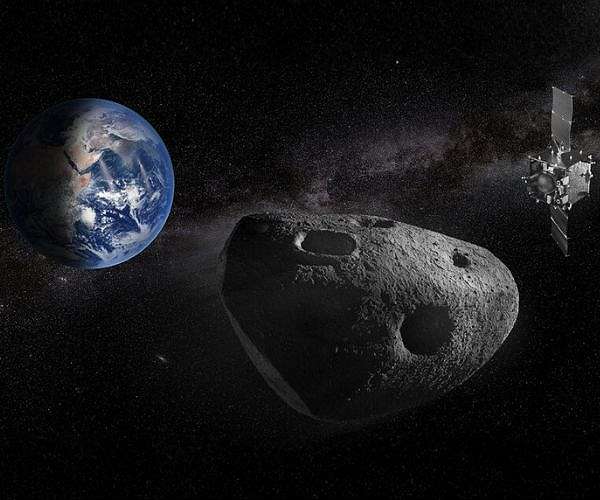
illustration only

ESA signs Ramses spacecraft and cubesat deals for Apophis flyby

by Clarence Oxford
Los Angeles CA (SPX) Feb 13, 2026

On 10 February 2026 the European Space Agency signed a contract with OHB Italia to develop the Rapid Apophis Mission for Space Safety, known as Ramses, securing the next phase of Europes dedicated mission to asteroid Apophis ahead of its close Earth flyby in 2029. Launching in 2028, Ramses will rendezvous with the near-Earth asteroid before its rare encounter with our planet, providing detailed measurements of its physical properties and the way it responds to Earths gravity.

The new contract, valued at 81.2 million euros, was signed at ESAs ESTEC technology centre in the Netherlands and initiates the construction, assembly and testing of the main Ramses spacecraft. It builds on an earlier agreement signed in October 2024 for preparatory work, bringing the total mission contract value with OHB Italia to around 150 million euros.

Ramses is designed to deepen understanding of near-Earth objects and strengthen planetary defence capabilities by closely tracking how Apophis behaves as it passes within roughly 32,000 kilometers of Earth, less than one tenth of the distance to the Moon. Scientists are particularly interested in how the roughly 375 meter wide asteroid's shape, spin and internal structure react to the gravitational forces during this unusually close but safe flyby.

ESA officials describe Ramses as a once in a lifetime opportunity to study Apophis under real dynamical stress. Orson Sutherland, Mars and Beyond Projects Group Leader at ESA, said the mission will help advance methods to protect Earth from hazardous objects while demonstrating European leadership in robotic deep-space exploration and international cooperation.

The mission draws heavily on experience from ESAs Hera mission, the agencys first dedicated planetary defence spacecraft now en route to the Didymos binary asteroid system. Like Hera, Ramses will carry two deployable CubeSats built by European industry, extending the scientific reach of the mission once it arrives at Apophis with close-up investigations from multiple vantage points.

One of these small spacecraft, named Farinella in honor of Italian planetary scientist Paolo Farinella, is being built by Tyvak International under a separate contract signed alongside the main Ramses agreement. The new Farinella contract, worth 8.2 million euros, follows an initial 4.7 million euro deal for preparatory work signed in 2025 and covers the construction and testing of the CubeSat.

Tyvak International CEO Fabio Nichele said the company aims to deliver a compact spacecraft capable of making a large contribution to Apophis science during the close Earth encounter. He emphasized that the project showcases the role of innovative small satellites in planetary science and demonstrates the strength of European industrial collaboration in space safety missions.

Ramses also incorporates significant contributions from the Japan Aerospace Exploration Agency, reflecting the missions international character. JAXA is providing key hardware including the spacecrafts solar arrays and a thermal infrared imager, and there is the potential for a rideshare launch with JAXAs Destiny Plus mission. Japanese scientists will also participate in the missions scientific investigations at Apophis.

The mission recently passed its Critical Design Review, which was conducted over several months by an ESA expert board and completed on 6 February. The review confirmed that the detailed spacecraft design meets all technical, scientific and programmatic requirements and is ready to move into full-scale manufacturing.

According to Ramses mission manager Paolo Martino, clearing this critical hurdle in a short timeframe demonstrates that the spacecraft design is mature and robust despite the missions accelerated schedule. He noted that maintaining the rapid development pace is a sign of the teams engineering capability and commitment under demanding timing constraints.

With the contract in place and the design frozen, industrial teams will now start building, assembling and integrating the Ramses flight hardware, including the main spacecraft bus and scientific payload instruments. Over the coming year these components will undergo environmental and functional testing to ensure they can withstand launch and operations in deep space.

Ramses is scheduled to launch in Spring 2028, targeting a rendezvous with Apophis in time to observe the asteroid before, during and after its April 2029 Earth flyby. The mission supports the core objectives of ESAs Space Safety Programme by improving knowledge of how near-Earth objects react to external forces and by refining strategies for defending Earth from potentially hazardous asteroids in the future.

Related Links
Planetary Defence at ESA
Asteroid and Comet Mission News, Science and Technology

Subscribe Free To Our Daily Newsletters
Tweet

RELATED CONTENT
The following news reports may link to other Space Media Network websites.
IRON AND ICE
Amino acids in Bennu asteroid hint at icy radioactive origin
Los Angeles CA (SPX) Feb 10, 2026
Amino acids discovered in samples from the Bennu asteroid may have formed in an icy, radioactive environment in the early solar system, according to a new study led by Penn State researchers. The findings challenge long-held assumptions that these building blocks of life on asteroids formed primarily in the presence of warm liquid water. The team analyzed a small amount of Bennu material, delivered to Earth in 2023 by NASA's OSIRIS-REx mission, using specialized instruments that can measure isotop ... read more

IRON AND ICE
The coming end of ISS, symbol of an era of global cooperation

Launch to ISS pushed to Thursday over weather: NASA

NASA confirms first flight to ISS since medical evacuation

Voyager wins NASA ISS mission management role through 2030

IRON AND ICE
UK backs new electric propulsion hub for satellite engines

Isar Aerospace expands engine and stage testing at Esrange

SpaceX shifts focus from Mars to Moon, Musk says

NASA backs studies to boost hypersonic flight testing

IRON AND ICE
Curiosity Blog, Sols 4788-4797: Welcome Back from Conjunction

NASA Study: Non-biologic Processes Don't Fully Explain Mars Organics

Martian toxin found to toughen microbe built bricks

Perseverance rover completes landmark AI guided trek across Jezero rim

IRON AND ICE
Dragon spacecraft gears up for crew 12 arrival and station science work

China prepares offshore test base for reusable liquid rocket launches

Retired EVA workhorse to guide China's next-gen spacesuit and lunar gear

Tiangong science program delivers data surge

IRON AND ICE
BlackSky expands Gen 3 Assured deals with new defense customer

Muon Space ramps up multi-mission satellite constellations

ESA member states back SWISSto12 HummingSat with fresh funding round

Aerospacelab expands Pulsar navigation constellation work with new Xona satellite order

IRON AND ICE
Launching the idea of data centers in space

Abundant element alloy enables rare earth free cryogenic cooling

Gilat books multimillion order for Sidewinder inflight ESA terminals

NGA taps Vantor for AI change detection from space

IRON AND ICE
JWST study links sulfur rich gas giants to core growth in distant HR 8799 system

Pressure driven leakage from marine snow feeds deep ocean microbes

Engineered microbes use light to build new molecules

Survey of 80 near Earth asteroids sharpens view of their origins and risks

IRON AND ICE
Jupiter size refined by new radio mapping

Polar weather on Jupiter and Saturn hints at the planets' interior details

Europa ice delamination may deliver nutrients to hidden ocean

Birth conditions fixed water contrast on Jupiters moons

Subscribe Free To Our Daily Newsletters


The content herein, unless otherwise known to be public domain, are Copyright 1995-2024 - Space Media Network. All websites are published in Australia and are solely subject to Australian law and governed by Fair Use principals for news reporting and research purposes. AFP, UPI and IANS news wire stories are copyright Agence France-Presse, United Press International and Indo-Asia News Service. ESA news reports are copyright European Space Agency. All NASA sourced material is public domain. Additional copyrights may apply in whole or part to other bona fide parties. All articles labeled "by Staff Writers" include reports supplied to Space Media Network by industry news wires, PR agencies, corporate press officers and the like. Such articles are individually curated and edited by Space Media Network staff on the basis of the report's information value to our industry and professional readership. Advertising does not imply endorsement, agreement or approval of any opinions, statements or information provided by Space Media Network on any Web page published or hosted by Space Media Network. General Data Protection Regulation (GDPR) Statement Our advertisers use various cookies and the like to deliver the best ad banner available at one time. All network advertising suppliers have GDPR policies (Legitimate Interest) that conform with EU regulations for data collection. By using our websites you consent to cookie based advertising. If you do not agree with this then you must stop using the websites from May 25, 2018. Privacy Statement. Additional information can be found here at About Us.