





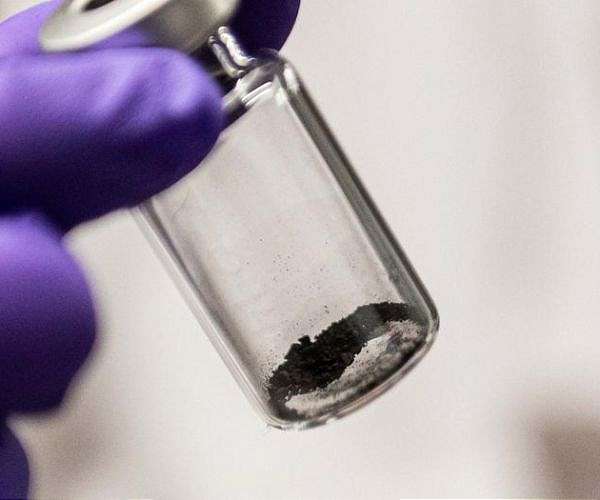
The team analyzed a small amount of Bennu material, delivered to Earth in 2023 by NASA's OSIRIS-REx mission, using specialized instruments that can measure isotopes, or slight differences in atomic mass. They focused on glycine, the simplest amino acid, which is often treated as a key indicator of early prebiotic chemistry. Detecting glycine in asteroids suggests that some of life's ingredients could have formed in space and been transported to the early Earth.
Previously, scientists proposed that glycine on asteroids formed through Strecker synthesis, a pathway in which hydrogen cyanide, ammonia, and aldehydes or ketones react in the presence of liquid water. The new work indicates that at least some of Bennu's glycine may instead have formed in frozen ice irradiated in the cold outer regions of the young solar system. This result broadens the range of conditions under which essential organic molecules can arise.
Using modified instrumentation at Penn State, the researchers were able to perform isotopic measurements on very low abundances of organic compounds such as glycine. They report that the isotopic signatures in Bennu's amino acids differ markedly from those in well-studied carbon-rich meteorites like the Murchison meteorite, which fell in Australia in 1969. In Murchison, amino acids appear consistent with formation in environments that had liquid water and relatively mild temperatures on their parent bodies.
The comparison between Bennu and Murchison suggests that their parent bodies originated in chemically distinct regions of the solar system. Co-lead authors Allison Baczynski and Ophelie McIntosh note that this diversity in isotopic patterns points to multiple formation pathways for amino acids, even within small bodies such as asteroids. The work implies that the early solar system hosted a variety of chemical environments capable of producing life's foundational molecules.
The study also uncovered an unexpected isotopic difference between the two mirror-image forms, or enantiomers, of glutamic acid in Bennu samples. These left- and right-handed forms of the same amino acid are usually assumed to share similar isotopic characteristics, yet in Bennu they show strongly contrasting nitrogen values. The cause of this discrepancy is unknown and is a focus of ongoing investigation by the team.
Researchers plan to extend their analysis to a broader set of meteorites to test whether other objects resemble Bennu or Murchison, or show entirely different isotopic signatures and formation conditions. By mapping this diversity, scientists hope to refine scenarios for how organic molecules emerged and were distributed through the early solar system. The study highlights the role of advanced analytical tools in extracting detailed chemical histories from tiny extraterrestrial samples.
Research Report:Multiple formation pathways for amino acids in the early Solar System based on carbon and nitrogen isotopes in asteroid Bennu samples
Related Links
Penn State
Asteroid and Comet Mission News, Science and Technology
| Subscribe Free To Our Daily Newsletters |

| Subscribe Free To Our Daily Newsletters |








