





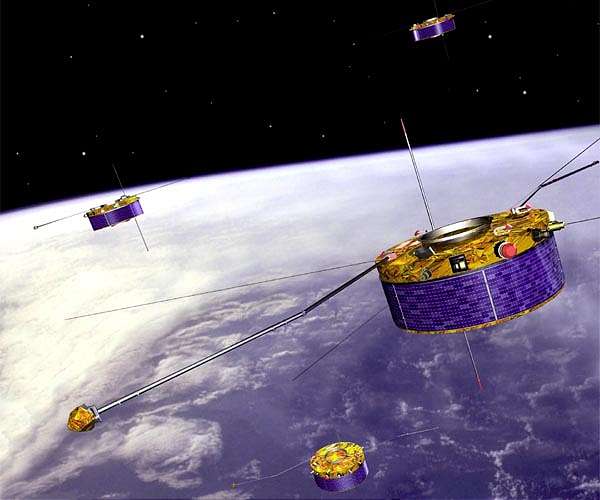
The Cluster mission, launched in 2000, consists of four identical satellites that have studied Earths magnetosphere for more than two decades. The first pair, including Cluster 2 or Salsa, has already been guided to a targeted atmospheric reentry, while the remaining spacecraft, Cluster 3 and 4, nicknamed Samba and Tango, are being steered towards controlled disposal. ESA is using these end of life events as a rare opportunity to gather scientifically valuable reentry measurements that can inform safer and more sustainable satellite designs.
"Moving two satellites to meet a plane sounds extreme, but the unique reentry data well collect is worth orchestrating the challenging encounter over a remote stretch of ocean," said Beatriz Jilete, space debris systems engineer at ESA. Samba and Tango were already set to burn up safely over a remote corner of the South Pacific in 2024, one after the other about 24 hours apart, but the team also had to satisfy the demanding logistics of aircraft based observations, which require transit time, refuelling and crew rest between flights.
To make both events reachable from the same airport, ESAs mission operations team adjusted the reentry trajectories of the two spacecraft. Samba will now come down further east, while Tango will reenter somewhat further west, reducing the distance the aircraft must cover between events and keeping both reentries within range of a small plane operating from a single base. These small modifications preserve safe disposal over remote ocean regions while enabling back to back observing campaigns.
Reentry data is essential for "design for demise" approaches, in which satellites are engineered to burn up as completely as possible so that dangerous fragments do not reach the ground. "With better data on exactly when and how they heat up, break up, and which materials survive, engineers can design satellites that burn up completely, so called design for demise satellites," said Stijn Lemmens, Draco project manager at ESA. However, gathering such data is difficult because reentries occur high in the atmosphere, typically around 80 km altitude, far above balloons and below most satellite orbits, and usually over locations that cannot be predicted with enough precision for reliable ground or air based observations.
With the Cluster quartets targeted reentries, ESA is demonstrating a more responsible way to reduce the growing problem of space debris and uncontrolled reentries, even from orbits that were not originally designed for such precise disposal. By watching four identical satellites reenter in a predictable region but under slightly different trajectories and weather conditions, researchers can compare how each spacecraft breaks up and identify consistent patterns in the fragmentation process. "The four Cluster satellites are identical and so by watching them reenter the atmosphere in a predictable location with slightly different trajectories and in different weather conditions, we get a unique opportunity to conduct a valuable reentry experiment to study the break up of satellites," said Jilete.
The first of the four spacecraft, Salsa, reentered on 8 September 2024 and was successfully observed by scientists aboard a research aircraft. The team flew for hours to reach the edge of a no fly safety zone around the predicted reentry location and then waited for the spacecraft to appear. Instruments on board the plane captured images and measurements of the fiery breakup, even though the actual timing differed somewhat from predictions, turning the observation into a tense exercise until the sighting was confirmed.
Those initial observations demonstrated that targeted reentries can be monitored even in remote ocean regions and provided baseline data on Cluster fragmentation. "The reentry was captured by various onboard instruments, even though the predictions were slightly off. It was a tense time until the sighting could be confirmed definitively," said Lemmens. The planned repeat observations of Samba and Tango, built on lessons from Salsa, are expected to add a valuable comparative dimension, showing how small changes in trajectory and atmospheric conditions influence the break up sequence and debris cloud.
To enable this extended campaign, ESAs flight dynamics team first analysed how to shift the reentry footprints of Samba and Tango without compromising safety. Once a workable plan was in place, the space debris team verified that the new trajectories would not introduce unacceptable collision risks with other objects in orbit. The flight control team then uplinked the necessary commands, and the satellites executed small thruster burns on 19 and 20 January to reshape their orbits so that both final descents would fall within range of the observing aircraft.
There is also the possibility that the Cluster spacecraft themselves will report data almost until the moment of destruction. "An interesting opportunity might also be the Cluster satellites themselves reporting until shortly before their demise. Their power is working better than in the first two Clusters to reenter, so we are hopeful that we might be able to stay in contact longer and collect some more data this time around," said Bruno Sousa, Cluster operations manager at ESA. Because the solar panels on Samba and Tango have not degraded as much as on the first pair, the team hopes that the satellites may remain operational through their last close approach to Earth before reentry, potentially returning temperature and system health data as low as about 110 km altitude.
During earlier reentries, the satellites entered safe mode during their final perigee pass because their solar panels overheated when they dipped deep into the upper atmosphere. If Samba and Tango can keep transmitting telemetry at similar altitudes, engineers will gain a rare direct look at how the thermal environment evolves during the moments leading up to catastrophic breakup. This information can refine models of heat loads on structures, solar arrays and internal components, supporting more accurate predictions of when and where a spacecraft will fragment.
Beyond Cluster, ESA is preparing an even more ambitious reentry research mission called Draco, designed to watch the entire destructive process from the inside. Scheduled for launch in 2027, Draco will carry more than two hundred sensors and four cameras, all focused on recording how the spacecraft heats up, deforms and breaks apart as it plunges back through the atmosphere. An indestructible capsule on board will protect the recorded data and ensure it can be recovered after the spacecraft itself is destroyed.
The Draco mission will be complemented by another aircraft based observing campaign, with ESAs reentry scientists once again ready to fly beneath the path of the falling spacecraft. With three practice runs from the Cluster reentries behind them, the team aims to link visual and instrument measurements from the plane directly to the internal sensor data from Draco at each moment in time. This combined inside outside view should provide an unprecedented benchmark for validating and improving computer models of reentry physics.
With data from the Cluster series of targeted reentries and the dedicated Draco mission, ESA expects to significantly improve its reentry simulations. Better models will help predict where fragments might land and how they interact with the atmosphere, reducing uncertainty in risk assessments and support for civil protection authorities. Over the longer term, the findings will feed into the design of future satellites so that more of their mass is guaranteed to burn up during reentry, lowering the chances that surviving parts could endanger people or infrastructure on the ground.
Related Links
SpaceDebris at ESA
Space Technology News - Applications and Research
| Subscribe Free To Our Daily Newsletters |
| Subscribe Free To Our Daily Newsletters |







