





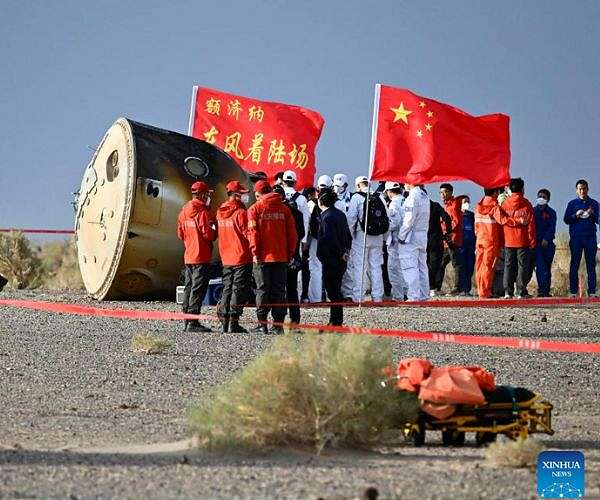
The team focused on the April 2, 2024 reentry of the orbital module from China's Shenzhou 15 spacecraft, an object roughly 1 meter across and weighing more than 1.5 tons. As the module plunged back through the atmosphere above the western United States, it traveled faster than the speed of sound and generated a series of sonic booms, or shock waves, similar to those produced by supersonic aircraft. These shock waves rattled the ground and produced characteristic vibrations that propagated through the crust and were recorded by seismometers across southern California.
Lead author Benjamin Fernando, a postdoctoral research fellow at Johns Hopkins who studies earthquakes on Earth, Mars, and other planets, and coauthor Constantinos Charalambous of Imperial College London used data from 127 seismometers to reconstruct the Shenzhou module's path. By mapping the stations that recorded the sonic signals, they could determine the trajectory and direction of travel and estimate where any debris might have landed. Their analysis indicates that during reentry the module streaked northeast at roughly Mach 25 to 30, passing over regions including Santa Barbara and Las Vegas at around ten times the speed of the fastest jet in the world.
Because the strength of the signals varied from station to station, the scientists also used the intensity of each seismic reading to infer how high above the ground the shock waves were generated. This allowed them to estimate the altitude of the module along its path and pinpoint where it began to break apart into fragments. The reconstructed track suggests the object was traveling about 25 miles north of the trajectory predicted by U.S. Space Command from orbital tracking alone, highlighting how seismic observations can provide an independent and more precise measurement once debris enters the atmosphere.
Engulfed in superheated plasma as they fall, large pieces of space junk can release clouds of small, potentially toxic particles that linger in the air for hours and drift with changing winds. Knowing the actual path of reentry in near real time would help authorities model where such particulates travel, assess who might be exposed, and issue warnings or conduct environmental testing if needed. The same information can guide rapid recovery of surviving fragments on the ground, which is especially important when spacecraft carry hazardous materials.
Fernando notes that such concerns are not hypothetical. In 1996, debris from Russia's Mars 96 mission reentered over South America, and officials at the time believed the probe's radioactive power source survived intact and splashed down in the ocean. The exact impact site was never conclusively identified. Years later, researchers reported finding artificial plutonium in a Chilean glacier, which they suspect leaked from the Mars 96 power source as it broke up during descent and contaminated the surrounding environment. Incidents like this underscore the value of additional tracking techniques for the rare but serious cases in which spacecraft contain radioactive components.
Until now, most efforts to track reentering objects have relied on radar measurements taken while the debris is still in low Earth orbit. Those data are used to forecast when and where a spacecraft will encounter enough atmospheric drag to fall back to Earth, but the predictions can be off by thousands of miles when uncertainties in atmospheric conditions and object behavior accumulate. The new approach does not replace radar, but instead complements it by following the object after it actually begins reentry, providing a direct measurement of what the debris is doing rather than a projection based only on its orbit.
The researchers argue that because dense seismometer networks already monitor tectonic activity in many regions, they could be used immediately to improve space debris tracking worldwide with only modest modifications to existing processing pipelines. Automated systems could screen continuous seismic data streams for the distinctive signatures of sonic booms, flag potential reentry events, and rapidly compute a trajectory estimate. Fernando says that shaving the time needed to determine where debris has fallen from days to minutes, or even to within about 100 seconds of reentry, would greatly aid emergency responders, environmental agencies, and recovery teams.
Reentries are becoming more common as the number of satellites and rocket stages in orbit continues to grow. Fernando points out that in 2025 multiple satellites were entering the atmosphere each day and that in many cases there was no independent verification of their breakup behavior, whether they burned up entirely, or whether fragments reached the ground. As satellite constellations expand and more nations and companies operate in space, the team expects this problem to intensify, making it increasingly important to develop and deploy multiple methods to track and characterize falling space debris.
The study, published in the journal Science, demonstrates that reentry and disintegration dynamics can be reconstructed using seismic data gathered for an entirely different purpose. By repurposing these ground based instruments as opportunistic detectors of atmospheric shock waves, the researchers have opened a new avenue for monitoring the return of human made objects from orbit. They contend that fully exploiting such cross disciplinary tools will help spacefaring societies better manage the risks associated with decades of activity in near Earth space.
Research Report:Reentry and disintegration dynamics of space debris tracked using seismic data
Related Links
Johns Hopkins University
Space Technology News - Applications and Research
| Subscribe Free To Our Daily Newsletters |

| Subscribe Free To Our Daily Newsletters |







