





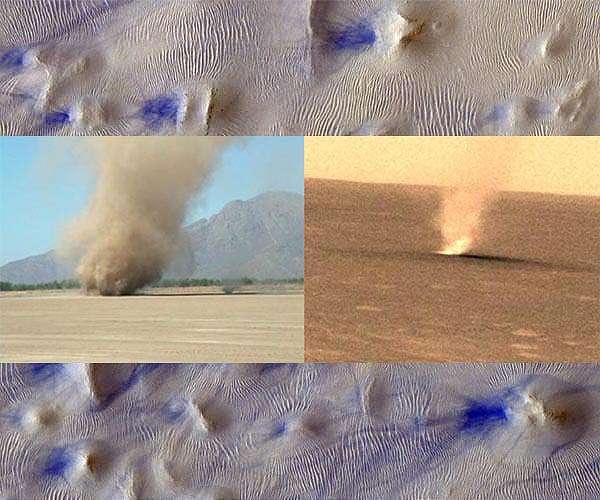
Planetary scientist Alian Wang has been shedding light on Mars' electrifying dust activities through a series of papers. Her latest research, published in Earth and Planetary Science Letters, explores the isotopic geochemical consequences of these activities.
Imagine powerful dust storms and swirling dust devils racing across the Martian surface. The frictional electrification of dust grains can build up electrical potentials strong enough to cause electrostatic discharges (ESDs) that break down the planet's thin atmosphere. These ESDs, which are more frequent on Mars due to the low atmospheric pressure, manifest as subtle, eerie glows, much like Earth's auroras, leading to various electrochemical processes.
Wang, a research professor of Earth, environmental, and planetary sciences at Washington University in St. Louis and a fellow of the university's McDonnell Center for the Space Sciences, investigates the electrifying world of Martian dust activities, illuminating how these electrochemical reactions give birth to various oxidized chemicals. Supported by NASA's Solar System Working Program, her team built two planetary simulation chambers, PEACh (Planetary Environment and Analysis Chamber) and SCHILGAR (Simulation Chamber with InLine Gas AnalyzeR), to uncover a fascinating array of reaction products, including volatile chlorine species, activated oxides, airborne carbonates, and (per)chlorates. These chemicals are transformative players in Mars' geochemical dance.
In a previous study, Wang and her team discovered the crucial role of dust-induced electric discharges in Mars' chlorine cycle. The Martian surface is littered with chloride deposits, residues from ancient saline waters. Using a Martian simulation chamber with various traps to achieve mass balance, her team quantified the resulting reaction products. They concluded that Martian dust activities during the planet's hot and dry Amazonian period could generate carbonates, (per)chlorates, and volatile chlorine matching observations by recent Mars orbiters, rovers, and lander missions.
Wang's team, comprising members from six universities in the United States, China, and the United Kingdom, analyzed the isotopic compositions of chlorine, oxygen, and carbon in ESD products. They found substantial and coherent depletion of heavy isotopes.
"Because isotopes are minor constituents in materials, the isotopic ratios can only be affected by the MAJOR process in a system. Therefore, the substantial heavy isotope depletion of three mobile elements is a 'smoking-gun' that nails down the importance of dust-induced electrochemistry in shaping the contemporary Mars surface-atmosphere system," says Wang.
Each isotopic measurement, along with the previous quantifications, acts as a piece of a larger puzzle. This comprehensive view suggests that electrochemistry induced by Martian dust activities has sculpted the planet's chemical landscape. These findings reinforce the hypothesis that Martian dust activities have played a crucial role in shaping the contemporary geochemistry of both the surface and the atmosphere.
A conceptual model of Mars' contemporary global chlorine cycle and airborne carbonate minerals emerges from this isotopic study. This model reveals a fascinating interplay between the electrochemical processes and secondary minerals on Mars' surface and in its atmosphere. It demonstrates how the heavy isotope depletions in three mobile elements are transferred from the dust-driven ESD products to the atmosphere and then re-deposited onto the surface, even percolating into the subsurface to form the next generation of surface minerals. The on-going dust-driven electrochemistry throughout the Amazonian period has contributed to the progressive depletion of 37Cl, leading toward the very negative d37Cl value (-51 mph ) observed by NASA's Curiosity rover.
"Alian's work is very important. This is the first experimental study to look at how electrostatic discharges can affect isotopes in a Martian environment. Isotopic signatures are like fingerprints, and they can be used to trace the processes that have influenced the chlorine cycle on Mars, which makes this study especially valuable, " notes Kun Wang, an associate professor of Earth, environmental, and planetary sciences at Washington University. "While the experiments did not produce the extremely light Cl isotopic signatures measured by Mars rovers, they clearly show that electrostatic discharges can drive Cl isotopic fractionation in the right direction. This work is therefore an important step toward understanding the origin of these unusually light Cl signatures and the formation of perchlorate minerals on the Martian surface. It also highlights just how different Mars is from Earth, with very different atmospheric and surface processes controlling chemical reactions."
Wang's latest study coincides with new findings from NASA's Perseverance rover that recorded 55 electric discharges on Mars during two dust devils and the convective front of two dust storms, published in Nature, in which her previous studies were cited as the chemical consequences of electrical discharges, affirming her role as a leading expert in understanding Mars' electrified environment. Her discoveries about the identification, quantification and isotopic signature of (per)chlorates, amorphous salts, airborne carbonates, and volatile chlorine species all align with observations made from Mars missions, providing compelling evidence of dust-induced electrochemistry on Amazonian Mars.
Wang's research opens doors to new possibilities beyond Mars. Similar electrochemical phenomena might exist on other planets and moons such as Venus, the Moon, and the outer planetary systems. This expands the significance of her work, suggesting that electrochemistry induced by Martian dust, Venusian lightning, and energetic electrons on the Moon and outer planets are essential factors in planetary processes throughout the solar system.
"This research sheds light on an important facet of modern Mars: the interaction of the atmosphere and the surface. But it also tells us about how the chemistry of the surface has, in part, come to be-with valuable lessons for other worlds where triboelectric charging may take place, including Venus and Titan," shares Paul Byrne, an associate professor of Earth, environmental, and planetary sciences at Washington University.
This innovative research direction electrifies our understanding of Mars, uncovering the potent role of dust activities in shaping its chemical landscape. Wang's contributions propel planetary science forward, offering deeper insights into the dynamic forces at play on Mars and beyond. As we continue to explore, her discoveries provide the foundation for a richer understanding of our celestial neighbors, sparking curiosity and inspiring future missions to uncover the secrets held by other worlds in our solar system.
As Mars continues to reveal its secrets, groundbreaking research brings us closer to understanding our planetary neighbor, its history, and its potential to support life. The mysteries of Mars remind us that the Red Planet still holds many wonders, waiting to be fully explored.
Research Report:Isotope effects (Cl, O, C) of heterogeneous electrochemistry induced by Martian dust activities
Related Links
McDonnell Center for the Space Sciences
Mars News and Information at MarsDaily.com
Lunar Dreams and more
| Subscribe Free To Our Daily Newsletters |
| Subscribe Free To Our Daily Newsletters |







