24/7 Space News
STELLAR CHEMISTRY
Dusty early galaxies shed new light on how the universe built its first giants
illustration only

Dusty early galaxies shed new light on how the universe built its first giants

by Clarence Oxford
Los Angeles CA (SPX) Mar 09, 2026
A team of 48 astronomers from 14 countries, led by the University of Massachusetts Amherst, has identified a previously unseen population of dusty, star-forming galaxies located at the far reaches of the observable universe and dating to only about one billion years after the Big Bang, which is estimated to have occurred 13.7 billion years ago.

These galaxies appear to provide a missing evolutionary step that links ultradistant, extremely bright galaxies observed at around 13.3 billion years ago with massive, quiescent systems that had already stopped forming stars roughly 2 billion years after the Big Bang.

The discovery, published in The Astrophysical Journal Letters, suggests that current cosmological models underestimate how early and how efficiently stars formed in the young universe.

Jorge Zavala, assistant professor of astronomy at UMass Amherst and lead author of the paper, has long focused on a rare class of dusty, star-forming galaxies first identified in the late 1990s, but their heavy dust content has made them difficult to study with traditional telescopes.

Dust in these systems absorbs ultraviolet and visible light, leaving them effectively invisible to instruments that operate mainly in those parts of the spectrum and obscuring key stages in galaxy growth.

The advent of submillimeter observatories changed that picture by opening a window onto longer-wavelength emission, where dust-reprocessed radiation from star formation emerges as infrared and submillimeter light.

Using the Atacama Large Millimeter/submillimeter Array (ALMA) in Chile, Zavala and colleagues first assembled a catalog of about 400 bright, dusty galaxies, providing a foundation for searching even fainter, more distant populations.

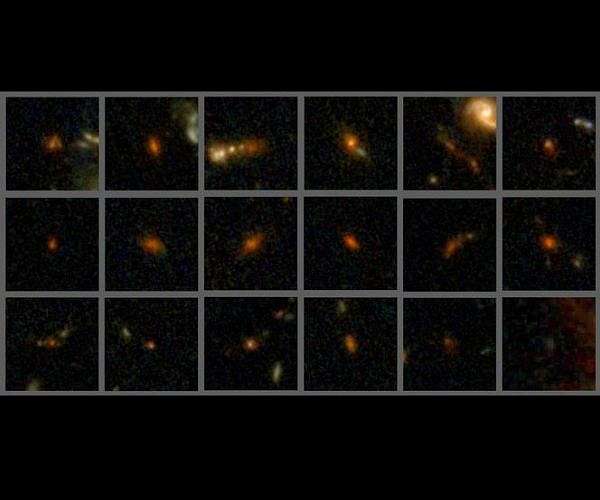
They then combined those data with near-infrared observations from NASA's James Webb Space Telescope, which allowed the team to isolate about 70 faint dusty galaxy candidates close to the edge of the observable universe, most of which had not been detected previously.

By stacking the ALMA observations at the positions of these candidates, the astronomers were able to confirm that they are indeed dusty, star-forming galaxies seen as they existed almost 13 billion years ago.

The analysis shows that these galaxies are both massive and rich in metals and cosmic dust, implying that generations of stars had already lived and died by this early epoch.

According to Zavala, the existence of such evolved, dust-rich systems so soon after the Big Bang indicates that star formation must have started earlier, and proceeded more rapidly, than standard models predict for the early universe.

The newly studied population also appears to be connected to two other rare galaxy classes: ultrabright, star-forming galaxies that JWST has recently identified shortly after the Big Bang, and older, massive quiescent galaxies that have largely ceased forming stars by about 2 billion years after the universe began.

Taken together, these three groups of objects may outline a lifecycle in which ultrabright systems represent the early growth phase, the newly identified dusty galaxies mark a more mature, still vigorously star-forming stage, and the quiescent galaxies correspond to the final, inactive phase.

If this evolutionary sequence is confirmed by future work, it will imply that widely used models of galaxy formation and evolution are missing important physical processes in the first few billion years of cosmic history.

The study underscores how rapidly new facilities are reshaping the view of the distant universe, and how combining data from complementary observatories such as ALMA and JWST can reveal populations that were previously hidden.

Zavala emphasized that the project depended on close collaboration among researchers and institutions around the globe, supported in part by funding from the U.S. National Science Foundation.

Research Report:ALMA and JWST Identification of Faint Dusty Star-forming Galaxies up to z ~ 8 and Their Connection with Other Galaxy Populations

Related Links
University of Massachusetts Amherst
Stellar Chemistry, The Universe And All Within It

Subscribe Free To Our Daily Newsletters
RELATED CONTENT
STELLAR CHEMISTRY
Dark matter core may drive Milky Way center
London, UK (SPX) Feb 08, 2026
Our Milky Way galaxy may not host a supermassive black hole at its center but instead an enormous concentration of dark matter that exerts an equivalent gravitational influence on nearby stars and gas, according to new research published in Monthly Notices of the Royal Astronomical Society. The authors argue that this invisible substance, which makes up most of the universe's mass, can account both for the high speed orbits of stars only light hours from the galactic center and for the large scale rotat ... read more

STELLAR CHEMISTRY
NASA announces overhaul of Artemis lunar program amid technical delays

Texas AM partners with Aegis to orbit TAMU SPIRIT research hub on ISS

Regrowing marginal farmland can curb emissions without cutting food output

Chinese visitors to Japan slump as spat rumbles on

STELLAR CHEMISTRY
Prometheus starts work on new Indiana solid rocket motor campus

NASA prepares Artemis II rocket for rollback after upper stage issue

Superconducting thruster cuts power and mass for space propulsion

Lithium trace in upper air linked to Falcon 9 rocket breakup

STELLAR CHEMISTRY
Perseverance rover now self-locates precisely on Mars

Curiosity Blog, Sols 4798-4803: Back for More Science

Mars relay orbiter seen as backbone for future exploration

UAE extends Mars probe mission until 2028

STELLAR CHEMISTRY
Dragon spacecraft gears up for crew 12 arrival and station science work

China prepares offshore test base for reusable liquid rocket launches

Retired EVA workhorse to guide China's next-gen spacesuit and lunar gear

Tiangong science program delivers data surge

STELLAR CHEMISTRY
AAC Clyde Space adds Sedna satellites to boost maritime data services

China tests AI satellite swarm for space-based computing

BlackSky expands Gen 3 Assured deals with new defense customer

Muon Space ramps up multi-mission satellite constellations

STELLAR CHEMISTRY
KSAT prepares Hyperion in orbit relay test for satellite data

India chases 'DeepSeek moment' with homegrown AI models

AI mapping sharpens global view of human development gaps

Junk to high-tech: India bets on e-waste for critical minerals

STELLAR CHEMISTRY
Debris disc oddities point to hidden outer planets

Hydrogen sulfide detected in distant gas giant exoplanets for the first time

JWST study links sulfur rich gas giants to core growth in distant HR 8799 system

Survey of 80 near Earth asteroids sharpens view of their origins and risks

STELLAR CHEMISTRY
Simple collapse may build cosmic snowman worlds

Jupiter size refined by new radio mapping

Polar weather on Jupiter and Saturn hints at the planets' interior details

Europa ice delamination may deliver nutrients to hidden ocean


The content herein, unless otherwise known to be public domain, are Copyright 1995-2026 - SpaceDaily.com. All websites are published in Australia and are solely subject to Australian law and governed by Fair Use principals for news reporting and research purposes. AFP, UPI and IANS news wire stories are copyright Agence France-Presse, United Press International and Indo-Asia News Service. ESA news reports are copyright European Space Agency. All NASA sourced material is public domain. Additional copyrights may apply in whole or part to other bona fide parties. All articles labeled "by Staff Writers" include reports supplied to Space Media Network by industry news wires, PR agencies, corporate press officers and the like. Such articles are individually curated and edited by Space Media Network staff on the basis of the report's information value to our industry and professional readership. Advertising does not imply endorsement, agreement or approval of any opinions, statements or information provided by Space Media Network on any Web page published or hosted by Space Media Network. General Data Protection Regulation (GDPR) Statement Our advertisers use various cookies and the like to deliver the best ad banner available at one time. All network advertising suppliers have GDPR policies (Legitimate Interest) that conform with EU regulations for data collection. By using our websites you consent to cookie based advertising. If you do not agree with this then you must stop using the websites from May 25, 2018. Privacy Statement. Additional information can be found here at About Us.
Subscribe Free To Our Daily Newsletters