





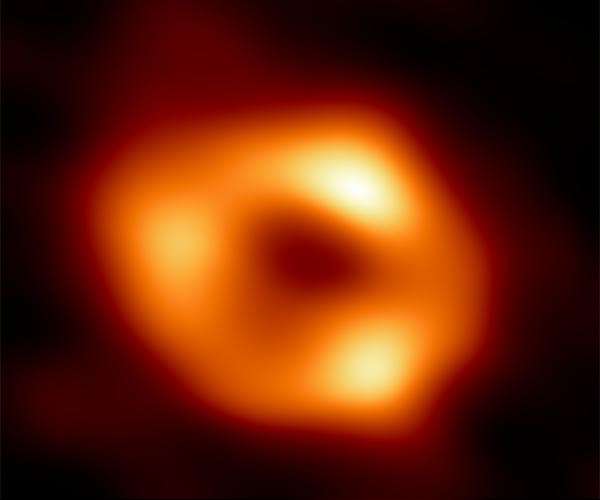
For decades astronomers have interpreted the extreme orbits of a group of stars near the center of the Milky Way, known as the S stars, as evidence for a compact supermassive black hole dubbed Sagittarius A*. In the new study, an international team proposes an alternative explanation in which a specific form of dark matter made of light fermions builds a compact core surrounded by a diffuse halo, together forming a single continuous structure. In this scenario the inner core becomes sufficiently dense and massive to mimic the gravitational pull of a black hole, reproducing the observed S star orbits and the motions of nearby dust embedded objects called G sources.
The model relies on recent measurements from the European Space Agency's GAIA DR3 release, which provide a detailed rotation curve for the outer halo of the Milky Way. These data reveal a Keplerian decline, a gradual slowdown in orbital speed at large distances from the galactic center that must be explained by any successful mass distribution model. The authors report that the outer part of their fermionic dark matter halo, combined with the ordinary matter in the galactic disk and bulge, naturally reproduces the observed rotation curve.
A key feature of the fermionic dark matter configuration is its more compact halo structure compared with traditional cold dark matter halos, which tend to follow extended power law profiles. In the fermionic picture, the central core and surrounding halo arise from the same underlying particle physics but manifest very different densities and scales. Study co author Carlos Arguelles of the Institute of Astrophysics La Plata describes the approach as the first dark matter model to connect the dynamics of stars very close to the galactic center with the kinematics of stars and gas far out in the halo using a single framework.
"We are not just replacing the black hole with a dark object; we are proposing that the supermassive central object and the galaxy's dark matter halo are two manifestations of the same, continuous substance," said Arguelles. In this view the compact inner region that governs the S star and G source orbits is simply the densest part of the same dark matter distribution that shapes the Milky Way's outer rotation. The authors emphasize that their model fits both the small scale and large scale data sets without requiring separate components or ad hoc assumptions.
The new work also builds on previous theoretical studies of fermionic dark matter cores. A 2024 analysis by Pelle and collaborators in MNRAS showed that when such a dense dark matter core is illuminated by an accretion disk, it can cast a shadow like feature similar to those imaged by the Event Horizon Telescope collaboration for objects such as Sagittarius A*. That calculation demonstrated that strong light bending around a compact dark matter core can generate a central dim region encircled by a bright ring, closely resembling the expected appearance of a black hole shadow.
Lead author Valentina Crespi of the Institute of Astrophysics La Plata said this consistency with shadow observations is central to the new proposal. "Our model not only explains the orbits of stars and the galaxy's rotation but is also consistent with the famous 'black hole shadow' image," Crespi explained. "The dense dark matter core can mimic the shadow because it bends light so strongly, creating a central darkness surrounded by a bright ring." This dual success on both dynamical and imaging grounds strengthens the case for the fermionic dark matter interpretation.
To evaluate how well their scenario competes with the conventional black hole picture, the researchers carried out a statistical comparison between the fermionic dark matter model and a model centered on a massive black hole at Sagittarius A*. They report that current measurements of the inner stellar orbits do not yet allow a decisive distinction between the two possibilities. However, they argue that the dark matter core hypothesis has the advantage of simultaneously accounting for the behavior of the central stars, the observed shadow like feature, and the rotational properties of the Milky Way at large radii within one self consistent framework.
The authors highlight several observational avenues that could help discriminate between a true black hole and a dense dark matter core. Instruments such as the GRAVITY interferometer on the Very Large Telescope in Chile are expected to deliver more precise tracking of stellar trajectories very close to the galactic center, tightening constraints on the underlying gravitational potential. Another promising test involves the search for photon rings, a distinctive signature predicted for black holes but not for the fermionic dark matter core.
A photon ring forms when light orbits a black hole multiple times before escaping, generating a sharp, bright feature that should appear in very high resolution images of the immediate environment near the event horizon. In the dark matter core scenario, where there is no event horizon, such stable photon orbits do not arise and the corresponding ring structure would be absent. Detecting or ruling out photon rings around the Milky Way's central object could therefore provide a clear diagnostic of its true nature.
The study was carried out by scientists from the Institute of Astrophysics La Plata in Argentina, the International Centre for Relativistic Astrophysics Network and the National Institute for Astrophysics in Italy, the Relativity and Gravitation Research Group in Colombia, and the Institute of Physics at the University of Cologne in Germany. By uniting insights from galactic dynamics, dark matter theory, and high resolution imaging, the collaboration aims to test whether the Milky Way's central engine is an extreme manifestation of dark matter instead of a classic supermassive black hole. The outcome of future observations could reshape how astronomers understand the heart of our galaxy and similar compact objects in other galaxies.
Research Report:The dynamics of S-stars and G-sources orbiting a supermassive compact object made of fermionic dark matter
Related Links
Royal Astronomical Society
Stellar Chemistry, The Universe And All Within It
| Subscribe Free To Our Daily Newsletters |
| Subscribe Free To Our Daily Newsletters |








