





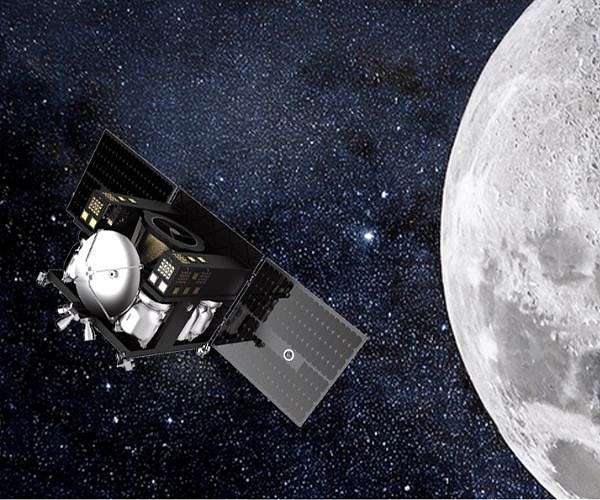
The Mani satellite will orbit the Moon's north and south polar regions, acquiring high-resolution images that can be combined into detailed elevation models.
By imaging the same areas from several viewing angles and tracking the resulting shadows, the mission team will calculate elevation differences, slopes, and small-scale terrain features that are not resolved in current datasets.
These data products are intended to improve site selection for astronaut and robotic landings and to help identify locations suitable for permanent infrastructure such as lunar bases.
The satellite will also map how light reflects from specific areas on the Moon that are used to study earthshine, in which sunlight reflected from Earth illuminates the lunar surface.
Improved knowledge of earthshine will contribute to studies of how efficiently Earth reflects solar radiation, which is relevant for understanding the evolution of the global climate system.
On 16 December, European Space Agency member states approved a prioritized work plan that includes the Mani mission, allowing the project to advance to its next development phase.
The satellite is scheduled for launch in 2029 and is described by the University of Copenhagen as Denmark's largest satellite mission to date and the first Danish-led satellite to operate beyond Earth's orbit.
"With this decision, the largest Danish satellite mission ever is on its way to becoming reality. It's the first time Denmark will lead an ESA mission and the first time a Danish-led satellite will leave Earth's orbit. The journey truly begins now - it's about to get exciting," says mission leader Jens Frydenvang, Associate Professor at the Globe Institute, University of Copenhagen.
The Mani satellite will capture high-resolution images of the Moon's surface to support safer future missions by helping to secure landing sites for astronauts and robotic explorers.
"Our mapping can make lunar landings safer. And with our data, we can also help identify the best locations for building bases for future astronauts," says Jens Frydenvang.
The University of Copenhagen coordinates an international consortium of research institutions and industry partners to deliver the Mani mission, with Danish partners including Aalborg University, Aarhus University, the University of Southern Denmark, the Danish Meteorological Institute, and Space Inventor.
The mapping technology was developed at the Niels Bohr Institute and is based on taking multiple images of a given area from different angles and recording the shadows cast on the lunar surface.
As sunlight moves across the Moon, the shadows change shape, and when the satellite obtains images of the same area from several viewing directions, the measurements can be used to calculate elevation differences, slopes, and terrain properties and to build maps with higher resolution than existing products.
That shadows are central to the Mani mission stems from earlier work by postdoc Iris Fernandes, who in 2019 developed a mathematical model to recognize chalk layers and patterns in images of the Cliffs of Stevns in Denmark, only to find that the model misclassified shadows as rock layers.
"At some point, I realized that shadows can also tell us a lot about the landscape, for example the size and shape of what casts the shadow. I'm a big space nerd, so I knew the Moon is a place with plenty of shadows without atmospheric disturbances. So, I started working with lunar data to see if shadows could help us understand the surface instead," says Iris Fernandes, postdoc at the Niels Bohr Institute and science data lead for the Mani mission.
Together with Professor Klaus Mosegaard from the Niels Bohr Institute, she developed an algorithm that can reconstruct the Moon's surface with much finer detail than previously possible.
The Mani mission is designed to generate new data on the Moon through collaboration between Danish and international universities and research organizations, with industrial partners responsible for building the spacecraft and key components.
Eva Hoffmann, Prorector for Research and Innovation at the University of Copenhagen, welcomed ESA's decision to move the mission forward.
"The Mani mission is a milestone for Danish space research. I'm proud that a project led by the University of Copenhagen, with participation from other Danish universities, has received ESA's green light. It's a brilliant example of why collaboration between academia and industry is crucial for innovative solutions. And it shows that Denmark is in the big league when it comes to space research," says Eva Hoffmann.
At the University of Copenhagen, the Globe Institute, Niels Bohr Institute, and Department of Computer Science will lead the mission and process the data generated in orbit, while academic partners include the Polish Academy of Sciences (Polska Akademia Nauk) and Universite Paris-Saclay alongside the Danish institutions.
Danish company Space Inventor is the primary industrial partner and will build the satellite and integrate instruments and components delivered by Polish, Dutch, and Slovenian companies.
The mission is planned for launch in 2029, after which the spacecraft will begin polar orbits and a systematic imaging campaign over the lunar surface.
Related Links
Mani mission
Mars News and Information at MarsDaily.com
Lunar Dreams and more
| Subscribe Free To Our Daily Newsletters |

| Subscribe Free To Our Daily Newsletters |








