





The Free State of Bavaria is supporting construction of the HECC with 58 million euros, while DLR is contributing an additional 20 million euros from its institutional core funding. The funding notice was formally presented on 4 February 2026 in Oberpfaffenhofen by Bavarian Minister-President Markus Soder to Anke Kaysser-Pyzalla, Chair of the DLR Executive Board, together with DLR Space Divisional Board Member Anke Pagels-Kerp and Felix Huber, Director of the DLR Space Operations and Astronaut Training institute.
According to Kaysser-Pyzalla, decades of operational experience and technology transfer have turned Oberpfaffenhofen into a site with internationally recognized expertise in space operations and astronaut training. She described the new HECC as marking the beginning of a new era for DLR space operations, with robotic exploration in support of crewed missions set to play an increasingly important role within an international cooperation framework.
German Federal Minister for Research, Technology and Space Dorothee Bar highlighted that the HECC will make Oberpfaffenhofen Europe's future hub for robotic and human exploration. She emphasized that federal and state governments are jointly expanding Germany's capabilities in spaceflight operations, framing the HECC as a key German contribution to Europe's sovereignty in space.
From the Bavarian perspective, Minister-President Soder described the project as creating "Bavaria's gateway to the stars" and underlined the alliance between the Free State, DLR and ESA. Bavaria is investing 58 million euros in the HECC building and a further five million euros in the development of an orbital gateway and an artificial intelligence project to support astronauts. Soder stressed that the Moon will act as a springboard into deeper space and potentially a stopover on the way to Mars, enabling real-time robotic monitoring, autonomous energy systems and permanent living and working environments in space, with benefits that reach back to daily life on Earth.
Bavarian Minister for Economic Affairs Hubert Aiwanger added that space has become a major economic and technological driver. He said the HECC will bring future technologies to Bavaria, secure highly skilled jobs and provide the foundation for governmental and commercial missions alike. Aiwanger pointed to the long-standing support from the Bavarian Ministry of Economic Affairs for DLR's Oberpfaffenhofen site and argued that the HECC continues this trajectory, illustrating how advanced technology, industry and research intersect in the region.
The HECC will be integrated into GSOC's existing infrastructure and will include a new building designed to accommodate up to 200 staff members. Within this complex, a dedicated lunar control center will be created, equipped with clean rooms and multi-mission control rooms capable of supporting the parallel operation of different types of missions. High-security zones with their own server and control rooms are planned to meet the increasingly demanding requirements of future operations, while GSOC teams develop new deployment and operations concepts tailored to Moon and Mars missions.
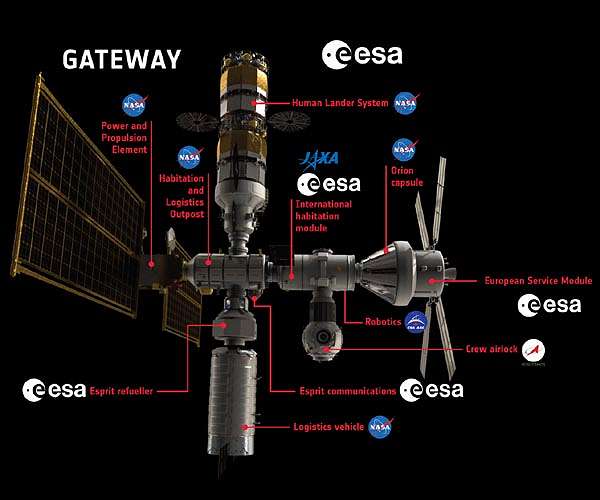
A central task for the HECC will be to manage European operations of the Gateway space station planned in lunar orbit as part of NASA's Artemis program. GSOC is already preparing operational procedures for the International Habitat (I-HAB), one of Gateway's core modules that will provide living and working space for astronauts. From Oberpfaffenhofen, the HECC will assume operational responsibility for three Gateway elements: the I-HAB habitation module, the HLCS communication system linking the station to the lunar surface and the ESPRIT refuelling module.
The Gateway is scheduled to be assembled in lunar orbit over the course of this decade and will function as humanity's next outpost in space. As part of Artemis, it will support the sustained return of humans to the Moon while serving as a platform to test technologies, operations concepts and life support approaches that are required for future crewed missions to Mars. The HECC's role in running critical European Gateway systems positions Germany and its partners at the center of these next steps in human exploration.
In the longer term, the HECC will also support missions beyond the Earth-Moon system. For Mars missions, signal travel times between Earth and spacecraft can reach up to 40 minutes, making conventional real-time control impossible and driving the need for more autonomy on board. To meet this challenge, GSOC is developing artificial intelligence solutions such as the METIS assistance system (Mars Exploration Telemetry-driven Information System), which is intended to help manage autonomous or semi-autonomous spacecraft operations in deep space.
With sustained support from the European Space Agency (ESA), the HECC is intended to become Europe's central control facility for human and robotic exploration missions. The combination of Bavarian funding and DLR investment provides the technological and infrastructural basis for this role at the Oberpfaffenhofen site. Construction of the new Human Exploration Control Center is scheduled to begin in 2028, with operational readiness targeted for 2030.
DLR's Oberpfaffenhofen site already hosts the German Space Operations Center, which has decades of experience in crewed space missions. Early milestones included the German Spacelab missions D1 and D2 on the US Space Shuttle and flights by German cosmonauts to the MIR space station. In 2004, the Columbus Control Center began operating the European Columbus module on the International Space Station, followed in 2007 by the Galileo Competence Center for operating Europe's Galileo satellite navigation system. DLR and ESA are now extending this accumulated expertise to their collaboration with NASA under the Artemis lunar program, with the HECC representing the next major step in that evolution.
Related Links
German Aerospace Center (DLR)
Mars News and Information at MarsDaily.com
Lunar Dreams and more
| Subscribe Free To Our Daily Newsletters |
| Subscribe Free To Our Daily Newsletters |








