





Published in the journal One Earth, "The risk of a hothouse Earth trajectory" is an analysis by an international collaboration led by Oregon State University's William Ripple that synthesizes scientific findings on climate feedback loops and 16 tipping elements - Earth subsystems that may undergo loss of stability if critical temperature thresholds are passed.
Those sharp changes could likely result in a cascade of subsystem interactions that would steer the planet toward a path to extreme warming and sea level rise - conditions that could be difficult to reverse on human timescales, even with deep emissions cuts.
"After a million years of oscillating between ice ages separated by warmer periods, the Earth's climate stabilized more than 11,000 years ago, enabling agriculture and complex societies," said Ripple, distinguished professor of ecology in the OSU College of Forestry. "We're now moving away from that stability and could be entering a period of unprecedented climate change."
Tipping elements include ice sheets in Antarctica and Greenland, mountain glaciers, sea ice, boreal forests and permafrost, the Amazon rainforest and the Atlantic Meridional Overturning Circulation or AMOC, a system of ocean currents that's a key influencer of global climate.
The researchers note that nearly 10 years after the Paris Agreement, which sought to limit long-term average warming to 1.5 degrees Celsius above preindustrial levels, global temperature increases exceeded 1.5 degrees Celsius for 12 consecutive months - a period that also included extreme, deadly and costly wildfires, floods and other climate-related natural disasters.
"Temperature limit exceedance is usually evaluated using 20-year averages, but climate model simulations suggest the recent 12-month breach indicates the long-term average temperature increase is at or near 1.5 degrees," said study co-author Christopher Wolf, a former OSU postdoctoral researcher who is now a scientist with Corvallis-based Terrestrial Ecosystems Research Associates, known as TERA. "It's likely that global temperatures are as warm as, or warmer than, at any point in the last 125,000 years and that climate change is advancing faster than many scientists predicted."
It's also likely that carbon dioxide levels are the highest they've been in at least 2 million years, the scientists say. At more than 420 parts per million, the atmospheric CO2 concentration is about 50% higher than it was prior to the Industrial Revolution.
When the climate changes, the researchers note, responses can be triggered that circle back to affect the climate itself, amplifying or dampening the original change. These processes are known as climate feedback loops.
"Amplifying feedbacks increase the risks of accelerated warming," Ripple said. "For example, melting ice and snow, permafrost thaw, forest dieback and soil-carbon loss can all magnify warming - and in turn affect the climate system's sensitivity to greenhouse gases."
Ripple, Wolf and their collaborators - Wolf's TERA colleague Jillian Gregg and top climate scientists in Germany, Denmark and Austria - say current data coupled with the inherent uncertainties of climate forecasting should be taken as a signal that urgent climate mitigation and adaptation strategies are needed.
"Existing climate mitigation approaches, including scaling up renewable energy and protecting carbon-storing ecosystems, are critical to limit the increase in global temperatures," said Ripple.
Strategies that embed climate resilience into governmental policy frameworks should be a priority as well, the authors say, along with a socially just phaseout of fossil fuels. The scientists also discuss the need for novel approaches, including coordinated global tipping-point monitoring and better plans for managing risk.
"Uncertain tipping thresholds underscore the importance of precaution - crossing even some of those thresholds could commit the planet to a hothouse trajectory with long-lasting and possibly irreversible consequences," Wolf said. "Policymakers and the public remain largely unaware of the risks posed by what would effectively be a point-of-no-return transition. And while averting the hothouse trajectory won't be easy, it's much more achievable than trying to backtrack once we're on it."
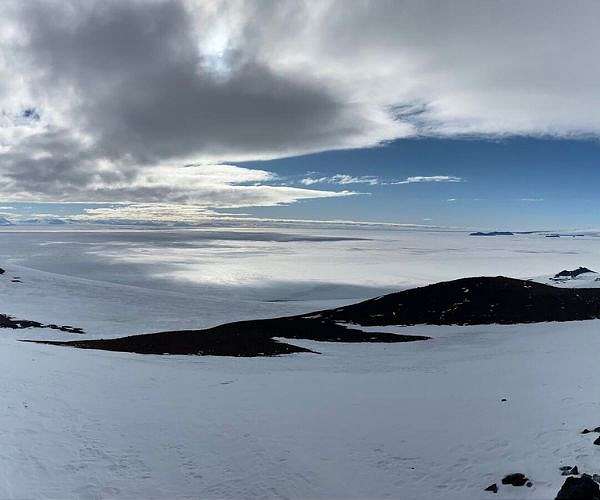
Tipping may already be happening with the Greenland and West Antarctic ice sheets, the scientists say, and boreal permafrost, mountain glaciers and the Amazon rainforest appear on the verge of tipping.
In the Earth's tightly coupled climate system, destabilization in one region can reverberate across oceans and continents as melting ice accelerates warming by reducing albedo and altering the Atlantic Meridional Overturning Circulation, resulting in changes to tropical rain belts.
For example, as the Greenland ice sheet melts, it could further weaken the AMOC, which in turn could trigger parts of the Amazon to tip from rainforest to savanna.
"The AMOC is already showing signs of weakening, and this could increase the risk of Amazon dieback, with major negative impacts on carbon storage and biodiversity," Ripple said. "Carbon released by an Amazon dieback would further amplify global warming and interact with other feedback loops. We need to act quickly on our rapidly dwindling opportunities to prevent dangerous and unmanageable climate outcomes."
Working with Ripple, Wolf and Gregg on the analysis were Johan Rockstrom and Nico Wunderling of the Potsdam Institute for Climate Impact Research; Katherine Richardson of the University of Copenhagen; Thomas Westerhold of University Bremen; and Hans Joachim Schellnhuber of the International Institute for Applied Systems Analysis.
Related Links
Oregon State University
Climate Science News - Modeling, Mitigation Adaptation
| Subscribe Free To Our Daily Newsletters |
| Subscribe Free To Our Daily Newsletters |








