





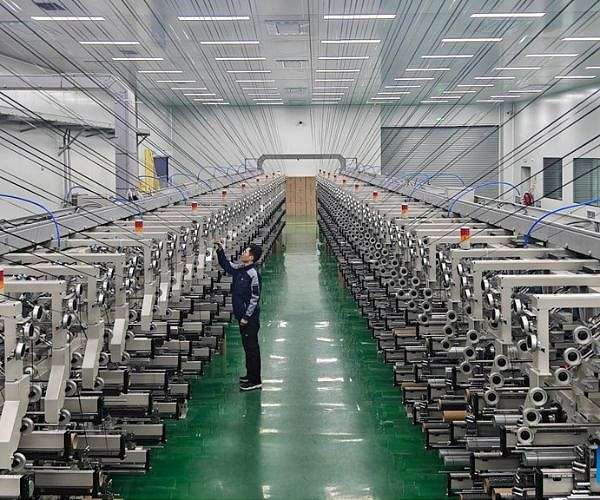
According to senior engineer Jing Deqi of the Institute of Coal Chemistry under the Chinese Academy of Sciences, the carbon fiber produced on this line has a single filament diameter of just 5 to 6 micrometers, less than one tenth the width of a human hair. Despite its slender dimensions, each filament achieves tensile strength above 6,600 MPa, and with a density around one quarter that of steel, the material offers more than five times the strength of steel by weight.
Jing explained that a one meter bundle of T1000 grade carbon fiber weighs about 0.5 grams yet can support a load exceeding 200 kilograms, roughly equivalent to the combined weight of three adult men. The material contains more than 90 percent carbon and retains carbon's inherent advantages of low weight, high strength, and resistance to corrosion and heat, while remaining as flexible and processable as textile yarn.
These properties have earned carbon fiber the description "king of modern materials" and made it a key input for sectors including aerospace, new energy vehicles, high end equipment manufacturing, sporting goods, and medical devices. At large scales, T1000 carbon fiber can be used for heat resistant outer shells of rockets and spacecraft, lightweight yet strong fuselages for aircraft, and robust driver cabins for high performance sports cars.
At smaller scales, the material appears in carbon plates embedded in marathon running shoes to enhance propulsion, in lightweight and resilient fishing rods, and in road bicycle frames light enough to carry upstairs in one hand. It also plays an essential role in the giant blades of wind turbines, aerodynamic noses of high speed trains, and storage tanks for hydrogen fuel cell powered vehicles.
For years, this high performance material, often called "black gold," was dominated by companies in the United States and Japan, which controlled more than 90 percent of the global high end carbon fiber market. The Institute of Coal Chemistry began research in this field in the 1960s and 1970s, but while researchers could produce high performance samples in the laboratory, they struggled to overcome the challenges of scaling to stable mass production.
In 2005, the institute received a national mandate to develop aerospace grade T300 carbon fiber and build an industrial production line. The "T" designation refers to a strength grading system originally defined by Japanese manufacturer Toray, in which higher numbers correspond to superior tensile strength and significantly greater manufacturing difficulty.
Supported by national policies and rising market demand, China's carbon fiber sector has advanced rapidly through independent innovation. Domestic teams achieved breakthroughs and large scale production of T700 and T800 grade fibers in succession, steadily increasing the share of homegrown materials in the domestic market and laying the groundwork for pursuing higher performance classes.
T1000 currently represents the frontier of ultra high strength carbon fiber. To reach this level, a team led by Zhang Shouchun, deputy director of the Institute of Coal Chemistry, spent years refining every step of the laboratory process to establish a complete and reproducible route suitable for eventual industrialization. Zhang described the development path as "feeling for stones while crossing a river," emphasizing that despite the difficulty, the team remained determined to move forward.
In 2024, the institute partnered with Huayang Carbon Material Technology Co., Ltd. to begin construction of the first phase of a demonstration production line for a thousand ton level high performance carbon fiber project in Datong. The project uses a fully indigenous innovation chain, carrying technology from laboratory to factory and enabling efficient conversion of research results into commercial product.
During commissioning, the team faced persistent challenges in maintaining stable operation. When process parameters fluctuated, Zhang and colleagues repeatedly traversed multiple workshops each day to check equipment, working in environments where some areas exceeded 40 degrees Celsius while others were near 5 degrees Celsius. After more than a month of continuous troubleshooting under these conditions, they were able to stabilize the line.
Zhang reports that the project adopts a self developed technological route, and that the product's average tensile strength surpasses 6,600 MPa, exceeding comparable foreign products and offering improved application performance. This places China's high performance carbon fiber technology among the leading group internationally and demonstrates the country's ability to independently produce ultra high strength grades at scale.
By November 2025, the Datong production line had completed continuous operation verification, and the first phase reached an annual production capacity of around 200 tonnes. With stable production achieved, the new line is expected to enhance China's self sufficiency in critical areas where high performance carbon fiber is a strategic material.
Zhang said the project's success will help drive development across multiple industrial chains and support emerging industries. Anticipated application fields include aerospace, rail transit, new energy vehicles, and the low altitude economy, all of which stand to benefit from lighter, stronger, and more durable structural materials.
Looking toward the period covered by China's 15th Five Year Plan from 2026 to 2030, the team expects T1000 carbon fiber from the Datong line to contribute to the ongoing shift of Chinese manufacturing toward higher end, more intelligent, and greener production models. Zhang added that the institute aims to pursue even higher grades of carbon fiber and convert additional technological advances into mature products in order to meet the increasingly diverse requirements of different sectors.
Related Links
Institute of Coal Chemistry Chinese Academy of Sciences
Space Technology News - Applications and Research
| Subscribe Free To Our Daily Newsletters |
| Subscribe Free To Our Daily Newsletters |







