24/7 Space News
EXO WORLDS
Pandora exoplanet mission checks in after launch
illustration only

Pandora exoplanet mission checks in after launch

by Clarence Oxford
Los Angeles CA (SPX) Jan 13, 2026

NASA mission controllers have acquired full signal from the agency's Pandora small satellite, confirming the health and initial operations of the exoplanet observatory following launch from Vandenberg Space Force Base in California on Jan. 11, 2026.

The spacecraft rode to orbit on a SpaceX Falcon 9 rocket from Space Launch Complex 4 East, sharing the flight with the Star-Planet Activity Research CubeSat, known as SPARCS, and the Black Hole Coded Aperture Telescope CubeSat, or BlackCAT.

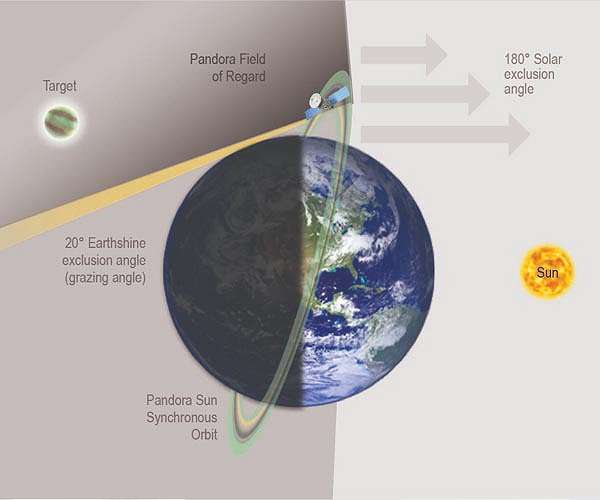
Pandora is designed to study planets outside our solar system, called exoplanets, that were discovered by other observatories, probing the composition of their atmospheres and how their host stars may generate or modify the signals detected from these distant worlds.

When an exoplanet passes in front of its star, atoms and molecules in the planet's atmosphere can absorb specific colors of starlight, leaving telltale fingerprints in the observed spectrum that astronomers can use to identify elements and compounds such as water vapor, hazes, or clouds.

However, stellar activity on the host star's surface can mimic or mask those atmospheric signatures, producing variations in brightness and spectral features that complicate efforts to reliably isolate the planet's contribution to the combined light.

To address this challenge, Pandora will monitor the brightness of each target star in visible wavelengths while at the same time collecting near infrared data from both the star and the transiting planet, providing a multiwavelength view that separates stellar noise from planetary signals.

The mission will repeatedly observe each selected exoplanet system 10 times for 24 hours at a stretch, building long time series that capture multiple transits and stellar variability patterns so scientists can model and subtract the stellar behavior.

NASA's Goddard Space Flight Center in Greenbelt, Maryland leads Pandora for the agency and supplied the infrared sensor that sits at the heart of the observatory's science payload.

Lawrence Livermore National Laboratory is responsible for project management and engineering, and worked with Corning on the manufacture and development of the mission's telescope while also developing the imaging detector assemblies, control electronics, and associated thermal and mechanical subsystems.

Blue Canyon Technologies provided the spacecraft bus and is carrying out assembly, integration, and environmental testing, while NASA's Ames Research Center in California's Silicon Valley will handle data processing for the mission.

Pandora's mission operations center is located at the University of Arizona in Tucson, and a number of additional universities are contributing to the mission's science team, analysis, and interpretation of the exoplanet observations.

Launch services for Pandora were procured under NASA's Venture-Class Acquisition of Dedicated and Rideshare contract, known as VADR, which is managed by NASA's Launch Services Program based at Kennedy Space Center in Florida.

NASA will continue to share updates on Pandora and related exoplanet science through its NASA Universe and Kennedy Space Center accounts on X, Facebook, and Instagram, and through the mission information page at https://science.nasa.gov/mission/pandora.

Related Links
Pandora at NASA
Lands Beyond Beyond - extra solar planets - news and science
Life Beyond Earth

Subscribe Free To Our Daily Newsletters
Tweet

RELATED CONTENT
The following news reports may link to other Space Media Network websites.
EXO WORLDS
Rogue planet mass pinned down for the first time
Tokyo, Japan (SPX) Jan 06, 2026
Peking University, January 2, 2026: A coordinated observation campaign using space- and ground-based telescopes has yielded the first precise mass measurement of a rogue planet, confirming that one long-standing candidate is indeed a planet. Unlike planets in the Solar System, rogue planets travel through space without orbiting a host star. Over the last decade, astronomers have identified about a dozen rogue planet candidates through brief microlensing events, when a compact object passes in fron ... read more

EXO WORLDS
International Space Station crew to return early after astronaut medical issue

Second ESCAPADE spacecraft completes key trajectory fix on path to Mars

Why Space Exploration Depends on Predicting the Unpredictable

China launches twin Shijian-29 satellites to test space-target detection tech

EXO WORLDS
Starfighters completes supersonic tests for GE Aerospace ramjet program

Galileo satellites ride Ariane 6 to boost Europe navigation resilience

North Korea tests hypersonic missiles, says nuclear forces ready for war

AI systems proposed to boost launch cadence reliability and traffic management

EXO WORLDS
The electrifying science behind Martian dust

Sandblasting winds sculpt Mars landscape

Thin ice may have protected lake water on frozen Mars

Curiosity's Nevado Sajama postcard captures Mars on the eve of conjunction

EXO WORLDS
Tiangong science program delivers data surge

China tallies record launch year as lunar and asteroid plans advance

China harnesses nationwide system to drive spaceflight and satellite navigation advances

Shenzhou 21 crew complete eight hour spacewalk outside Tiangong station

EXO WORLDS
Time-expanded network model cuts complexity in mega constellation launch planning

Southern Launch to Host Lux Aeterna Re-Entries South Australia

Smart modeling framework targets 6G spectrum chaos in space air and ground networks

K2 Space raises 250m to scale Mega class high power satellites

EXO WORLDS
Momentus to flight test 3D printed fuel tank on Vigoride 7

How IVRT Testing Ensures Consistent Product Quality

This exotic form of ice just got weirder

Planet delivers first light image from Pelican 6 satellite capturing Lhasa Gonggar Airport

EXO WORLDS
Joint ground- and space-based observations reveal Saturn-mass rogue planet

Creating hallucination-free, psychedelic-like molecules by shining light on life's basic building blocks

ALMA views giant dusty disk in Gomezs Hamburger with signs of early giant planet formation

Giant amoeba virus ushikuvirus sheds light on how complex cells evolved

EXO WORLDS
Jupiter's moon Europa has a seafloor that may be quiet and lifeless

Uranus and Neptune may be rock rich worlds

SwRI links Uranus radiation belt mystery to solar storm driven waves

Looking inside icy moons

Subscribe Free To Our Daily Newsletters


The content herein, unless otherwise known to be public domain, are Copyright 1995-2024 - Space Media Network. All websites are published in Australia and are solely subject to Australian law and governed by Fair Use principals for news reporting and research purposes. AFP, UPI and IANS news wire stories are copyright Agence France-Presse, United Press International and Indo-Asia News Service. ESA news reports are copyright European Space Agency. All NASA sourced material is public domain. Additional copyrights may apply in whole or part to other bona fide parties. All articles labeled "by Staff Writers" include reports supplied to Space Media Network by industry news wires, PR agencies, corporate press officers and the like. Such articles are individually curated and edited by Space Media Network staff on the basis of the report's information value to our industry and professional readership. Advertising does not imply endorsement, agreement or approval of any opinions, statements or information provided by Space Media Network on any Web page published or hosted by Space Media Network. General Data Protection Regulation (GDPR) Statement Our advertisers use various cookies and the like to deliver the best ad banner available at one time. All network advertising suppliers have GDPR policies (Legitimate Interest) that conform with EU regulations for data collection. By using our websites you consent to cookie based advertising. If you do not agree with this then you must stop using the websites from May 25, 2018. Privacy Statement. Additional information can be found here at About Us.