





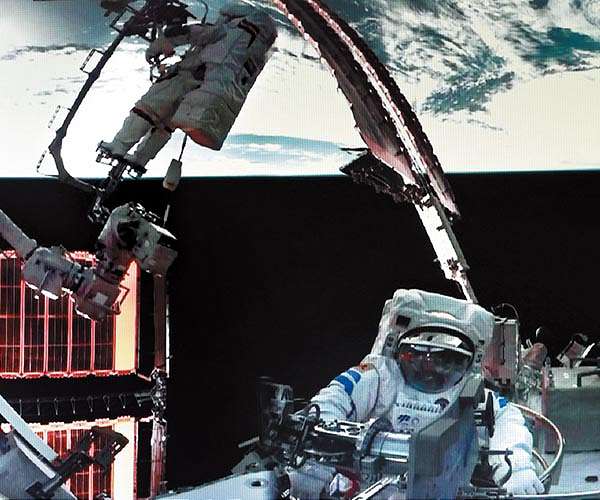
Mission commander Zhang Lu and spaceflight engineer Wu Fei exited the station to install additional debris protection devices and replace external equipment, while payload specialist Zhang Hongzhang supported the operation from inside the orbital complex. The EVA focused on improving the station's resilience against the increasing density of orbital debris in low Earth orbit and ensuring long term operational safety.
During the spacewalk, the astronauts inspected and photographed windows on the Shenzhou spacecraft reentry module. The inspection followed earlier damage attributed to impacts from small debris fragments, which previously delayed a crew return and underscored the growing risks associated with congestion in heavily used orbital regions.
The spacewalk was reported as the 25th EVA conducted by Chinese astronauts since the start of the country's human spaceflight program. At 32 years old, Wu Fei became the youngest Chinese astronaut to perform an extravehicular activity, marking a generational milestone as China's astronaut corps expands to support sustained station operations.
China's Tiangong space station, completed in 2022, consists of the Tianhe core module and two laboratory modules, Wentian and Mengtian. The station is designed for continuous occupation and supports a rotating crew conducting scientific research, technology demonstrations, and maintenance activities. Since becoming fully operational, Tiangong has hosted a growing portfolio of experiments in microgravity physics, life sciences, materials science, and Earth observation.
Recent missions have increasingly emphasized routine maintenance and system upgrades rather than initial construction, reflecting the transition from assembly to long term utilization. Regular EVAs are now a planned part of station operations, used to install shielding, upgrade external payloads, and inspect critical systems exposed to the space environment.
The Shenzhou 21 crew arrived at Tiangong in early November and has spent nearly forty days aboard the station. In addition to maintenance tasks, the crew continues to conduct scientific experiments and training activities to support future missions and to validate procedures for extended human presence in orbit.
China's human spaceflight program has outlined plans to operate Tiangong for at least a decade, with regular crew rotations and cargo resupply missions. Officials have also indicated openness to international scientific cooperation aboard the station, positioning Tiangong as a long term platform for microgravity research as the International Space Station approaches the later stages of its operational life.
Additional spacewalks may be conducted during the Shenzhou 21 mission if required, depending on inspection results and operational needs. The EVA highlights China's growing emphasis on station sustainability, crew safety, and operational maturity as it consolidates its role as a permanent human presence in low Earth orbit.
Related Links
China Daily
The Chinese Space Program - News, Policy and Technology
China News from SinoDaily.com
| Subscribe Free To Our Daily Newsletters |
| Subscribe Free To Our Daily Newsletters |







