24/7 Space News
OUTER PLANETS
Uranus and Neptune may be rock rich worlds
illustration only

Uranus and Neptune may be rock rich worlds

by Robert Schreiber
Zurich, Switzerland (SPX) Dec 11, 2025

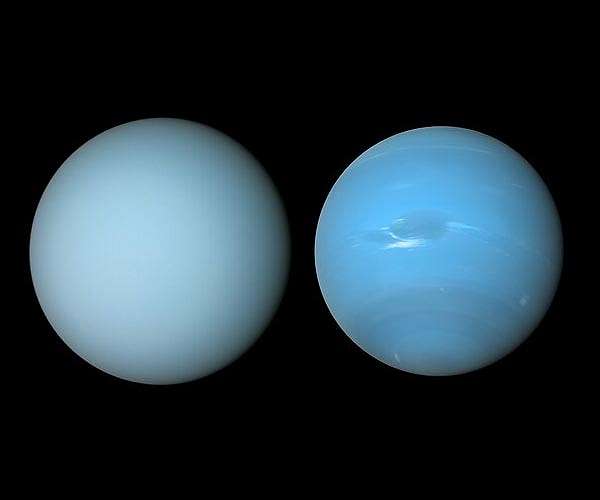
The Solar System is often divided into four inner rocky planets, two gas giants, and two ice giants thought to be dominated by water and other volatiles, but new work from the University of Zurich suggests Uranus and Neptune may contain much more rock than assumed so far. The study indicates that these distant planets can be consistent with interior structures that are either ice rich or rock rich, and that the standard picture of them as purely ice dominated worlds is too narrow. The interpretation is also compatible with earlier findings that Pluto, a dwarf planet in the outer Solar System, appears to be largely rocky in composition.

To investigate the interiors of Uranus and Neptune, the team created a new framework for modeling planetary structure that combines physically motivated equations with a flexible numerical procedure. Earlier interior models either imposed strict, predefined layering or relied on simplified empirical density profiles, which limited the range of possible solutions. Lead author Luca Morf and co author Ravit Helled instead generated many internal density profiles, calculated the resulting gravity fields, compared them with the observed gravitational moments of the planets, and iterated until the models matched the data while remaining thermodynamically and compositionally consistent.

With this agnostic but physical approach, the researchers obtained a wide set of interior solutions for both Uranus and Neptune. These solutions span rock to water mass ratios from about 0.04 to nearly 4 for Uranus and from about 0.20 to just under 2 for Neptune, covering both water dominated and rock dominated cases. Within the uncertainties of current measurements, the gravity data do not require Uranus and Neptune to be ice rich and instead allow structures in which rock provides a substantial share of the interior mass.

The models also include layers of ionic water that play a key role in generating the planets magnetic fields. Unlike Earth, which has a relatively simple dipolar magnetic field with two clear poles, Uranus and Neptune exhibit complex fields with multiple poles and strong tilts. The new work shows that magnetic dynamos operating in ionic water layers away from the planetary centers can reproduce these non dipolar, multipolar field geometries.

According to the modeling, the region where Uranus generates its magnetic field lies deeper inside the planet than the equivalent dynamo region in Neptune. This difference in depth may help explain why the two planets, despite similar sizes and masses, show distinct magnetic configurations. The results link the details of interior structure, including how rock and water are distributed with depth, to the properties of the magnetic fields measured by spacecraft flybys.

The authors caution that key uncertainties remain in how materials behave at the extreme pressures and temperatures inside giant planets. In particular, limited knowledge of the equations of state of rock and water mixtures and of hydrogen helium water systems at these conditions introduces uncertainties in the inferred compositions. Improving laboratory measurements and theoretical calculations for such materials is essential to narrowing the range of allowed interior models.

Even with these uncertainties, the study broadens the spectrum of plausible interior configurations for Uranus and Neptune and challenges the simple classification of both worlds as ice giants. The results suggest that both planets could reasonably be described as rock giants or ice giants, depending on which part of the allowed model space turns out to match reality. The work underscores that current data on mass, radius, and gravity are not sufficient to resolve this compositional degeneracy.

The findings also have implications for understanding planet formation in the outer Solar System and for interpreting exoplanets with similar masses and radii. If Uranus and Neptune can host a large rock fraction, then models of how icy and rocky material accumulated in the protoplanetary disk may need revision. Comparable sized exoplanets could also span a wide range of rock and water ratios, meaning that planets with similar bulk properties might have very different internal makeups.

Research Report:Icy or rocky? Convective or stable? New interior models of Uranus and Neptune.

Related Links
University of Zurich
The million outer planets of a star called Sol

Subscribe Free To Our Daily Newsletters
Tweet

RELATED CONTENT
The following news reports may link to other Space Media Network websites.
OUTER PLANETS
SwRI links Uranus radiation belt mystery to solar storm driven waves
Los Angeles CA (SPX) Dec 08, 2025
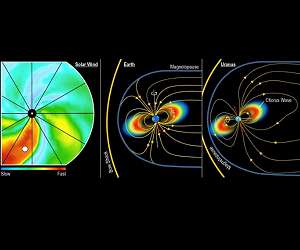
SwRI scientists report that a reanalysis of Voyager 2 measurements suggests a powerful solar storm may explain why Uranus hosts an electron radiation belt far more intense than expected. They propose that a large-scale solar wind structure, known as a co-rotating interaction region, was passing through the Uranian system during the 1986 flyby, driving extreme space weather conditions that boosted electron energies beyond prior predictions. Voyager 2 remains the only spacecraft to have flown past U ... read more

OUTER PLANETS
Lodestar Space wins SECP support to advance AI satellite awareness system

ISS to change commanders before Soyuz crew leaves orbit

Micro nano robots aim to cut carbon buildup in closed life support systems

NASA extends ISS National Lab management contract through 2030

OUTER PLANETS
Space shuttle design study maps path to breakthrough inventions

Neutron Hungry Hippo fairing completes qualification ahead of first launch

LandSpace reviews booster loss after Zhuque-3 reusable rocket test

UK plasma thruster test positions Pulsar Fusion for larger satellite propulsion

OUTER PLANETS
Martian sound study models acoustic signals in Jezero crater

Martian butterfly crater reveals low angle impact and buried lava history

Bacterial partnership offers pathway to produce Mars regolith bricks for future habitats

Chinese team runs long term Martian dust cycle simulation with GoMars model

OUTER PLANETS
Wenchang spaceport hits record cadence with double-digit launches in 2025

China consolidates new commercial space regulator and industry roadmap

Beijing space lab targets orbital data centers for AI era

China supports private space firms to expand global reach

OUTER PLANETS
Private capital targets mission-critical software power and platforms in new space economy

MDA Space plans C250 million senior unsecured note issue maturing 2030

SLI and AscendArc agree on 200 million GEO satellite leasing framework

Beyond Gravity positions new modular satellite platform for European LEO missions

OUTER PLANETS
Leading the Odds: Five Bookmakers Transforming Ireland's Modern Betting Landscape

Space operators urged to share costs of clearing orbital debris

X-MAT introduces X-FOAM: A game-changing ceramic foam for extreme environments

How Real-Time Follower Tracking Transforms Modern Social Media Analytics

OUTER PLANETS
Subaru OASIS survey uncovers massive planet and brown dwarf

The bacteria that wont wake up found in spacecraft cleanrooms

Supernova mixing traced as source of key life elements

RISTRETTO spectrograph cleared for Proxima b atmospheric hunt

OUTER PLANETS
SwRI links Uranus radiation belt mystery to solar storm driven waves

Looking inside icy moons

Saturn moon mission planning shifts to flower constellation theory

Could these wacky warm Jupiters help astronomers solve the planet formation puzzle?

Subscribe Free To Our Daily Newsletters


The content herein, unless otherwise known to be public domain, are Copyright 1995-2024 - Space Media Network. All websites are published in Australia and are solely subject to Australian law and governed by Fair Use principals for news reporting and research purposes. AFP, UPI and IANS news wire stories are copyright Agence France-Presse, United Press International and Indo-Asia News Service. ESA news reports are copyright European Space Agency. All NASA sourced material is public domain. Additional copyrights may apply in whole or part to other bona fide parties. All articles labeled "by Staff Writers" include reports supplied to Space Media Network by industry news wires, PR agencies, corporate press officers and the like. Such articles are individually curated and edited by Space Media Network staff on the basis of the report's information value to our industry and professional readership. Advertising does not imply endorsement, agreement or approval of any opinions, statements or information provided by Space Media Network on any Web page published or hosted by Space Media Network. General Data Protection Regulation (GDPR) Statement Our advertisers use various cookies and the like to deliver the best ad banner available at one time. All network advertising suppliers have GDPR policies (Legitimate Interest) that conform with EU regulations for data collection. By using our websites you consent to cookie based advertising. If you do not agree with this then you must stop using the websites from May 25, 2018. Privacy Statement. Additional information can be found here at About Us.