24/7 Space News
SPACEMART
China outlines mega constellations in ITU satellite filings
illustration only

China outlines mega constellations in ITU satellite filings

by Riko Seibo
Tokyo, Japan (SPX) Jan 13, 2026

China has submitted plans for more than 200,000 satellites to the International Telecommunication Union, underscoring a drive to secure orbital positions and radio spectrum as global competition for low Earth orbit intensifies. The applications on the ITU website cover more than a dozen planned satellite constellations, with individual networks ranging from a few dozen spacecraft to systems approaching 100,000 satellites.

The largest proposed systems, designated CTC-1 and CTC-2, each list 96,714 satellites and were filed by the Institute of Radio Spectrum Utilization and Technological Innovation, a recently formed research and development organization focused on advancing and commercializing radio spectrum technologies. That institute alone accounts for over 95 percent of all satellites included in the Chinese filings, highlighting its central role in the new orbital plans.

Additional filings come from a mix of state-backed and commercial actors, including China Satellite Network Group and Shanghai Yuanxin Satellite Technology. Telecom operators China Mobile and China Telecom have also lodged satellite network plans, alongside private space companies such as GalaxySpace, Guodian Gaoke Space Technology and Spacety, signaling broad participation across the country's communications and space sectors.

Ding Botao, deputy director of information research at the Shanghai Academy of Social Sciences, said the large number of planned satellites reflects China's readiness to undertake extensive, coordinated deployment in low Earth orbit. "The move signals China's resolve and capability to carry out large-scale, systematic deployment in low-Earth orbit," Ding said.

An expert from China's national radio regulation center said filing network information with the ITU is the initial step required worldwide before operators can deploy satellite systems. Because access to satellite frequencies and orbital resources must be coordinated internationally, procedures usually begin two to seven years ahead of launches to ensure compatibility and reduce interference risks.

The expert added that China has consistently observed ITU radio regulations in its satellite planning and operations. The path from international filing to launch and then to service rollout is typically lengthy, and the eventual size of constellations and their technical parameters can be adjusted and optimized as projects evolve.

According to the expert, the scale and diversity of the latest filings do not mean every satellite listed will necessarily reach orbit, but they provide regulatory room for future growth and refinement. As multiple countries submit proposals for constellations numbering more than 100,000 satellites, securing spectrum and orbital rights early has become a strategic priority in the emerging era of dense low Earth orbit networks.

Related Links
China Satellite Network Group
The latest information about the Commercial Satellite Industry

Subscribe Free To Our Daily Newsletters
Tweet

RELATED CONTENT
The following news reports may link to other Space Media Network websites.
SPACEMART
Time-expanded network model cuts complexity in mega constellation launch planning
Tokyo, Japan (SPX) Dec 30, 2025
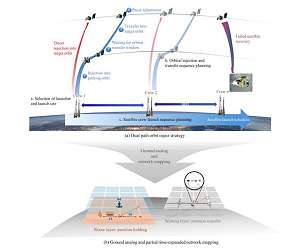
Large Low Earth Orbit (LEO) constellations promise continuous, high-capacity information services, but planners must work within limits set by launch cadence, payload capacity, and orbital mechanics to deploy satellites in batches at reasonable cost. Researchers Junru Lin, Tiantian Zhang, and Min Hu at Space Engineering University in Beijing have developed an optimization framework that keeps detailed timing information while shrinking the underlying mathematical problem, offering a practical tool for d ... read more

SPACEMART
International Space Station crew to return early after astronaut medical issue

Second ESCAPADE spacecraft completes key trajectory fix on path to Mars

Why Space Exploration Depends on Predicting the Unpredictable

China launches twin Shijian-29 satellites to test space-target detection tech

SPACEMART
Starfighters completes supersonic tests for GE Aerospace ramjet program

Galileo satellites ride Ariane 6 to boost Europe navigation resilience

North Korea tests hypersonic missiles, says nuclear forces ready for war

AI systems proposed to boost launch cadence reliability and traffic management

SPACEMART
The electrifying science behind Martian dust

Sandblasting winds sculpt Mars landscape

Thin ice may have protected lake water on frozen Mars

Curiosity's Nevado Sajama postcard captures Mars on the eve of conjunction

SPACEMART
Tiangong science program delivers data surge

China tallies record launch year as lunar and asteroid plans advance

China harnesses nationwide system to drive spaceflight and satellite navigation advances

Shenzhou 21 crew complete eight hour spacewalk outside Tiangong station

SPACEMART
Time-expanded network model cuts complexity in mega constellation launch planning

Southern Launch to Host Lux Aeterna Re-Entries South Australia

Smart modeling framework targets 6G spectrum chaos in space air and ground networks

K2 Space raises 250m to scale Mega class high power satellites

SPACEMART
Momentus to flight test 3D printed fuel tank on Vigoride 7

How IVRT Testing Ensures Consistent Product Quality

This exotic form of ice just got weirder

Planet delivers first light image from Pelican 6 satellite capturing Lhasa Gonggar Airport

SPACEMART
Joint ground- and space-based observations reveal Saturn-mass rogue planet

Creating hallucination-free, psychedelic-like molecules by shining light on life's basic building blocks

ALMA views giant dusty disk in Gomezs Hamburger with signs of early giant planet formation

Giant amoeba virus ushikuvirus sheds light on how complex cells evolved

SPACEMART
Jupiter's moon Europa has a seafloor that may be quiet and lifeless

Uranus and Neptune may be rock rich worlds

SwRI links Uranus radiation belt mystery to solar storm driven waves

Looking inside icy moons

Subscribe Free To Our Daily Newsletters


The content herein, unless otherwise known to be public domain, are Copyright 1995-2024 - Space Media Network. All websites are published in Australia and are solely subject to Australian law and governed by Fair Use principals for news reporting and research purposes. AFP, UPI and IANS news wire stories are copyright Agence France-Presse, United Press International and Indo-Asia News Service. ESA news reports are copyright European Space Agency. All NASA sourced material is public domain. Additional copyrights may apply in whole or part to other bona fide parties. All articles labeled "by Staff Writers" include reports supplied to Space Media Network by industry news wires, PR agencies, corporate press officers and the like. Such articles are individually curated and edited by Space Media Network staff on the basis of the report's information value to our industry and professional readership. Advertising does not imply endorsement, agreement or approval of any opinions, statements or information provided by Space Media Network on any Web page published or hosted by Space Media Network. General Data Protection Regulation (GDPR) Statement Our advertisers use various cookies and the like to deliver the best ad banner available at one time. All network advertising suppliers have GDPR policies (Legitimate Interest) that conform with EU regulations for data collection. By using our websites you consent to cookie based advertising. If you do not agree with this then you must stop using the websites from May 25, 2018. Privacy Statement. Additional information can be found here at About Us.