24/7 Space News
OUTER PLANETS
Jupiter's moon Europa has a seafloor that may be quiet and lifeless
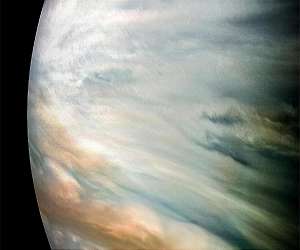
illustration only

Jupiter's moon Europa has a seafloor that may be quiet and lifeless

by Chris Woolston for WUSTL News
St. Louis MO (SPX) Jan 06, 2026
The giant planet Jupiter has nearly 100 known moons, yet none have captured the interest and imagination of astronomers and space scientists quite like Europa, an ice-shrouded world that is thought to possess a vast ocean of liquid salt water. For decades, scientists have wondered whether that ocean could harbor the right conditions for life, placing Europa near the top of the list of solar system bodies to explore.

A new study led by Paul Byrne, an associate professor of Earth, environmental, and planetary sciences, throws cold water on the idea that Europa could support life at the seafloor. Using calculations that consider the moon's size, the makeup of its rocky core, and the gravitational forces from Jupiter, Byrne and a team of scientists conclude that Europa likely lacks the tectonic motion, warm hydrothermal vents, or any other sort of underwater geologic activity that would presumably be a prerequisite for life.

"If we could explore that ocean with a remote-control submarine, we predict we wouldn't see any new fractures, active volcanoes, or plumes of hot water on the seafloor," Byrne said. "Geologically, there's not a lot happening down there. Everything would be quiet." And on an icy world like Europa, a quiet seafloor might well mean a lifeless ocean, he added.

The study was published in Nature Communications. Co-authors from the Department of Earth, Environmental, and Planetary Sciences include Professor Philip Skemer, associate chair of the department; Professor Jeffrey Catalano; Douglas Wiens, the Robert S. Brookings Distinguished Professor; and graduate student Henry Dawson. Byrne, Skemer, Catalano, Wiens, and Dawson are also members of the McDonnell Center for the Space Sciences.

For Byrne, a planetary scientist, Europa's appeal extends well beyond the question of life. "I'm really interested to know what that seafloor looks like," he said. "For all of the talk about the ocean itself, there has been little discussion about the seafloor."

Without a submarine, Byrne and co-authors had to combine known facts about Europa with inferences drawn from the geology of Earth and other bodies, including our own Moon.

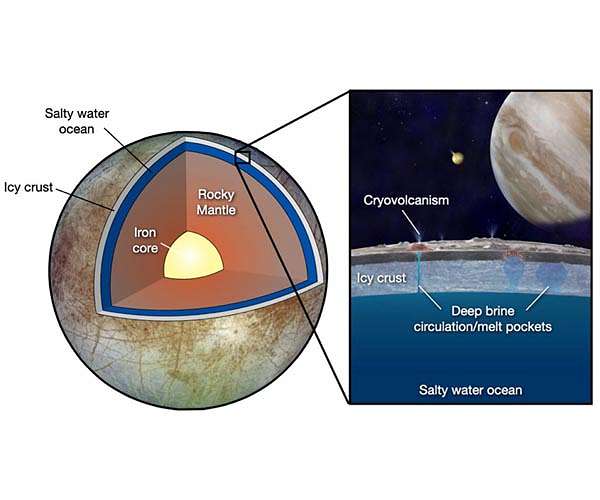
The ice shell on Europa is thought to be 15 to 25 km thick, and the ocean covers the entire moon to a depth of up to 100 km. Even though Europa is slightly smaller than our own Moon, it likely holds much more water than Earth.

Beneath that ice and water lies a rocky core analogous to Earth's. While Earth's core still burns hot, Byrne and co-authors calculated that any heat from Europa's core would have escaped billions of years ago.

The team also calculated the gravitational forces from Jupiter, a pull that can be strong enough to keep a moon geologically alive. On its innermost large moon, Io, Jupiter's gravity roils tides and heats the rocks beneath the icy surface. Io, in fact, is the most volcanically active body in the solar system. The tides on Io are especially violent because the moon has an erratic orbit that periodically takes it closer to Jupiter, but Europa's orbit is relatively stable and distant, lessening the chance for substantial tidal forces, Byrne explained.

"Europa likely has some tidal heating, which is why it's not completely frozen," Byrne said. "And it may have had a lot more heating in the distant past. But we don't see any volcanoes shooting out of the ice today like we see on Io, and our calculations suggest that the tides aren't strong enough to drive any sort of significant geologic activity at the seafloor."

Europa's quiet seafloor geology doesn't provide much support for any contemporary life beneath the ice, Byrne said. "The energy just doesn't seem to be there to support life, at least today."

Byrne is still excited about future chances to explore Europa, especially the Europa Clipper spacecraft that will fly by the moon in the spring of 2031. That mission - conceived and championed in part by Bill McKinnon, the Clark Way Harrison Distinguished Professor in Arts and Sciences and interim director of the McDonnell Center for the Space Sciences - will take close-up pictures of Europa's surface and provide more precise measurements of its ice cap and ocean. "Those measurements should answer a lot of questions and give us more certainty," Byrne said.

Even if, eventually, modern Europa is found to be lifeless, Byrne won't be disappointed. "I'm not upset if we don't find life on this particular moon," he said. "I'm confident that there is life out there somewhere, even if it's 100 light-years away. That's why we explore-to see what's out there."

Related Links
Washington University in St. Louis
The million outer planets of a star called Sol

Subscribe Free To Our Daily Newsletters
Tweet

RELATED CONTENT
OUTER PLANETS
A New Model of Water in Jupiter's Atmosphere
Pasadena CA (SPX) Oct 01, 2025
Caltech researchers have developed a new simulation of the hydrological cycle on Jupiter, modeling how water vapor condenses into clouds and falls as rain throughout the giant planet's swirled, turbulent atmosphere. The research shows that Jupiter's water is not uniformly distributed, giving missions like NASA's Juno orbiter important guidance about where to look for water on the planet. Jupiter was considered the first planet in our solar system to form, and its massive gravitational influence sh ... read more

OUTER PLANETS
Second ESCAPADE spacecraft completes key trajectory fix on path to Mars

China launches twin Shijian-29 satellites to test space-target detection tech

ESA reaches new benchmark in autonomous formation flying

Overseas scholars drawn to China's scientific clout, funding

OUTER PLANETS
North Korea tests hypersonic missiles, says nuclear forces ready for war

Starfighters completes supersonic tests for GE Aerospace ramjet program

Galileo satellites ride Ariane 6 to boost Europe navigation resilience

AI systems proposed to boost launch cadence reliability and traffic management

OUTER PLANETS
Sandblasting winds sculpt Mars landscape

Thin ice may have protected lake water on frozen Mars

Curiosity's Nevado Sajama postcard captures Mars on the eve of conjunction

Wind-Sculpted Landscapes: Investigating the Martian Megaripple 'Hazyview'

OUTER PLANETS
China harnesses nationwide system to drive spaceflight and satellite navigation advances

Shenzhou 21 crew complete eight hour spacewalk outside Tiangong station

Foreign satellites ride Kinetica 1 on new CAS Space mission

Experts at Hainan symposium call for stronger global space partnership

OUTER PLANETS
Time-expanded network model cuts complexity in mega constellation launch planning

Southern Launch to Host Lux Aeterna Re-Entries South Australia

Smart modeling framework targets 6G spectrum chaos in space air and ground networks

K2 Space raises 250m to scale Mega class high power satellites

OUTER PLANETS
Essential Strategies for Enhancing Data Integrity and Compliance in Today's Business Environment

Momentus to flight test 3D printed fuel tank on Vigoride 7

Satellites lined up for shared space computing power networks

Planet delivers first light image from Pelican 6 satellite capturing Lhasa Gonggar Airport

OUTER PLANETS
Deep Arctic gas hydrate mounds host ultra deep cold seep ecosystem

Joint ground- and space-based observations reveal Saturn-mass rogue planet

ALMA views giant dusty disk in Gomezs Hamburger with signs of early giant planet formation

We finally know how the most common types of planets are created

OUTER PLANETS
Jupiter's moon Europa has a seafloor that may be quiet and lifeless

Uranus and Neptune may be rock rich worlds

SwRI links Uranus radiation belt mystery to solar storm driven waves

Looking inside icy moons


The content herein, unless otherwise known to be public domain, are Copyright 1995-2026 - SpaceDaily.com. All websites are published in Australia and are solely subject to Australian law and governed by Fair Use principals for news reporting and research purposes. AFP, UPI and IANS news wire stories are copyright Agence France-Presse, United Press International and Indo-Asia News Service. ESA news reports are copyright European Space Agency. All NASA sourced material is public domain. Additional copyrights may apply in whole or part to other bona fide parties. All articles labeled "by Staff Writers" include reports supplied to Space Media Network by industry news wires, PR agencies, corporate press officers and the like. Such articles are individually curated and edited by Space Media Network staff on the basis of the report's information value to our industry and professional readership. Advertising does not imply endorsement, agreement or approval of any opinions, statements or information provided by Space Media Network on any Web page published or hosted by Space Media Network. General Data Protection Regulation (GDPR) Statement Our advertisers use various cookies and the like to deliver the best ad banner available at one time. All network advertising suppliers have GDPR policies (Legitimate Interest) that conform with EU regulations for data collection. By using our websites you consent to cookie based advertising. If you do not agree with this then you must stop using the websites from May 25, 2018. Privacy Statement. Additional information can be found here at About Us.
Subscribe Free To Our Daily Newsletters