24/7 Space News
ROCKET SCIENCE
China retrieves Long March 10 booster from South China Sea after test flight
illustration only

China retrieves Long March 10 booster from South China Sea after test flight

by Riko Seibo
Tokyo, Japan (SPX) Feb 16, 2026
China has carried out its first maritime recovery of a rocket first-stage booster, retrieving the main stage of a Long March 10 heavy-lift carrier rocket from the South China Sea following a key test flight earlier this week.

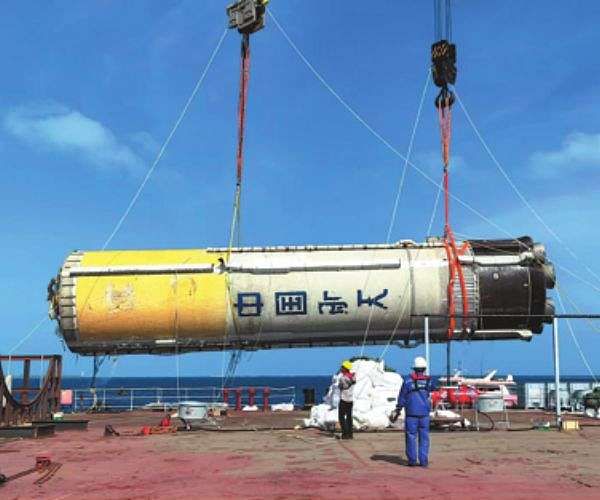
The China Manned Space Agency reported that the booster was recovered on Friday morning from a designated splashdown zone, marking the first time China has recovered major rocket components from the ocean. A crane lifted the stage from the water and placed it on a recovery vessel for transport and subsequent analysis.

Officials have not yet disclosed how engineers plan to process or reuse the recovered hardware, nor have they released detailed information about the recovery sequence and post-flight inspection campaign. The operation nonetheless represents a major step in China's effort to introduce reusable launch systems into its human spaceflight program.

The maritime recovery followed a critical flight test on Wednesday involving the Long March 10 first-stage booster integrated with the Mengzhou crewed spacecraft, the combination intended for China's planned crewed lunar missions around 2030. During the test, the booster conducted a controlled return using its engines and grid fins before performing a gentle splashdown in the preselected area in the South China Sea.

According to the agency, the flight marked the first successful attempt by a Chinese rocket stage to return safely to Earth for possible reuse, an achievement that aligns China's human spaceflight ambitions more closely with launch-reuse practices already demonstrated by the United States. At present, the United States is the only nation operating reusable orbital-class rockets.

Both the Long March 10 rocket and the Mengzhou spacecraft are in the final stages of research and development at China Aerospace Science and Technology Corp, the country's main state-owned space contractor. Engineers view these systems as core elements in China's roadmap to land astronauts on the moon before the end of the decade.

The Long March 10 is a new-generation launch vehicle designed by the China Academy of Launch Vehicle Technology. The standard lunar-mission configuration consists of a central core booster flanked by multiple side boosters. Standing 92.5 meters tall and measuring 5 meters in diameter, the rocket has a liftoff mass of 2,189 metric tons and a liftoff thrust of 2,678 tons.

In this configuration, the Long March 10 can send at least 27 tons of payload onto an Earth-moon transfer trajectory, a performance level required for crewed lunar missions and associated cargo flights. Designers note that this capability will support not only initial lunar landing attempts but also the buildup of larger mission architectures.

A shorter variant of the Long March 10 without side boosters is also under development. This version will be 67 meters tall with a liftoff mass of about 740 tons and will be capable of carrying 14 tons to low Earth orbit. Plans call for this configuration to support crew and cargo transportation to the Tiangong space station once it enters operational service.

Engineers state that the first two stages of the core booster are essentially common to both the lunar and the shorter space-station variants, simplifying development and production. In both cases, the first-stage booster is intended to be reusable, enabling it to perform controlled returns after launch.

For lunar missions, the Long March 10 will employ an additional third stage on top of the reusable first and expendable second stage to inject payloads into the Earth-moon transfer trajectory. The shorter configuration for Tiangong resupply flights will omit this third stage, optimizing the vehicle strictly for low Earth orbit operations.

Related Links
China Manned Space Agency
Rocket Science News at Space-Travel.Com

Subscribe Free To Our Daily Newsletters
RELATED CONTENT
ROCKET SCIENCE
Stoke Space expands Series D funding to $860M to drive Nova launch development
Sydney, Australia (SPX) Feb 13, 2026
Stoke Space Technologies has expanded its previously announced Series D financing round to a total of 860 million dollars as it advances work on its fully and rapidly reusable Nova launch vehicle and related infrastructure at Cape Canaveral Space Force Station in Florida. The company, based in Kent, Washington, is developing medium lift launch vehicles designed for high cadence operations to support a growing space economy. The round, first announced in October 2025 at 510 million dollars, has now ... read more

ROCKET SCIENCE
Texas AM partners with Aegis to orbit TAMU SPIRIT research hub on ISS

Sophie Adenot, the second French woman to fly to space

International crew arrives at space station

NASA announces overhaul of Artemis lunar program amid technical delays

ROCKET SCIENCE
Prometheus starts work on new Indiana solid rocket motor campus

NASA prepares Artemis II rocket for rollback after upper stage issue

Superconducting thruster cuts power and mass for space propulsion

Lithium trace in upper air linked to Falcon 9 rocket breakup

ROCKET SCIENCE
Perseverance rover now self-locates precisely on Mars

Curiosity Blog, Sols 4798-4803: Back for More Science

Mars relay orbiter seen as backbone for future exploration

UAE extends Mars probe mission until 2028

ROCKET SCIENCE
Dragon spacecraft gears up for crew 12 arrival and station science work

China prepares offshore test base for reusable liquid rocket launches

Retired EVA workhorse to guide China's next-gen spacesuit and lunar gear

Tiangong science program delivers data surge

ROCKET SCIENCE
Infleqtion lists shares on NYSE as neutral atom quantum firm

AAC Clyde Space adds Sedna satellites to boost maritime data services

China tests AI satellite swarm for space-based computing

BlackSky expands Gen 3 Assured deals with new defense customer

ROCKET SCIENCE
India chases 'DeepSeek moment' with homegrown AI models

Swift observatory changes operations ahead of planned orbit reboost

Pale Blue opens Tsukuba site to scale satellite propulsion production

AST SpaceMobile deploys record low orbit cellular array on BlueBird 6

ROCKET SCIENCE
Cheops spots inside out exoplanet quartet

Study questions assumptions about hidden alien technosignals

Study revisits chances of detecting alien technosignatures

Hydrogen sulfide detected in distant gas giant exoplanets for the first time

ROCKET SCIENCE
Simple collapse may build cosmic snowman worlds

Jupiter size refined by new radio mapping

Polar weather on Jupiter and Saturn hints at the planets' interior details

Europa ice delamination may deliver nutrients to hidden ocean


The content herein, unless otherwise known to be public domain, are Copyright 1995-2026 - SpaceDaily.com. All websites are published in Australia and are solely subject to Australian law and governed by Fair Use principals for news reporting and research purposes. AFP, UPI and IANS news wire stories are copyright Agence France-Presse, United Press International and Indo-Asia News Service. ESA news reports are copyright European Space Agency. All NASA sourced material is public domain. Additional copyrights may apply in whole or part to other bona fide parties. All articles labeled "by Staff Writers" include reports supplied to Space Media Network by industry news wires, PR agencies, corporate press officers and the like. Such articles are individually curated and edited by Space Media Network staff on the basis of the report's information value to our industry and professional readership. Advertising does not imply endorsement, agreement or approval of any opinions, statements or information provided by Space Media Network on any Web page published or hosted by Space Media Network. General Data Protection Regulation (GDPR) Statement Our advertisers use various cookies and the like to deliver the best ad banner available at one time. All network advertising suppliers have GDPR policies (Legitimate Interest) that conform with EU regulations for data collection. By using our websites you consent to cookie based advertising. If you do not agree with this then you must stop using the websites from May 25, 2018. Privacy Statement. Additional information can be found here at About Us.
Subscribe Free To Our Daily Newsletters