





The team reports that meteorite impact fluxes on the Moon's near and far sides are essentially consistent over time. This finding supports the use of a unified global lunar cratering chronology and contradicts earlier suggestions that the far side experienced an intensified bombardment compared with the hemisphere facing Earth.
The work appears in Science Advances and directly addresses how impact craters record the cumulative effects of meteorite bombardment since the Moon formed. Early telescopic observations by Galileo first revealed the cratered lunar surface, and later higher resolution images showed that crater density correlates systematically with surface age across different regions.
Following the Apollo and Luna sample return missions, researchers formalized this relationship using a lunar cratering chronology function that links crater density to absolute radiometric ages. This function became a cornerstone of lunar geological studies by allowing scientists to estimate ages for large areas of the Moon that lack returned samples, and it has underpinned age estimates for features across the inner Solar System.
Until Chang'e-6, however, all samples used to calibrate this chronology came from the lunar near side, leaving open whether the function accurately described global impact history. Some previous studies had suggested that differences in crustal structure or shielding might mean that impact fluxes differed between near and far sides, raising questions about the universality of the existing model.
The nature of the early lunar impact record has also remained controversial for decades. Many Apollo samples contain impact-related components with ages clustering around 3.9 billion years, a pattern that gave rise to the Late Heavy Bombardment hypothesis, which proposed a short, intense spike in impact activity across the inner Solar System at that time.
Alternative explanations have argued that the apparent 3.9 billion year clustering reflects sampling bias rather than a true system-wide bombardment pulse. In that view, many of the dated impact materials may mainly record ejecta from the formation of the Imbrium Basin, rather than a global surge in impact rates affecting all planetary surfaces simultaneously.
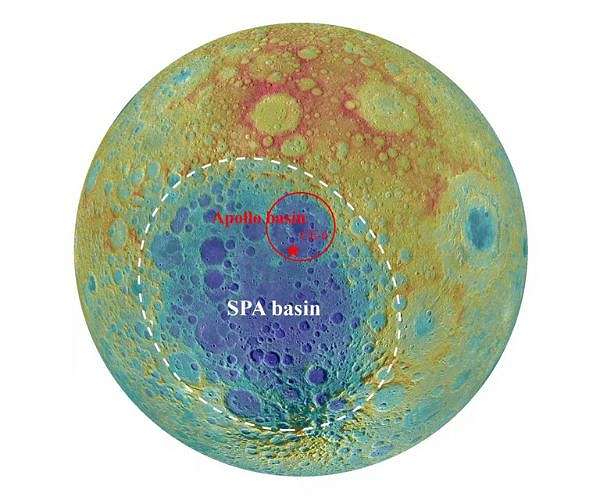
Chang'e-6 was designed in part to resolve these questions by sampling the lunar far side. The lander touched down in the Apollo Basin, itself nested within the South Pole-Aitken (SPA) Basin, which is the largest and oldest recognized impact basin on the Moon and preserves a critical record of early bombardment in the inner Solar System.
Analyses show that the returned samples are dominated by local basaltic material with a radiometric age of about 2.807 billion years, providing a crucial far-side calibration point for comparing impact fluxes between hemispheres. The team used this age together with measured crater densities around the landing region to test whether the far-side record aligns with the chronology curve derived from near-side sites.
The Chang'e-6 collection also includes noritic rock fragments dated to 4.247 billion years. Petrological, mineralogical, and remote sensing evidence indicates that these norites represent crystallized impact melts produced during the formation of the SPA Basin, giving a direct constraint on the timing of this major early impact event on the Moon.
Using well-established near-side calibration points and their associated crater densities, the researchers first reconstructed a lunar cratering chronology curve and quantified its uncertainties. When they plotted the Chang'e-6 far-side ages and crater densities on this curve, the points fell within the 95 percent confidence interval, demonstrating that impact fluxes on the near and far sides are statistically indistinguishable.
With this validation in hand, the team then built an updated lunar cratering chronology function that incorporates all reliable control points, including those provided by Chang'e-6. The resulting reconstruction of impact flux over time shows a smooth and rapid decline in impact rates during the early lunar history, rather than a sharp spike around 3.9 billion years ago.
The 4.247 billion year old noritic samples from Chang'e-6 are inconsistent with both the classical Late Heavy Bombardment model and alternative sawtooth-like scenarios in which impact flux would rise and fall in a series of peaks. Instead, the new data favor a monotonic decrease in impact activity following the main phase of planetary accretion in the inner Solar System.
These findings imply that the Moon, and likely other inner Solar System bodies, did not experience a brief, system-wide surge in impacts at approximately 3.9 billion years ago. Rather, the early impact environment appears to have evolved through a more gradual decline, with large basin-forming events such as South Pole-Aitken occurring earlier than previously inferred from near-side samples alone.
Beyond resolving debates over the Moon's bombardment history, the revised chronology anchored by Chang'e-6 data improves the framework for dating unsampled regions of the lunar surface. A more accurate global cratering function will refine age estimates for key geological units, help prioritize future landing and sampling sites, and provide better context for interpreting the impact histories of other rocky bodies.
The study also highlights the scientific value of far-side exploration and sample return for testing long-standing models built from near-side observations. By extending radiometric age control into regions that had never been sampled before, Chang'e-6 demonstrates how targeted missions can sharpen our understanding of planetary evolution and the timing of major events in the early Solar System.
Research Report: Lunar chronology model with the Chang'e-6 farside samples and implications for the early impact history
Related Links
Institute of Geology and Geophysics, Chinese Academy of Sciences
Mars News and Information at MarsDaily.com
Lunar Dreams and more
| Subscribe Free To Our Daily Newsletters |
| Subscribe Free To Our Daily Newsletters |








