24/7 Space News
MOON DAILY
Apollo Cosplay on a 21st-Century Clock - Why Artemis Keeps Slipping Toward 2029 - Part 3

Apollo Cosplay on a 21st-Century Clock - Why Artemis Keeps Slipping Toward 2029 - Part 3

by Staff Writers
Los Angeles CA (SPX) Mar 09, 2026
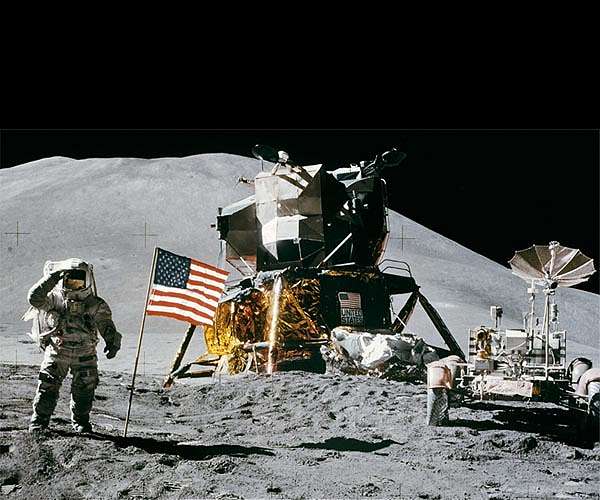
NASA's latest reboot of the Artemis Moon program comes with familiar language: "back to basics," "muscle memory," "step-by-step," and an explicit nod to the Mercury-Gemini-Apollo playbook. The agency wants to fly more often, change hardware less, and build up capability incrementally, just like the 1960s. The problem is that Artemis is trying to cosplay Apollo in a world with very different politics, partners and rivals - and the gaps are showing.

The new Apollo-style ladder

The revamped mission sequence reads like a modernized version of the Apollo arc:

- Artemis II in 2026: the "Apollo 8" moment, a roughly 10-day crewed lunar flyby that tests Orion's life support, navigation and comms in deep space

- Artemis III in 2027: a Gemini-like rendezvous and docking mission in low-Earth orbit, focused on shaking down commercial lunar landers and proving the orbital choreography with crew onboard rather than going straight to the surface

- Artemis IV in early 2028: the "Apollo 11" analog, first boots on the lunar south pole, with NASA dangling the possibility of a second landing (Artemis V) later that year.

Administrator Jared Isaacman has been explicit about the intent. Standardizing on one SLS configuration, flying roughly annually, and advancing objectives in a "logical, phased approach" are all framed as rediscovering the methods that made Apollo possible.

On paper, it is a tidy story: we forgot how we did it the first time, now we remember.

A 1960s script with 2020s actors

Underneath the rhetoric, though, Artemis is playing out in a landscape Apollo never had to contend with.

First, there's the commercial cast:

- The Human Landing System is no longer a pure in-house NASA vehicle; it is split between SpaceX's Starship variant and Blue Origin's Blue Moon, each with their own timelines, design philosophies and corporate priorities

- The new Artemis III LEO mission exists in large part because neither lander looks ready for the kind of rapid leap straight to a polar landing that NASA once talked about, and NASA now talks openly about flying "one or both" providers depending on readiness.

Then, there's the geopolitical rival:

- In the 1960s, the question was whether the United States or the Soviet Union would land first, and Apollo answered it definitively

- Today, China is aiming to put its own astronauts on the Moon by 2030, backed by a methodical robotic program and the planned International Lunar Research Station with Russia.

Against that backdrop, Artemis is not just racing a notional deadline; it is racing a real competitor who does not need to copy the Apollo theatre to score its own win.

The 60-year echo

The insistence on a 2028 landing date has as much to do with symbolism as schedules. Apollo 11 touched down on July 20, 1969; a successful Artemis landing in 2028 would come just under the wire of a neat 60-year "age of discovery" cadence.

The reality, however, is that the new ladder bakes in more opportunities for delay:

- Artemis I slipped years beyond its early targets before finally flying

- Artemis II has already moved to at least April 2026 thanks to pad-discovered hardware issues that forced a rollback and repair campaign in the VAB

- Starship Flight 12 - the first outing of the upgraded V3 vehicle that underpins HLS performance claims - has slipped into April 2026, and the first serious orbital refueling demo is now unlikely before late summer.

Add just one more year of slippage in that chain and the first landing naturally falls into 2029. That is not just "a bit late"; it is almost exactly 60 years after Apollo 11 - an anniversary that would make for a powerful stump speech, but also a quiet admission that a second great leap took six decades to materialize.

Nostalgia vs. program reality

The Apollo cosplay is not only about mission sequencing; it's baked into Artemis's hardware and messaging:

- SLS and Orion are framed as the modern Saturn V and Apollo capsule: big, government-owned, explicitly "national" vehicles

- NASA's own blog describes the changes as part of a "Golden Age of exploration and discovery," leaning heavily on 1960s imagery.

Yet the program reality keeps intruding:

- SLS remains eye-wateringly expensive, with per-launch costs around 4 billion USD and a limited industrial throughput that struggles to support the promised annual cadence

- The Block-1B and Block-2 upgrades, once held up as the future of heavy-lift, have been discarded to avoid further cost and schedule pain, forcing Artemis to make do with a smaller performance envelope and more dependence on commercial lift

- The central enabling technology for a sustained presence - reusable commercial landers with orbital refueling - is still in flux, and NASA's own safety advisers are warning against believing the most optimistic timelines.

In that light, "back to basics" reads less like a confident return to a proven model and more like an attempt to drape a complicated 21st-century partnership in Apollo's simpler myth.

A program pulled between eras

The February overhaul of Artemis is an honest attempt to reconcile those tensions. It acknowledges that the previous plan was too risky and too dependent on wishful thinking about lander readiness. It gives NASA a more gradual staircase to climb, with built-in test points and less hardware churn.

But it also nudges the first landing closer to that 2029 horizon, even as NASA clings to a 2028 - . And it does so while keeping intact the cost structure, industrial dynamics and now an increasingly turbulent budget environment that have already slowed Artemis down.

In the end, Artemis now looks like a program suspended between eras:

- In its rhetoric and mission names, it is still talking Apollo

- In its contracting, budget politics and reliance on billionaire-run launch systems, it lives firmly in the 2020s

- In its likely landing date, it is drifting toward a neat, almost too-poetic 60-year echo of the last time American boots first disturbed lunar dust.

Whether that echo plays as triumph or anticlimax will depend less on how many times NASA can invoke Apollo, and more on whether this latest "back to basics" plan can finally break the cycle of delay and deliver a real 21st-century presence on the Moon - before the clock, and the competition, runs out.

Related Links
Humans In Space at Artemis
Mars News and Information at MarsDaily.com
Lunar Dreams and more

Subscribe Free To Our Daily Newsletters
RELATED CONTENT
MOON DAILY
Changing the Rules Mid-Race - How Artemis Lets Washington Redefine "Winning" at the Moon - Part 4
Los Angeles CA (SPX) Mar 09, 2026
In classic Washington style, the United States has found a way to keep 'winning' the new Moon race even as its flagship program slips, bloats and mutates. With the latest Artemis overhaul, NASA isn't just re-planning a mission sequence - it's helping Trump's America quietly rewrite the rules of the game so that almost any outcome can be spun as victory. ... read more

MOON DAILY
NASA announces overhaul of Artemis lunar program amid technical delays

Texas AM partners with Aegis to orbit TAMU SPIRIT research hub on ISS

Regrowing marginal farmland can curb emissions without cutting food output

Chinese visitors to Japan slump as spat rumbles on

MOON DAILY
Prometheus starts work on new Indiana solid rocket motor campus

NASA prepares Artemis II rocket for rollback after upper stage issue

Superconducting thruster cuts power and mass for space propulsion

Lithium trace in upper air linked to Falcon 9 rocket breakup

MOON DAILY
Perseverance rover now self-locates precisely on Mars

Curiosity Blog, Sols 4798-4803: Back for More Science

Mars relay orbiter seen as backbone for future exploration

UAE extends Mars probe mission until 2028

MOON DAILY
Dragon spacecraft gears up for crew 12 arrival and station science work

China prepares offshore test base for reusable liquid rocket launches

Retired EVA workhorse to guide China's next-gen spacesuit and lunar gear

Tiangong science program delivers data surge

MOON DAILY
Infleqtion lists shares on NYSE as neutral atom quantum firm

AAC Clyde Space adds Sedna satellites to boost maritime data services

China tests AI satellite swarm for space-based computing

BlackSky expands Gen 3 Assured deals with new defense customer

MOON DAILY
Swift observatory changes operations ahead of planned orbit reboost

ST Engineering iDirect and G&S SatCom align network and service management on Intuition

NGA taps Vantor for AI change detection from space

ReOrbit and Google Cloud develop orbital space cloud network

MOON DAILY
Debris disc oddities point to hidden outer planets

Hydrogen sulfide detected in distant gas giant exoplanets for the first time

JWST study links sulfur rich gas giants to core growth in distant HR 8799 system

Survey of 80 near Earth asteroids sharpens view of their origins and risks

MOON DAILY
Simple collapse may build cosmic snowman worlds

Jupiter size refined by new radio mapping

Polar weather on Jupiter and Saturn hints at the planets' interior details

Europa ice delamination may deliver nutrients to hidden ocean


The content herein, unless otherwise known to be public domain, are Copyright 1995-2026 - SpaceDaily.com. All websites are published in Australia and are solely subject to Australian law and governed by Fair Use principals for news reporting and research purposes. AFP, UPI and IANS news wire stories are copyright Agence France-Presse, United Press International and Indo-Asia News Service. ESA news reports are copyright European Space Agency. All NASA sourced material is public domain. Additional copyrights may apply in whole or part to other bona fide parties. All articles labeled "by Staff Writers" include reports supplied to Space Media Network by industry news wires, PR agencies, corporate press officers and the like. Such articles are individually curated and edited by Space Media Network staff on the basis of the report's information value to our industry and professional readership. Advertising does not imply endorsement, agreement or approval of any opinions, statements or information provided by Space Media Network on any Web page published or hosted by Space Media Network. General Data Protection Regulation (GDPR) Statement Our advertisers use various cookies and the like to deliver the best ad banner available at one time. All network advertising suppliers have GDPR policies (Legitimate Interest) that conform with EU regulations for data collection. By using our websites you consent to cookie based advertising. If you do not agree with this then you must stop using the websites from May 25, 2018. Privacy Statement. Additional information can be found here at About Us.
Subscribe Free To Our Daily Newsletters