24/7 Space News
MOON DAILY
Ancient impact may explain moons contrasting sides
illustration only

Ancient impact may explain moons contrasting sides

by Riko Seibo
Tokyo, Japan (SPX) Mar 05, 2026
For decades scientists have puzzled over why the moons two hemispheres look so different despite sharing a common origin in the early solar system.

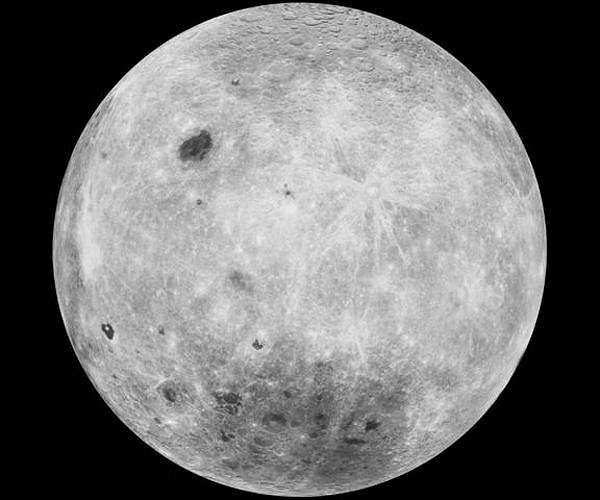
The near side that always faces Earth is dominated by dark flat volcanic plains called maria that create the familiar man in the moon pattern seen with the naked eye. In contrast the far side has a much thicker crust and appears as a rugged heavily cratered highland region with very little sign of large scale lava flooding.

New research published Tuesday in the journal Proceedings of the National Academy of Sciences points to a giant impact early in lunar history as a key driver of this stark dichotomy. A team from the Institute of Geology and Geophysics of the Chinese Academy of Sciences analyzed microscopic samples returned by Chinas Chang'e 6 mission from the moons far side.

Chang'e 6 achieved the first sample return from the lunar far side by landing within the vast South Pole Aitken basin one of the largest known impact structures in the solar system. The mission returned tiny grains weighing only about as much as a few grains of salt yet they preserve detailed chemical records of ancient events in the lunar crust and mantle.

Led by professor Tian Hengci the researchers focused on potassium a moderately volatile element that occurs in multiple isotopes with different atomic masses. During extremely high temperature events such as a giant asteroid impact lighter potassium isotopes tend to evaporate and escape more readily than heavier ones leaving behind material that is enriched in the heavy isotopes.

Laboratory measurements showed that the Chang'e 6 samples from the South Pole Aitken basin are unusually rich in heavy potassium isotopes compared with typical lunar rocks. The team interprets this enrichment as a chemical fingerprint of an enormous impact that generated intense heat capable of driving off lighter isotopes of potassium as well as other volatile elements such as zinc and sulfur.

According to the study this large scale loss of volatile elements fundamentally altered the thermal and chemical evolution of the moons far side. Volatile components help lower the melting point of rocks deep inside a planetary body making it easier for magma to form and rise to the surface to fuel volcanic eruptions.

With fewer volatiles remaining after the South Pole Aitken impact the far side interior stayed comparatively rigid and resistant to melting. As a result it produced far less magma over time than the near side which retained more volatile rich material and continued to generate large volcanic plains well after the impact era.

The findings offer a physically grounded explanation for why the near side developed extensive mare volcanism while the far side remained dominated by ancient highlands. They suggest that violent impacts do more than excavate craters on planetary surfaces and can instead reshape the deep interior by stripping away critical ingredients that control how easily rocks melt.

"The findings suggest that asteroid impacts do more than just leave a dent on the surface; they can fundamentally change the chemistry of a planet's guts," Tian said. He noted that this mechanism may operate not only on the moon but also on other rocky bodies whose histories include giant collisions.

Tian added that other hypotheses for the moons two faced appearance have emphasized tidal effects from Earth or uneven distribution of radioactive elements that heat the interior. While those processes may still play supporting roles the new isotopic evidence from Chang'e 6 highlights the profound influence that a single massive impact can have on the long term evolution of a worlds crust and mantle.

By tying together sample analysis spacecraft exploration and impact physics the study demonstrates how far side materials can illuminate processes that shaped the entire moon. Future missions returning additional samples from different regions of the South Pole Aitken basin and beyond are expected to test how widespread this volatile loss signature is and refine models of the moons early history.

Related Links
Institute of Geology and Geophysics at Chinese Academy of Sciences
Mars News and Information at MarsDaily.com
Lunar Dreams and more

Subscribe Free To Our Daily Newsletters
RELATED CONTENT
MOON DAILY
Sandia centrifuge campaign clears NASA VIPER rover for lunar launch
Los Angeles CA (SPX) Dec 18, 2025
NASA's Volatiles Investigating Polar Exploration Rover, or VIPER, has cleared a major test campaign at Sandia National Laboratories that is intended to show the 1,000-pound lunar rover can withstand the stresses of launch and flight on its way to the Moon's South Pole. "We've built a rover that is designed to go and prospect for water on the moon, but the vehicle must be certified for mission," said Dave Petri, NASA VIPER system integration and test lead. "We need to be sure its structure is prope ... read more

MOON DAILY
NASA announces overhaul of Artemis lunar program amid technical delays

Texas AM partners with Aegis to orbit TAMU SPIRIT research hub on ISS

Regrowing marginal farmland can curb emissions without cutting food output

Chinese visitors to Japan slump as spat rumbles on

MOON DAILY
Prometheus starts work on new Indiana solid rocket motor campus

NASA prepares Artemis II rocket for rollback after upper stage issue

Superconducting thruster cuts power and mass for space propulsion

Lithium trace in upper air linked to Falcon 9 rocket breakup

MOON DAILY
Perseverance rover now self-locates precisely on Mars

Curiosity Blog, Sols 4798-4803: Back for More Science

Mars relay orbiter seen as backbone for future exploration

UAE extends Mars probe mission until 2028

MOON DAILY
Dragon spacecraft gears up for crew 12 arrival and station science work

China prepares offshore test base for reusable liquid rocket launches

Retired EVA workhorse to guide China's next-gen spacesuit and lunar gear

Tiangong science program delivers data surge

MOON DAILY
Infleqtion lists shares on NYSE as neutral atom quantum firm

AAC Clyde Space adds Sedna satellites to boost maritime data services

China tests AI satellite swarm for space-based computing

BlackSky expands Gen 3 Assured deals with new defense customer

MOON DAILY
Dynamic terrain model boosts airborne gamma ray survey accuracy

KSAT prepares Hyperion in orbit relay test for satellite data

India chases 'DeepSeek moment' with homegrown AI models

ST Engineering iDirect and G&S SatCom align network and service management on Intuition

MOON DAILY
Debris disc oddities point to hidden outer planets

Hydrogen sulfide detected in distant gas giant exoplanets for the first time

JWST study links sulfur rich gas giants to core growth in distant HR 8799 system

Survey of 80 near Earth asteroids sharpens view of their origins and risks

MOON DAILY
Simple collapse may build cosmic snowman worlds

Jupiter size refined by new radio mapping

Polar weather on Jupiter and Saturn hints at the planets' interior details

Europa ice delamination may deliver nutrients to hidden ocean


The content herein, unless otherwise known to be public domain, are Copyright 1995-2026 - SpaceDaily.com. All websites are published in Australia and are solely subject to Australian law and governed by Fair Use principals for news reporting and research purposes. AFP, UPI and IANS news wire stories are copyright Agence France-Presse, United Press International and Indo-Asia News Service. ESA news reports are copyright European Space Agency. All NASA sourced material is public domain. Additional copyrights may apply in whole or part to other bona fide parties. All articles labeled "by Staff Writers" include reports supplied to Space Media Network by industry news wires, PR agencies, corporate press officers and the like. Such articles are individually curated and edited by Space Media Network staff on the basis of the report's information value to our industry and professional readership. Advertising does not imply endorsement, agreement or approval of any opinions, statements or information provided by Space Media Network on any Web page published or hosted by Space Media Network. General Data Protection Regulation (GDPR) Statement Our advertisers use various cookies and the like to deliver the best ad banner available at one time. All network advertising suppliers have GDPR policies (Legitimate Interest) that conform with EU regulations for data collection. By using our websites you consent to cookie based advertising. If you do not agree with this then you must stop using the websites from May 25, 2018. Privacy Statement. Additional information can be found here at About Us.
Subscribe Free To Our Daily Newsletters