





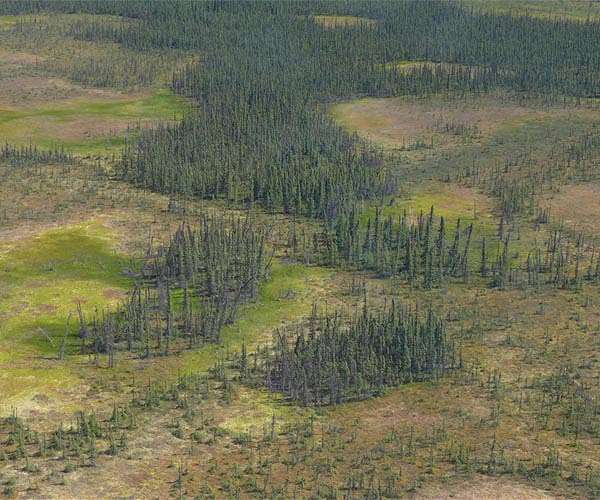
Led by the University of Exeter, the research team examined peatland cores taken from 91 locations across 12 sites in the European and Canadian Arctic. These tube-shaped samples of waterlogged soil allowed the scientists to reconstruct how peatlands have changed position over time. The results indicate that peatland margins have advanced in many places since around 1950, with some edges shifting by more than a meter per year.
By comparing recent peat layers with those laid down over the past two to three centuries, the researchers found that the peatlands in their study now cover a larger area than at any time in at least 200 to 300 years, and possibly longer. The cores show that these ecosystems are actively accumulating new peat, confirming that the expansion is ongoing rather than a relic of past conditions. Because the sampling sites span a broad range of Arctic environments, the authors conclude that similar expansion is likely occurring widely across the region.
Lead author Dr Josie Handley, now at the University of Cambridge, explained that changing Arctic ecology underpins this trend. Warmer conditions have encouraged more plant growth, and certain plant species are particularly effective at forming peat in saturated soils. As these peat-forming plants spread, they help convert surrounding terrain into new peatland, adding to the overall area of carbon-rich wetlands.
Peatlands cover only about 3 percent of Earths surface but store roughly 600 billion tons of carbon, which is more than is held in all of the worlds forest biomass combined. By demonstrating that Arctic peatlands are expanding during the modern warming period, the study suggests that more carbon is being locked into these northern landscapes. However, the authors emphasize that their work tracked the movement of peatland edges rather than measuring the total area of peatlands, so further research is needed to quantify how much land has shifted into this ecosystem type.
Professor Angela Gallego-Sala of the University of Exeter said that the changing footprint of peatlands will reshape the Arctic carbon balance. As peatlands grow and accumulate organic matter, they enhance carbon storage and can help slow the pace of climate change. At the same time, she warned that under more extreme future warming, peatlands could degrade and release stored carbon, turning the current carbon sink into a potential source.
Co-author Dr Katherine Crichton, also from the University of Exeter, noted that industrial interest in the Arctic is rising, with sectors such as shipping and mining targeting new opportunities as sea ice retreats and access improves. She said the confirmation that Arctic peatlands are expanding underscores the increasing importance of these fragile ecosystems. Protecting and valuing them will be crucial as economic activity in the region accelerates.
The study forms part of the Increased Accumulation in Arctic Peatlands (ICAAP) project, funded by the UK Natural Environment Research Council. ICAAP brings together international collaborators from institutions including Queens University Belfast, Universite du Quebec a Montreal and at Trois-Rivieres, the University of Helsinki and the University of Hawaii at Mauna Loa. The project builds on earlier satellite-based work and uses detailed field records to track peat accumulation and landscape change.
Research Report: Pan-Arctic peatlands have expanded during recent warming
Related Links
University of Exeter
Climate Science News - Modeling, Mitigation Adaptation
| Subscribe Free To Our Daily Newsletters |

| Subscribe Free To Our Daily Newsletters |








