24/7 Space News
ROBO SPACE
UN touts panel for 'human control' of AI as leaders weigh message

UN touts panel for 'human control' of AI as leaders weigh message

By Katie Forster
New Delhi (AFP) Feb 20, 2026
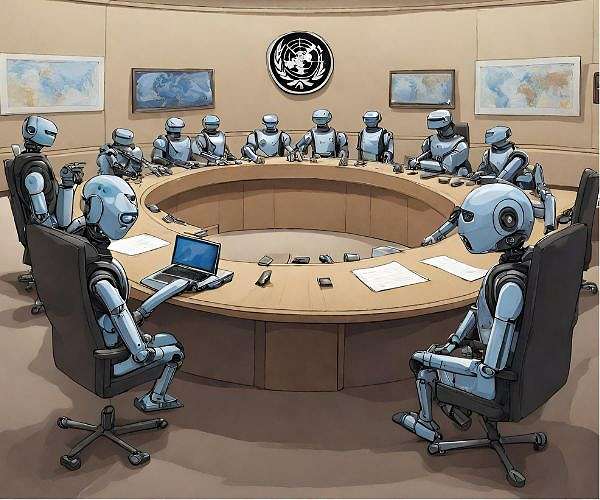
A new UN panel on artificial intelligence aims to "make human control a technical reality", the global body's chief said Friday as leaders at a New Delhi summit weighed their message on the future of the divisive technology.

The flip side of the gold rush surrounding AI is the risk of job disruption, online abuse and the heavy electricity consumption of data centres.

"We are barrelling into the unknown," UN chief Antonio Guterres told the AI Impact Summit in New Delhi, which wraps up later Friday. "The message is simple: Less hype, less fear. More facts and evidence."

The United Nations General Assembly has confirmed 40 members for a new group called the Independent International Scientific Panel on Artificial Intelligence, he said.

The advisory body -- aiming to be to AI what the UN's Intergovernmental Panel on Climate Change (IPCC) is to global warming -- was created in August.

"Science-led governance is not a brake on progress" but can make technological development "safer, fairer, and more widely shared", Guterres said.

"When we understand what systems can do -- and what they cannot -- we can move from rough measures to smarter, risk-based guardrails."

Dozens of world leaders and ministers are expected to deliver on Friday a shared view on the risks and opportunities posed by AI to cap the five-day summit.

It is the fourth annual global meeting focused on AI policy, and the next one will take place in Geneva in the first half of 2027, the Swiss president said on Thursday.

The Delhi gathering is the first AI summit in a developing country, with India taking the opportunity to push its ambitions to catch up with the United States and China.

India expects more than $200 billion in investments over the next two years, and US tech titans unveiled new deals and infrastructure projects this week.

- 'Common good' -

OpenAI's Sam Altman, who leads the company behind ChatGPT, has called for oversight in the past but said last year that taking too tight an approach could hold the United States back in the AI race.

"Centralisation of this technology, in one company or country, could lead to ruin," he said Thursday, one of several top tech CEOs to take the stage.

"This is not to suggest that we won't need any regulation or safeguards. We obviously do, urgently, like we have for other powerful technologies."

But the broad focus of the New Delhi event, and vague promises made at the previous summits in France, South Korea and Britain, could make concrete commitments unlikely.

Even so, "governance of powerful technologies typically begins with shared language: what risks matter, what thresholds are unacceptable", said Niki Iliadis, director of global AI governance at The Future Society.

"It's true that AI companies are influential, but they are not sovereign," she told AFP.

Discussions at the Delhi summit, attended by tens of thousands from across the AI industry, have covered big topics from child protections to the need for more equal access to AI tools worldwide.

"We are entering an era where humans and intelligence systems co-create, co-work and co-evolve," Indian Prime Minister Narendra Modi said on Thursday.

"We must resolve that AI is used for the global common good."

India also formally joined a US-led "Pax Silica" initiative aimed at "about building supply chains that will not be held hostage" at securing AI supply, Jacob Helberg, US Under Secretary of State for Economic Affairs, told the summit.

Related Links
All about the robots on Earth and beyond!

Subscribe Free To Our Daily Newsletters
RELATED CONTENT
ROBO SPACE
Brain learns faster from rare rewards than from repetition
Los Angeles CA (SPX) Feb 20, 2026
More than a century after Pavlov trained dogs to link a bell with food, neuroscientists at the University of California, San Francisco report that the brain may rely more on the timing of rewards than on sheer repetition when forming associative memories of cues and outcomes. Their work suggests that what matters for learning is how far apart cue-reward experiences are spaced in time, rather than how many times those pairings occur in total. The study, led by Vijay Mohan K. Namboodiri, PhD, an ass ... read more

ROBO SPACE
Texas AM partners with Aegis to orbit TAMU SPIRIT research hub on ISS

Sophie Adenot, the second French woman to fly to space

International crew arrives at space station

NASA announces overhaul of Artemis lunar program amid technical delays

ROBO SPACE
Prometheus starts work on new Indiana solid rocket motor campus

NASA prepares Artemis II rocket for rollback after upper stage issue

Superconducting thruster cuts power and mass for space propulsion

Lithium trace in upper air linked to Falcon 9 rocket breakup

ROBO SPACE
Perseverance rover now self-locates precisely on Mars

Curiosity Blog, Sols 4798-4803: Back for More Science

Mars relay orbiter seen as backbone for future exploration

UAE extends Mars probe mission until 2028

ROBO SPACE
Dragon spacecraft gears up for crew 12 arrival and station science work

China prepares offshore test base for reusable liquid rocket launches

Retired EVA workhorse to guide China's next-gen spacesuit and lunar gear

Tiangong science program delivers data surge

ROBO SPACE
Infleqtion lists shares on NYSE as neutral atom quantum firm

AAC Clyde Space adds Sedna satellites to boost maritime data services

China tests AI satellite swarm for space-based computing

BlackSky expands Gen 3 Assured deals with new defense customer

ROBO SPACE
India chases 'DeepSeek moment' with homegrown AI models

Swift observatory changes operations ahead of planned orbit reboost

Pale Blue opens Tsukuba site to scale satellite propulsion production

AST SpaceMobile deploys record low orbit cellular array on BlueBird 6

ROBO SPACE
Cheops spots inside out exoplanet quartet

Study questions assumptions about hidden alien technosignals

Study revisits chances of detecting alien technosignatures

Hydrogen sulfide detected in distant gas giant exoplanets for the first time

ROBO SPACE
Simple collapse may build cosmic snowman worlds

Jupiter size refined by new radio mapping

Polar weather on Jupiter and Saturn hints at the planets' interior details

Europa ice delamination may deliver nutrients to hidden ocean


The content herein, unless otherwise known to be public domain, are Copyright 1995-2026 - SpaceDaily.com. All websites are published in Australia and are solely subject to Australian law and governed by Fair Use principals for news reporting and research purposes. AFP, UPI and IANS news wire stories are copyright Agence France-Presse, United Press International and Indo-Asia News Service. ESA news reports are copyright European Space Agency. All NASA sourced material is public domain. Additional copyrights may apply in whole or part to other bona fide parties. All articles labeled "by Staff Writers" include reports supplied to Space Media Network by industry news wires, PR agencies, corporate press officers and the like. Such articles are individually curated and edited by Space Media Network staff on the basis of the report's information value to our industry and professional readership. Advertising does not imply endorsement, agreement or approval of any opinions, statements or information provided by Space Media Network on any Web page published or hosted by Space Media Network. General Data Protection Regulation (GDPR) Statement Our advertisers use various cookies and the like to deliver the best ad banner available at one time. All network advertising suppliers have GDPR policies (Legitimate Interest) that conform with EU regulations for data collection. By using our websites you consent to cookie based advertising. If you do not agree with this then you must stop using the websites from May 25, 2018. Privacy Statement. Additional information can be found here at About Us.
Subscribe Free To Our Daily Newsletters