24/7 Space News
STELLAR CHEMISTRY
Photonic neurons push ultra-fast trading beyond electronic limits
illustration only

Photonic neurons push ultra-fast trading beyond electronic limits

by Riko Seibo
Tokyo, Japan (SPX) Feb 13, 2026

In high frequency stock trading, the fastest systems typically capture the greatest advantage, putting a premium on shaving every possible fraction of a second from end to end latency. For years, the most advanced platforms have relied on FPGA based electronic processors to minimize delay, but these architectures are now running into hard limits set by clock speeds, data conversion overhead, and the physical routing of electronic signals. Even with aggressive optimization, pushing latencies lower with conventional electronics has become increasingly difficult.

A research team reporting in the journal eLight has now demonstrated a photonic neuromorphic computing architecture that shifts the core processing into the optical domain. Instead of handling information in discrete clocked steps, the new design performs weighted summation and nonlinear activation directly on optical signals as they propagate, letting data flow and be processed at the speed of light within the device.

The work targets a long standing scalability problem in photonic processing. Many earlier approaches, including those built around Mach Zehnder interferometers, demand large optical footprints that limit how many functional units can be integrated into a single chip. More compact schemes based on microring resonators raised the prospect of higher integration density, but they have been constrained by severe spectral alignment requirements that grow harder to manage as system scale increases.

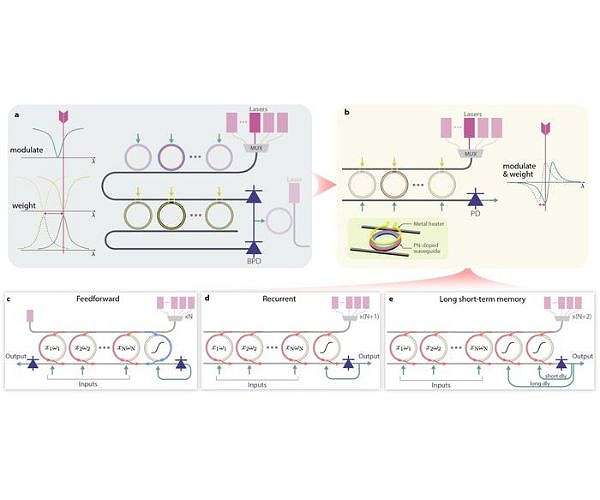
The new architecture tackles these bottlenecks by unifying optical modulation and synaptic weighting inside a single microring resonator. In previous microring based neurons, separate elements handled data encoding and weight control, multiplying the number of components that had to stay precisely aligned in wavelength. Consolidating both roles within each resonator sharply reduces the alignment burden and helps remove a key barrier to scaling up the number of photonic neurons on a chip.

Compactness is only part of the story. By adding straightforward electrical feedback paths, the same photonic neuron can be reconfigured to exhibit different kinds of temporal behavior. In one mode it operates as a feedforward unit, processing inputs without memory. In others it gains short term or combined short and long term memory, enabling it to respond not just to the latest input but also to patterns unfolding over time.

This temporal flexibility is especially important for real world time series problems such as financial market data, where both recent and historical information influence decision making. The researchers built a proof of concept system that applied a single scalable photonic neuron to high frequency trading style tasks, feeding it streams of stock price data and evaluating its performance on representative symbols.

Across multiple test cases, the photonic neuron generated generally positive cumulative gains, indicating that even a single reconfigurable optical neuron can extract useful trading signals under realistic conditions. The team explored several operating modes, beginning with purely feedforward processing and then adding feedback paths that supplied short term history, longer term context, or both to the neuron input.

In these experiments, including temporal memory consistently improved performance and stability, reducing volatility in the cumulative return curves and making the trading behavior more robust. The results offered concrete insight into how different memory configurations can help a single neuromorphic photonic element adapt to varied temporal dynamics in incoming data.

Crucially, the processing latency of the photonic neuron remains on the order of tens of picoseconds, far below the nanosecond scale latencies associated with state of the art FPGA based electronic trading platforms. Because the computation occurs directly in the optical field, the device inherently avoids the clocking and conversion delays that electronic systems must contend with, and it can in principle be scaled to higher levels of parallelism without incurring the same routing penalties.

Beyond the specific application to high frequency trading, the authors see the design as a building block for larger neuromorphic photonic systems able to handle complex, data intensive workloads. By addressing footprint, spectral alignment, and functional integration in a single compact device, the architecture opens a route to assembling many such neurons into large scale photonic neural networks.

The neuron concept is also compatible with established photonic integration processes, making it easier to envision practical chips that incorporate arrays of these elements alongside lasers, detectors, and control electronics. As integration grows, such systems could extend the core advantages of photonic computing ultra low latency, massive parallelism, and high energy efficiency into a widening range of industrial and scientific applications.

Potential targets include real time signal processing, advanced optical communications, and adaptive control systems that must react on extremely short timescales. In these domains, the ability to process data in flight as light propagates through reconfigurable photonic neurons could enable responses that lie well beyond the reach of conventional electronics.

Research Report: Compact, reconfigurable, and scalable photonic neurons by modulation-and-weighting microring resonators

Related Links
Changchun Institute of Optics, Fine Mechanics and Physics, CAS
Stellar Chemistry, The Universe And All Within It

Subscribe Free To Our Daily Newsletters
Tweet

RELATED CONTENT
The following news reports may link to other Space Media Network websites.
STELLAR CHEMISTRY
Shaping quantum light expands options for future technologies
Berlin, Germany (SPX) Dec 12, 2025
Researchers from the School of Physics at the University of the Witwatersrand, working with collaborators at the Universitat Autonoma de Barcelona, report that controlling the structure of photons in space and time allows quantum states to be tailored for use in communication, sensing and imaging. The team focuses on structured photons, where spatial, temporal or spectral properties are deliberately shaped to encode information and support advanced quantum protocols. Their work, presented as a rev ... read more

STELLAR CHEMISTRY
Crew 12 set for Dragon launch to Station in February

Bezos's Blue Origin to 'pause' space tourism to focus on Moon efforts

NASA Heat Shield Technology Enables Space Industry Growth

Earliest launch window to ISS set for February 11: NASA

STELLAR CHEMISTRY
NASA books fifth Axiom private astronaut flight to space station

NASA Moon mission launch srubbed to March after test

SpaceX grounds Falcon 9 missions, could impact ISS launch

Musk merges xAI into SpaceX in bid to build space data centers

STELLAR CHEMISTRY
Martian toxin found to toughen microbe built bricks

Perseverance rover completes landmark AI guided trek across Jezero rim

New clues to Mars habitability in discovery of ancient beach

Ancient deltas reveal vast Martian ocean across northern hemisphere

STELLAR CHEMISTRY
Dragon spacecraft gears up for crew 12 arrival and station science work

China prepares offshore test base for reusable liquid rocket launches

Retired EVA workhorse to guide China's next-gen spacesuit and lunar gear

Tiangong science program delivers data surge

STELLAR CHEMISTRY
ESA member states back SWISSto12 HummingSat with fresh funding round

Aerospacelab expands Pulsar navigation constellation work with new Xona satellite order

ThinkOrbital raises seed funding to advance orbital defense and construction systems

China outlines mega constellations in ITU satellite filings

STELLAR CHEMISTRY
Latam-GPT: a Latin American AI to combat US-centric bias

UAE's G42 says joining $1 bn AI project in Vietnam

EU nations back chemical recycling for plastic bottles

Amazonian fish skin biofilm tested as greener food packaging option

STELLAR CHEMISTRY
Survey of 80 near Earth asteroids sharpens view of their origins and risks

Lab made cosmic dust experiment reveals paths to life chemistry

Einstein effect clears planets from tight double star systems

Icy cycles may have driven early protocell evolution

STELLAR CHEMISTRY
Jupiter size refined by new radio mapping

Polar weather on Jupiter and Saturn hints at the planets' interior details

Europa ice delamination may deliver nutrients to hidden ocean

Birth conditions fixed water contrast on Jupiters moons

Subscribe Free To Our Daily Newsletters


The content herein, unless otherwise known to be public domain, are Copyright 1995-2024 - Space Media Network. All websites are published in Australia and are solely subject to Australian law and governed by Fair Use principals for news reporting and research purposes. AFP, UPI and IANS news wire stories are copyright Agence France-Presse, United Press International and Indo-Asia News Service. ESA news reports are copyright European Space Agency. All NASA sourced material is public domain. Additional copyrights may apply in whole or part to other bona fide parties. All articles labeled "by Staff Writers" include reports supplied to Space Media Network by industry news wires, PR agencies, corporate press officers and the like. Such articles are individually curated and edited by Space Media Network staff on the basis of the report's information value to our industry and professional readership. Advertising does not imply endorsement, agreement or approval of any opinions, statements or information provided by Space Media Network on any Web page published or hosted by Space Media Network. General Data Protection Regulation (GDPR) Statement Our advertisers use various cookies and the like to deliver the best ad banner available at one time. All network advertising suppliers have GDPR policies (Legitimate Interest) that conform with EU regulations for data collection. By using our websites you consent to cookie based advertising. If you do not agree with this then you must stop using the websites from May 25, 2018. Privacy Statement. Additional information can be found here at About Us.