24/7 Space News
STELLAR CHEMISTRY
JUNO VR system brings detector events into immersive 3D space
illustration only

JUNO VR system brings detector events into immersive 3D space

by Riko Seibo
Tokyo, Japan (SPX) Feb 17, 2026
Researchers working on the Jiangmen Underground Neutrino Observatory (JUNO) experiment have developed a Unity-based virtual reality system that immersively visualizes detector geometry and event information. The new framework is designed to overcome the limitations of traditional visualization tools and provide a three-dimensional, interactive view of complex neutrino detector data.

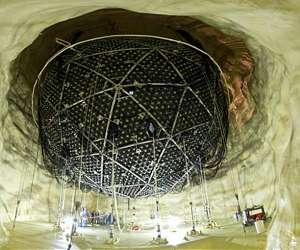
The VR application is tightly aligned with the JUNO detector's geometric descriptions and event records generated by offline software. It preserves high-precision details for tens of thousands of photomultiplier tubes while converting offline data into interactive scenes that users can explore from multiple perspectives. This panoramic access to detector structures and physics events is intended to refine simulations, improve reconstruction algorithms, and support more detailed physics analysis.

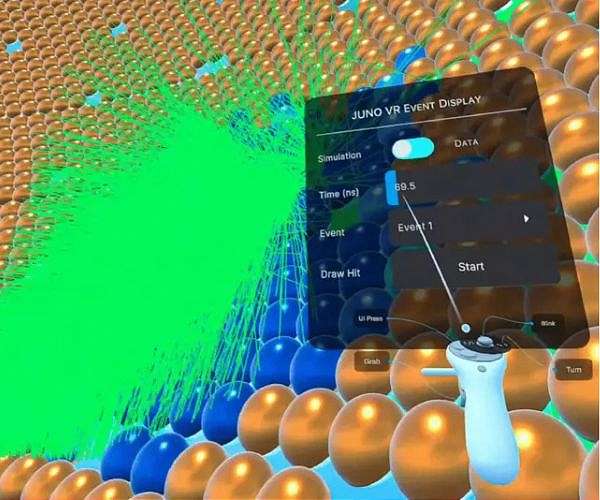
A key component of the system is a spatial user interface optimized for head-mounted displays such as the Meta Quest 3. The interface integrates a sub-detector geometry control panel and an event display control panel, allowing researchers to toggle detector components, filter event types, and adjust visualization parameters directly within the virtual environment. Handheld controllers support free roaming inside the detector model so users can inspect internal structures and event features at close range.

The visualization engine renders photomultiplier tube hit information using a color gradient from light blue to dark blue to represent hit multiplicity. A high-performance particle system simulates photon propagation paths in real time, providing an intuitive view of how light generated by interactions travels through the detector. Different interaction classes are displayed with tailored modes to highlight their characteristic signatures.

For inverse beta decay events, the system clearly presents the temporal correlation between positron and neutron signals, including the characteristic delay of about 170 microseconds between the prompt and delayed components. In high-energy cosmic muon events, the VR display reconstructs muon tracks crossing the detector volume and the associated energy deposition patterns. Users can replay these event evolutions at nanosecond-level increments, enabling close inspection of timing structures and spatial correlations that might be difficult to perceive in conventional displays.

The research team, led by Yu-Mei Zhang and Zheng-Yun You, views the immersive platform as a tool for both detector operation and frontier neutrino physics studies. They are applying the system to key operational phases, such as detailed analyses of neutrino signal events and searches for rare signatures that may reveal new phenomena. The ability to navigate within a full-scale virtual detector is expected to assist in identifying subtle patterns and anomalies in large, complex datasets.

According to Professor Zheng-Yun You of Sun Yat-sen University, VR offers physicists an analysis environment that simulates being inside the detector. Through the VR interface, researchers can reconstruct an event in three-dimensional space, move through the scene, and examine features from multiple angles to uncover structures that might otherwise be overlooked. The team anticipates that immersive visualization approaches like this one could be extended to other large-scale scientific facilities that face similar challenges in understanding intricate geometries and rich event information.

The full study, titled "Unity-based virtual reality for detector and event visualization in JUNO experiment," appears in the journal Nuclear Science and Techniques and is accessible via DOI 10.1007/s41365-026-01900-x.

Research Report: Unity-based virtual reality for detector and event visualization in JUNO experiment

Related Links
Nuclear Science and Techniques - SINAP
Jiangmen Underground Neutrino Observatory
Stellar Chemistry, The Universe And All Within It

Subscribe Free To Our Daily Newsletters
RELATED CONTENT
STELLAR CHEMISTRY
Solar ghost particles seen flipping carbon atoms in underground detector
Berlin, Germany (SPX) Dec 11, 2025
Scientists have recorded solar neutrinos changing carbon-13 into nitrogen-13 inside the SNO+ detector in Canada, marking the first observation of this specific interaction between neutrinos and carbon nuclei. Neutrinos, sometimes called ghost particles, rarely interact with matter even though trillions pass through every person each second, and they are produced in nuclear reactions such as those in the Sun's core. Detecting them is difficult because most traverse detectors without leaving any sig ... read more

STELLAR CHEMISTRY
Texas AM partners with Aegis to orbit TAMU SPIRIT research hub on ISS

Sophie Adenot, the second French woman to fly to space

International crew arrives at space station

NASA announces overhaul of Artemis lunar program amid technical delays

STELLAR CHEMISTRY
Prometheus starts work on new Indiana solid rocket motor campus

NASA prepares Artemis II rocket for rollback after upper stage issue

Superconducting thruster cuts power and mass for space propulsion

Lithium trace in upper air linked to Falcon 9 rocket breakup

STELLAR CHEMISTRY
Perseverance rover now self-locates precisely on Mars

Curiosity Blog, Sols 4798-4803: Back for More Science

Mars relay orbiter seen as backbone for future exploration

UAE extends Mars probe mission until 2028

STELLAR CHEMISTRY
Dragon spacecraft gears up for crew 12 arrival and station science work

China prepares offshore test base for reusable liquid rocket launches

Retired EVA workhorse to guide China's next-gen spacesuit and lunar gear

Tiangong science program delivers data surge

STELLAR CHEMISTRY
Infleqtion lists shares on NYSE as neutral atom quantum firm

AAC Clyde Space adds Sedna satellites to boost maritime data services

China tests AI satellite swarm for space-based computing

BlackSky expands Gen 3 Assured deals with new defense customer

STELLAR CHEMISTRY
India chases 'DeepSeek moment' with homegrown AI models

Swift observatory changes operations ahead of planned orbit reboost

Pale Blue opens Tsukuba site to scale satellite propulsion production

AST SpaceMobile deploys record low orbit cellular array on BlueBird 6

STELLAR CHEMISTRY
Cheops spots inside out exoplanet quartet

Study questions assumptions about hidden alien technosignals

Study revisits chances of detecting alien technosignatures

Hydrogen sulfide detected in distant gas giant exoplanets for the first time

STELLAR CHEMISTRY
Simple collapse may build cosmic snowman worlds

Jupiter size refined by new radio mapping

Polar weather on Jupiter and Saturn hints at the planets' interior details

Europa ice delamination may deliver nutrients to hidden ocean


The content herein, unless otherwise known to be public domain, are Copyright 1995-2026 - SpaceDaily.com. All websites are published in Australia and are solely subject to Australian law and governed by Fair Use principals for news reporting and research purposes. AFP, UPI and IANS news wire stories are copyright Agence France-Presse, United Press International and Indo-Asia News Service. ESA news reports are copyright European Space Agency. All NASA sourced material is public domain. Additional copyrights may apply in whole or part to other bona fide parties. All articles labeled "by Staff Writers" include reports supplied to Space Media Network by industry news wires, PR agencies, corporate press officers and the like. Such articles are individually curated and edited by Space Media Network staff on the basis of the report's information value to our industry and professional readership. Advertising does not imply endorsement, agreement or approval of any opinions, statements or information provided by Space Media Network on any Web page published or hosted by Space Media Network. General Data Protection Regulation (GDPR) Statement Our advertisers use various cookies and the like to deliver the best ad banner available at one time. All network advertising suppliers have GDPR policies (Legitimate Interest) that conform with EU regulations for data collection. By using our websites you consent to cookie based advertising. If you do not agree with this then you must stop using the websites from May 25, 2018. Privacy Statement. Additional information can be found here at About Us.
Subscribe Free To Our Daily Newsletters