24/7 Space News
CLIMATE SCIENCE
'Unprecedented' emissions maps will hone mitigation
illustration only

'Unprecedented' emissions maps will hone mitigation

by Caitlin Hayes, Cornell Chronicle
Ithaca, NY (SPX) Feb 16, 2026

To lower agricultural emissions, policymakers and communities first need to pinpoint the sources. Not just by country but crop by crop, field by field. In other words, they need maps. Detailed maps.

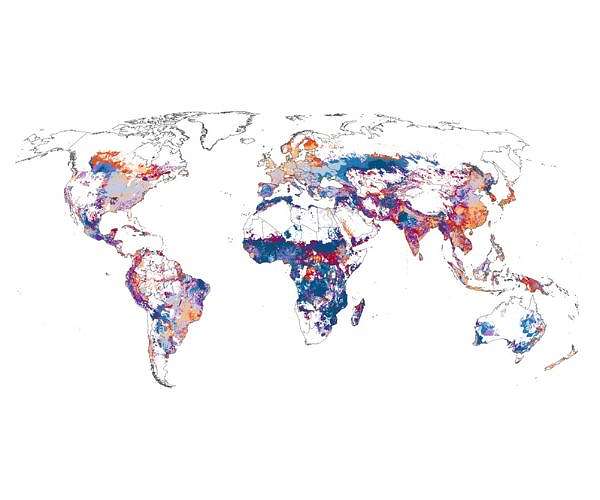
In a study published Feb. 13 in Nature Climate Change, researchers have synthesized data from multiple ground sources and models to map global cropland emissions at high resolution - down to about 10 kilometers - while breaking down emissions by crop and source and identifying regions for more precise mitigation.

"This is an absolute global synthesis of all the information you need, by country, by production system, for calculating greenhouse gas emissions - it's been a significant undertaking," said senior author Mario Herrero, the Nancy and Peter Meinig Family Investigator in the Life Sciences and professor in the Ashley School of Global Development and the Environment, part of the College of Agriculture and Life Sciences (CALS). "This enormous update will now be used by all sorts of groups for targeting and understanding much better the emissions sources and developing precision mitigation strategies to address them."

Croplands constitute 12% of land use globally and account for 25% of greenhouse gas emissions within the agricultural sector. But the last effort to actually map global cropland emissions dates to 2000. Since then, the sector has grown, management practices have changed, and researchers have many more tools to model complex systems.

The new and improved maps incorporate historical data and models, ground and remote sensing, inventory surveys, hydrological information and more. With this integrated data set, the researchers calculated that croplands emitted the greenhouse gas equivalent of 2.5 gigatons of carbon dioxide in 2020, with East Asia and Pacific contributing about half of the total, followed by South Asia, Europe and Central Asia, which collectively contributed 30%.

The data captured emissions across 46 crop classes, but four crops - rice, maize, oil palm and wheat - accounted for nearly three-quarters of cropland emissions, with rice leading at 43%. The source of the emissions differed depending on the crop; the main culprits were drained peatlands for palm oil production (35%), flooded rice paddies (35%) and synthetic fertilizer used in high-production areas (23%).

The researchers said the data highlights the need to tailor mitigation strategies depending on the crop and emissions source, writing that controlled rewetting of peatlands, shifts in the management of flooded rice paddies and optimized fertilizer use could significantly reduce emissions in their respective regions and contexts.

And the biggest hotspots are in Asia, Herrero said.

"It's all about rice. That's where the biggest sources and the biggest opportunities are," said Herrero, also a senior faculty fellow and scholar with the Cornell Atkinson Center for Sustainability. "Some of the more nutritious foods, fruits and vegetables, have way lower footprints. I was surprised by the importance of peatland areas, too, which was much larger than expected."

The data underscored a correlation between high food production and emissions: Regions that produce a lot of food were often high emitters, and the authors argue that mitigation planning should take productivity into account.

"A lot of studies find the regional hotspot and then say that we need to target this region for mitigation, but we think that may be unfair without considering the production side," said first author and postdoctoral researcher Peiyu Cao. "One of the innovations of this paper is that we link the food production to the emissions to show how efficient the production system is."

The data points to regions that could improve efficiency, even if they have low emissions: Some regions in Africa, for example, have low emissions but also low food production.

"We should be applying different strategies - for African countries, we may ask them to improve their productivity while keeping their emissions low," Cao said. "In Asia, we may want them to keep their high productivity but focus on emission reduction."

Cao said the strategies for improving efficiency already exist: Many developed countries succeed in keeping emissions low and productivity high. "The challenge is to overcome the barriers for adopting these techniques in regions with low efficiency," he said.

Herrero said the maps will ultimately allow countries and communities to address emissions at a hyper-local level.

"It's really local people who have to act," he said. "What's unprecedented here is that these maps provide really a crucial subnational analysis on where you have mitigation opportunities, which is important: Funds for mitigation are scarce, and we need to prioritize."

Research Report: Spatially explicit global assessment of cropland greenhouse gas emissions circa 2020

Related Links
Cornell University
Climate Science News - Modeling, Mitigation Adaptation

Subscribe Free To Our Daily Newsletters
Tweet

RELATED CONTENT
The following news reports may link to other Space Media Network websites.
CLIMATE SCIENCE
UN expert slams harsh sanctions on climate activists in Norway
Geneva (AFP) Feb 2, 2026
A UN expert took Norway to task Monday over "punitive and repressive" sanctions slapped on four activists who threw paint on sculptures and a government ministry to protest oil exploration. Michel Forst, the UN special rapporteur on environmental defenders, described as "highly troubling" the Norwegian supreme court rulings in December, which handed the protesters prison time and steep fines. Forst is an independent expert appointed to monitor compliance with the UN's Aarhus Convention, which pr ... read more

CLIMATE SCIENCE
International crew takes off for space station

NASA confirms first flight to ISS since medical evacuation

The coming end of ISS, symbol of an era of global cooperation

Crew 12 set for Dragon launch to Station in February

CLIMATE SCIENCE
Latvian startup advances nuclear-fueled power for satellites and future Moon missions

SpaceX shifts focus from Mars to Moon, Musk says

NASA books fifth Axiom private astronaut flight to space station

NASA Moon mission launch srubbed to March after test

CLIMATE SCIENCE
Curiosity Blog, Sols 4788-4797: Welcome Back from Conjunction

NASA Study: Non-biologic Processes Don't Fully Explain Mars Organics

Martian toxin found to toughen microbe built bricks

Perseverance rover completes landmark AI guided trek across Jezero rim

CLIMATE SCIENCE
Dragon spacecraft gears up for crew 12 arrival and station science work

China prepares offshore test base for reusable liquid rocket launches

Retired EVA workhorse to guide China's next-gen spacesuit and lunar gear

Tiangong science program delivers data surge

CLIMATE SCIENCE
BlackSky expands Gen 3 Assured deals with new defense customer

Muon Space ramps up multi-mission satellite constellations

ESA member states back SWISSto12 HummingSat with fresh funding round

Aerospacelab expands Pulsar navigation constellation work with new Xona satellite order

CLIMATE SCIENCE
SoftBank rides AI boom to post $1.6 billion net profit

Light based computing module aims to cut AI power demand

Latam-GPT: a Latin American AI to combat US-centric bias

UAE's G42 says joining $1 bn AI project in Vietnam

CLIMATE SCIENCE
Survey of 80 near Earth asteroids sharpens view of their origins and risks

Lab made cosmic dust experiment reveals paths to life chemistry

Einstein effect clears planets from tight double star systems

Icy cycles may have driven early protocell evolution

CLIMATE SCIENCE
Jupiter size refined by new radio mapping

Polar weather on Jupiter and Saturn hints at the planets' interior details

Europa ice delamination may deliver nutrients to hidden ocean

Birth conditions fixed water contrast on Jupiters moons

Subscribe Free To Our Daily Newsletters


The content herein, unless otherwise known to be public domain, are Copyright 1995-2024 - Space Media Network. All websites are published in Australia and are solely subject to Australian law and governed by Fair Use principals for news reporting and research purposes. AFP, UPI and IANS news wire stories are copyright Agence France-Presse, United Press International and Indo-Asia News Service. ESA news reports are copyright European Space Agency. All NASA sourced material is public domain. Additional copyrights may apply in whole or part to other bona fide parties. All articles labeled "by Staff Writers" include reports supplied to Space Media Network by industry news wires, PR agencies, corporate press officers and the like. Such articles are individually curated and edited by Space Media Network staff on the basis of the report's information value to our industry and professional readership. Advertising does not imply endorsement, agreement or approval of any opinions, statements or information provided by Space Media Network on any Web page published or hosted by Space Media Network. General Data Protection Regulation (GDPR) Statement Our advertisers use various cookies and the like to deliver the best ad banner available at one time. All network advertising suppliers have GDPR policies (Legitimate Interest) that conform with EU regulations for data collection. By using our websites you consent to cookie based advertising. If you do not agree with this then you must stop using the websites from May 25, 2018. Privacy Statement. Additional information can be found here at About Us.