24/7 Space News
SOLAR DAILY
Tethered orbital data centers aim to power AI with solar energy
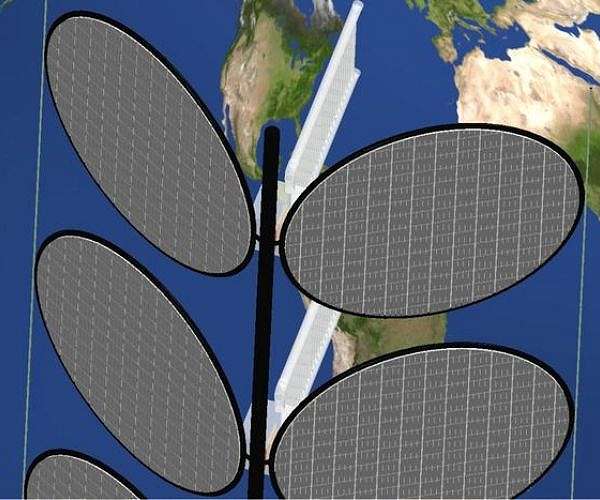
illustration only

Tethered orbital data centers aim to power AI with solar energy

by Clarence Oxford
Los Angeles CA (SPX) Jan 30, 2026
Penn Engineers have proposed a solar-powered orbital data center architecture that could scale to meet growing demand for artificial intelligence computing without drawing electricity from terrestrial grids. The concept uses flexible, tether-based structures in orbit to host thousands of computing nodes for AI inference, relying on established space tether technology rather than massive rigid platforms or vast constellations of independent satellites.

The design resembles a leafy plant, with multiple stems holding computing hardware and branching, leaf-like solar panels. Each stem is effectively a long tether populated with identical nodes that carry computer chips, solar power systems and cooling hardware, forming a modular chain that can be extended by adding more nodes.

Tethers in orbit experience competing forces from Earth's gravity and the centrifugal effect of orbital motion, which naturally pull them taut and align them vertically with one end toward Earth and the other toward space. By distributing computing nodes along these tethers, the system can maintain a stable orientation while supporting many interconnected modules in a single structure.

The architecture is optimized for passive orientation rather than active pointing systems. Solar panels are slightly angled, and the gentle but continuous pressure of sunlight acts like wind on a weather vane, helping keep the panels and computing hardware oriented correctly without relying on motors or thrusters.

According to the researchers, a single tethered structure could extend for several or even tens of kilometers in orbit. Simulations indicate that such a system could host thousands of computing nodes and support up to 20 megawatts of computing power, comparable to a medium-sized terrestrial data center used for AI inference.

Data processed by these orbital data centers would be transmitted to and from Earth using laser-based optical links, a technology already employed in satellite communications. While the latency and throughput requirements for AI training make full training in orbit impractical, the team notes that future growth in AI usage will largely come from running already-trained models, a role that fits the proposed system.

The researchers position their approach as a middle ground between unscalable satellite constellations and impractically large rigid structures. Constellations of many small satellites would require millions of independent spacecraft to match large terrestrial data centers, while enormous assembled platforms exceed current manufacturing and deployment capabilities.

By contrast, the tether-based architecture makes use of decades of research and in-space testing of tethers. The use of repeated, modular nodes allows incremental scaling, similar to adding beads to a necklace, without fundamentally changing the structural concept as capacity increases.

The team also investigated how micrometeoroid and orbital debris impacts would affect such a large orbital system. Using computer simulations, they examined the cumulative effects of many impacts instead of focusing on isolated collisions with individual components.

Results suggest that the tethered structure is naturally resilient to these impacts. A strike may cause a brief wobble or rotation, but the disturbance travels along the tether and gradually dissipates, a behavior the researchers compare to the way motion dies down in a wind chime after it is disturbed.

In a wide range of simulated scenarios, the system deviated from its optimal orientation by only a few degrees, remaining within acceptable limits for solar power collection and stable operations. The design also includes multiple tethers supporting each node, so that if one tether is severed by an impact, the node and the larger structure can continue functioning.

Managing heat in space poses a separate challenge, because orbital systems can only reject heat by radiating it away. The design incorporates radiators to shed waste heat from sustained computing loads, and the researchers plan to refine these radiators to make them lighter and more durable.

The next step is to move beyond simulations and develop a small-scale prototype with a limited number of nodes to validate the tether-based orientation, power and thermal concepts. The team emphasizes that the dominant growth in AI usage is coming from repeated inference rather than from training new models, and they argue that offloading this inference to orbit could reduce the environmental burden of data centers on Earth.

The work, conducted at the University of Pennsylvania School of Engineering and Applied Science, highlights how existing space technologies could be adapted to support emerging AI workloads. By placing modular, solar-powered data centers in orbit, the researchers aim to create a path for scaling AI computing while easing demands on terrestrial electricity and water resources.

Research Report:Tether-Based Architecture for Solar-Powered Orbital Data Center

Related Links
University of Pennsylvania School of Engineering and Applied Science
All About Solar Energy at SolarDaily.com

Subscribe Free To Our Daily Newsletters
Tweet

RELATED CONTENT
SOLAR DAILY
Physicists predict significant growth for cadmium telluride photovoltaics
Toledo OH (SPX) Jan 30, 2026
A solar energy generation technology once considered limited in its potential is poised for significant growth in the United States. That's the conclusion of a team of scientists who analyzed the outlook for cadmium telluride photovoltaics in research published in the peer-reviewed journal Joule. University of Toledo physicists including Dr. Michael Heben, a Distinguished University Professor and McMaster Chair and Director of the Wright Center for Photovoltaics Innovation and Commercializat ... read more

SOLAR DAILY
The coming end of ISS, symbol of an era of global cooperation

Bezos's Blue Origin to 'pause' space tourism to focus on Moon efforts

NASA confirms first flight to ISS since medical evacuation

Crew 12 set for Dragon launch to Station in February

SOLAR DAILY
Isar Aerospace expands engine and stage testing at Esrange

NASA Moon mission launch srubbed to March after test

NASA delays Moon mission over frigid weather

China sea launch boosts private rocket activity in 2026

SOLAR DAILY
Martian toxin found to toughen microbe built bricks

Curiosity Blog, Sols 4788-4797: Welcome Back from Conjunction

NASA Study: Non-biologic Processes Don't Fully Explain Mars Organics

Perseverance rover completes landmark AI guided trek across Jezero rim

SOLAR DAILY
Dragon spacecraft gears up for crew 12 arrival and station science work

China prepares offshore test base for reusable liquid rocket launches

Retired EVA workhorse to guide China's next-gen spacesuit and lunar gear

Tiangong science program delivers data surge

SOLAR DAILY
BlackSky expands Gen 3 Assured deals with new defense customer

ESA member states back SWISSto12 HummingSat with fresh funding round

Muon Space ramps up multi-mission satellite constellations

Aerospacelab expands Pulsar navigation constellation work with new Xona satellite order

SOLAR DAILY
Launching the idea of data centers in space

Gilat books multimillion order for Sidewinder inflight ESA terminals

Anthropic unveils new AI model as OpenAI rivalry heats up

NTU Singapore boosts agile space access with trio of new projects

SOLAR DAILY
Survey of 80 near Earth asteroids sharpens view of their origins and risks

Lab made cosmic dust experiment reveals paths to life chemistry

Einstein effect clears planets from tight double star systems

Engineered microbes use light to build new molecules

SOLAR DAILY
Jupiter size refined by new radio mapping

Polar weather on Jupiter and Saturn hints at the planets' interior details

Europa ice delamination may deliver nutrients to hidden ocean

Birth conditions fixed water contrast on Jupiters moons


The content herein, unless otherwise known to be public domain, are Copyright 1995-2026 - SpaceDaily.com. All websites are published in Australia and are solely subject to Australian law and governed by Fair Use principals for news reporting and research purposes. AFP, UPI and IANS news wire stories are copyright Agence France-Presse, United Press International and Indo-Asia News Service. ESA news reports are copyright European Space Agency. All NASA sourced material is public domain. Additional copyrights may apply in whole or part to other bona fide parties. All articles labeled "by Staff Writers" include reports supplied to Space Media Network by industry news wires, PR agencies, corporate press officers and the like. Such articles are individually curated and edited by Space Media Network staff on the basis of the report's information value to our industry and professional readership. Advertising does not imply endorsement, agreement or approval of any opinions, statements or information provided by Space Media Network on any Web page published or hosted by Space Media Network. General Data Protection Regulation (GDPR) Statement Our advertisers use various cookies and the like to deliver the best ad banner available at one time. All network advertising suppliers have GDPR policies (Legitimate Interest) that conform with EU regulations for data collection. By using our websites you consent to cookie based advertising. If you do not agree with this then you must stop using the websites from May 25, 2018. Privacy Statement. Additional information can be found here at About Us.
Subscribe Free To Our Daily Newsletters