24/7 Space News
ROCKET SCIENCE
NASA Moon mission launch srubbed to March after test

NASA Moon mission launch srubbed to March after test

By Charlotte Causit and Maggy Donaldson in New York
Washington, United States (AFP) Feb 3, 2026

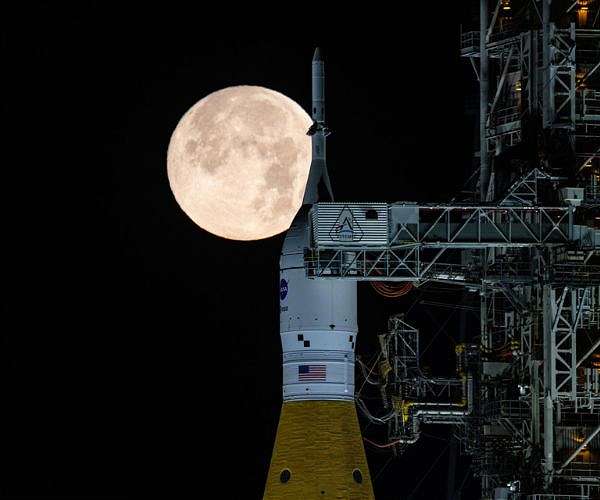
NASA said Tuesday it's delaying until March the launch of its first crewed flyby mission to the Moon in more than 50 years, after encountering leaks during final tests.

The mishaps during a run-through that the US space agency calls a "wet dress rehearsal" dashed hopes that the mission around the Moon could launch as soon as Sunday. The next possible launch window now opens March 6.

The two-day test included filling the Space Launch System rocket with propellants, liquid hydrogen and liquid oxygen.

Teams were initially able to work through some of the hydrogen leaks they encountered, but ultimately the leak worsened as the simulated countdown reached about T-5 minutes, NASA Administrator Jared Isaacman said in a statement.

Operations were stopped, Isaacman said, adding that "we will only launch when we believe we are as ready to undertake this historic mission."

Hydrogen is particularly energetic, tiny, and difficult to contain, NASA officials told a Tuesday briefing.

Along with leakages teams had to troubleshoot a valve issue related to hatch pressurization, in addition to dropouts of audio communications, NASA said.

The latest leaks mirror issues that delayed for months the Artemis 1 launch, which was an uncrewed test mission that ultimately circled the Moon in 2022.

John Honeycutt, head of the Artemis 2 Mission Management Team, said scientists had been "aggressive" in their testing to understand the Artemis 1 leaks.

But "on the ground, we're pretty limited as to how much realism we can put into the test. We try to test like we fly, but this interface is a very complex interface. This one caught us off guard," he continued.

"To me, the big takeaway was we got a chance for the rocket to talk to us, and it did just that," Honeycutt said.

- Moon rush -

Mission managers said they are analyzing the data collected and making necessary repairs ahead of plans to run another dress rehearsal.

For now, officials said those fixes can be performed at the Florida launchpad.

The eventual Artemis 2 moonshot will send a team of four astronauts on a flyby of Earth's satellite.

That approximately 10-day mission will lay the groundwork for NASA's next planned Artemis phase, when a crewed mission is intended to actually land on the Moon.

US President Donald Trump has made evident that he wants to send astronauts back to the Moon as soon as possible, in order to "assert American leadership in space."

The Artemis 2 astronauts had been in quarantine in Houston, but were released following the delay.

"Immense pride seeing the rocket reach 100% fuel load last night, especially knowing how challenging the scenario was for our launch team doing the dangerous and unforgiving work," said team commander Reid Wiseman on X.

"The crew just shared a peaceful breakfast with our families and we jump back into training tomorrow to start our preps for a March launch to the Moon."

Related Links
Rocket Science News at Space-Travel.Com

Subscribe Free To Our Daily Newsletters
Tweet

RELATED CONTENT
The following news reports may link to other Space Media Network websites.
ROCKET SCIENCE
Autophage rocket concept wins EU prize for debris free launch technology
Paris, France (SPX) Jan 29, 2026
Alpha Impulsion, a space startup based in Toulouse and Naples, has received a 950000 euro award from the European Union for a major innovation in space propulsion aimed at more economical, efficient, and debris free access to orbit. The company has been recognized as the first enterprise to gain international acknowledgment for a propulsion solution that from the outset addresses sustainable use of Earth orbit, competitiveness, and European sovereignty in space activities. The funding suppor ... read more

ROCKET SCIENCE
Bezos's Blue Origin to 'pause' space tourism to focus on Moon efforts

Crew 12 set for Dragon launch to Station in February

NASA Heat Shield Technology Enables Space Industry Growth

Earliest launch window to ISS set for February 11: NASA

ROCKET SCIENCE
NASA delays Moon mission over frigid weather

China sea launch boosts private rocket activity in 2026

Rocket Lab conducts second Electron mission in eight days to orbit Korean imaging satellite

NASA books fifth Axiom private astronaut flight to space station

ROCKET SCIENCE
Martian toxin found to toughen microbe built bricks

Perseverance rover completes landmark AI guided trek across Jezero rim

New clues to Mars habitability in discovery of ancient beach

Ancient deltas reveal vast Martian ocean across northern hemisphere

ROCKET SCIENCE
Dragon spacecraft gears up for crew 12 arrival and station science work

China prepares offshore test base for reusable liquid rocket launches

Retired EVA workhorse to guide China's next-gen spacesuit and lunar gear

Tiangong science program delivers data surge

ROCKET SCIENCE
Muon Space ramps up multi-mission satellite constellations

ESA member states back SWISSto12 HummingSat with fresh funding round

BlackSky expands Gen 3 Assured deals with new defense customer

Aerospacelab expands Pulsar navigation constellation work with new Xona satellite order

ROCKET SCIENCE
ESA adjusts Cluster orbits for rare twin reentry campaign

Terran Orbital to supply Nebula satellite platform for Mitsubishi Electric LEO mission

NTU Singapore boosts agile space access with trio of new projects

Smartphone kit offers low cost on site radiation dose checks

ROCKET SCIENCE
Survey of 80 near Earth asteroids sharpens view of their origins and risks

Lab made cosmic dust experiment reveals paths to life chemistry

Einstein effect clears planets from tight double star systems

Engineered microbes use light to build new molecules

ROCKET SCIENCE
Jupiter size refined by new radio mapping

Polar weather on Jupiter and Saturn hints at the planets' interior details

Europa ice delamination may deliver nutrients to hidden ocean

Birth conditions fixed water contrast on Jupiters moons

Subscribe Free To Our Daily Newsletters


The content herein, unless otherwise known to be public domain, are Copyright 1995-2024 - Space Media Network. All websites are published in Australia and are solely subject to Australian law and governed by Fair Use principals for news reporting and research purposes. AFP, UPI and IANS news wire stories are copyright Agence France-Presse, United Press International and Indo-Asia News Service. ESA news reports are copyright European Space Agency. All NASA sourced material is public domain. Additional copyrights may apply in whole or part to other bona fide parties. All articles labeled "by Staff Writers" include reports supplied to Space Media Network by industry news wires, PR agencies, corporate press officers and the like. Such articles are individually curated and edited by Space Media Network staff on the basis of the report's information value to our industry and professional readership. Advertising does not imply endorsement, agreement or approval of any opinions, statements or information provided by Space Media Network on any Web page published or hosted by Space Media Network. General Data Protection Regulation (GDPR) Statement Our advertisers use various cookies and the like to deliver the best ad banner available at one time. All network advertising suppliers have GDPR policies (Legitimate Interest) that conform with EU regulations for data collection. By using our websites you consent to cookie based advertising. If you do not agree with this then you must stop using the websites from May 25, 2018. Privacy Statement. Additional information can be found here at About Us.