24/7 Space News
ROCKET SCIENCE
NASA delays Moon mission over frigid weather

NASA delays Moon mission over frigid weather

by AFP Staff Writers
Washington, United States (AFP) Jan 30, 2026

NASA on Friday pushed back the earliest date that astronauts could fly to the Moon, due to forecasts of freezing temperatures at the Florida launch site.

The earliest window for the moonshot will now be February 8, two days later than originally scheduled.

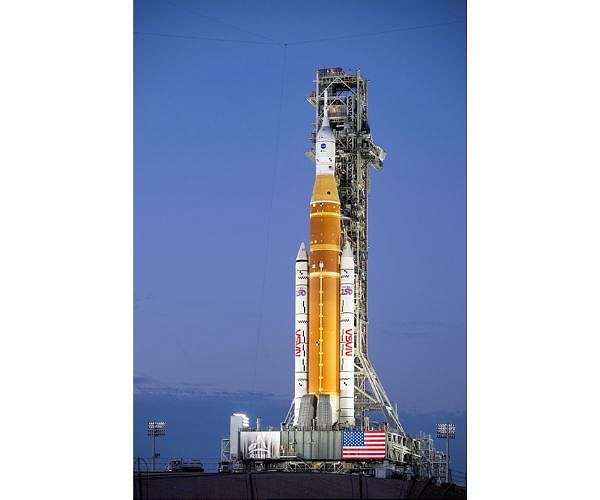
NASA was preparing to conduct a key fueling test over the weekend of the 322-foot (98-meter) rocket that is on the Cape Canaveral launch pad in Florida.

But large parts of the United States are grappling with severe winter weather, with Arctic air surging across the country following a deadly winter storm.

Florida is not immune: the normally sunny state could experience its lowest temperatures in decades that are forecast to hover around freezing.

"The expected weather this weekend would violate launch conditions," NASA said in a statement.

Weather permitting, NASA crews now are aiming to conduct their final tests Monday, after which a launch date will be determined.

The change narrows the possibility that NASA can launch their Artemis 2 team of four astronauts on their Moon flyby in February -- just three days of potential windows remain in that month.

The team remains in quarantine in Houston, NASA said.

Heaters are atop the Orion capsule to ensure it stays warm, the US space agency said, and purging systems are in place and configured for the colder weather to maintain proper conditions.

NASA officials are also preparing to launch a crew to the International Space Station, a mission that is being closely coordinated as it is currently planned to happen within days of a potential Artemis 2 launch.

The next NASA crew rotation to the ISS could happen as soon as February 11, but depending on the Artemis plans, it could get delayed.

"Our teams have worked very carefully to see how we can keep moving towards launch for both missions, while at the same time making sure we avoid any major conflicts," said Ken Bowersox, an administrator at NASA's Space Operations Mission Directorate, during a briefing Friday.

There's a possibility that Crew-12 could get some overlapping space time with the Moon team, a prospect that ISS astronauts said Friday they'd enjoy.

"If we do launch before Artemis, we'll be on board the International Space Station, and part of their flight plan actually involves a call to the ISS," said Jessica Meir, the crew's commander who said they'd be "excited" to have some intra-space conversation with their colleagues.

"We are all thrilled about the launch of Artemis. We are very excited to see how this will all play out."

The Crew-12 team to ISS also includes Sophie Adenot, who will be the second Frenchwoman to fly to space.

In another noteworthy tidbit, the new February 8 window for a potential launch to the Moon falls on the same day as the highly watched Super Bowl, the National Football League championship.

That launch window would open at 11:20 pm in Florida (0420 GMT on February 9) -- soon after the game would likely wrap.

Related Links
Rocket Science News at Space-Travel.Com

Subscribe Free To Our Daily Newsletters
Tweet

RELATED CONTENT
The following news reports may link to other Space Media Network websites.
ROCKET SCIENCE
NASA and GE run hybrid jet engine test toward commercial flight
Los Angeles CA (SPX) Jan 28, 2026
To an untrained eye, the aircraft engine sitting outside a Cincinnati area facility in December looked like standard hardware. For NASA and GE Aerospace researchers watching the unit fire up for a demonstration, it represented a hybrid engine performing at a level that could potentially power an airliner. The engine, tested at GE Aerospace's Peebles Test Operation site in Ohio, is a modified version of the company's Passport engine configured with hybrid-electric capability. The system can extract ... read more

ROCKET SCIENCE
Earliest launch window to ISS set for February 11: NASA

NASA astronaut stuck in space for nine months retires

Tourists hit record in Japan, despite plunge from China

What happens when fire ignites in space? 'A ball of flame'

ROCKET SCIENCE
NASA Testing Advances Space Nuclear Propulsion Capabilities

Autophage rocket concept wins EU prize for debris free launch technology

NASA and GE run hybrid jet engine test toward commercial flight

Starfighters completes key wind tunnel campaign for STARLAUNCH 1 air launch vehicle

ROCKET SCIENCE
Ancient deltas reveal vast Martian ocean across northern hemisphere

Tiny Mars' big impact on Earth's climate

The electrifying science behind Martian dust

Sandblasting winds sculpt Mars landscape

ROCKET SCIENCE
Retired EVA workhorse to guide China's next-gen spacesuit and lunar gear

China prepares offshore test base for reusable liquid rocket launches

Tiangong science program delivers data surge

China tallies record launch year as lunar and asteroid plans advance

ROCKET SCIENCE
Aerospacelab expands Pulsar navigation constellation work with new Xona satellite order

ThinkOrbital raises seed funding to advance orbital defense and construction systems

China outlines mega constellations in ITU satellite filings

Multiple satellite filings demonstrate transparency, responsibility and ambition: China Daily editorial

ROCKET SCIENCE
Understanding USDT How Stablecoins Maintain Value in Volatile Markets

Seismic networks offer new way to track space junk reentering atmosphere

Comtech wins multi-million dollar follow-on contract for civil space components

Atomic 6 debris shields selected for Portal Space Systems mission

ROCKET SCIENCE
Metal rich winds detected in giant dusty cloud around distant star

ALMA survey maps turbulent youth of distant planetary systems

Icy cycles may have driven early protocell evolution

Cosmic dust chemistry forges peptide building blocks in deep space

ROCKET SCIENCE
Polar weather on Jupiter and Saturn hints at the planets' interior details

Birth conditions fixed water contrast on Jupiters moons

Study links Europa's quiet seafloor to hidden potential for life

Europa ice delamination may deliver nutrients to hidden ocean

Subscribe Free To Our Daily Newsletters


The content herein, unless otherwise known to be public domain, are Copyright 1995-2024 - Space Media Network. All websites are published in Australia and are solely subject to Australian law and governed by Fair Use principals for news reporting and research purposes. AFP, UPI and IANS news wire stories are copyright Agence France-Presse, United Press International and Indo-Asia News Service. ESA news reports are copyright European Space Agency. All NASA sourced material is public domain. Additional copyrights may apply in whole or part to other bona fide parties. All articles labeled "by Staff Writers" include reports supplied to Space Media Network by industry news wires, PR agencies, corporate press officers and the like. Such articles are individually curated and edited by Space Media Network staff on the basis of the report's information value to our industry and professional readership. Advertising does not imply endorsement, agreement or approval of any opinions, statements or information provided by Space Media Network on any Web page published or hosted by Space Media Network. General Data Protection Regulation (GDPR) Statement Our advertisers use various cookies and the like to deliver the best ad banner available at one time. All network advertising suppliers have GDPR policies (Legitimate Interest) that conform with EU regulations for data collection. By using our websites you consent to cookie based advertising. If you do not agree with this then you must stop using the websites from May 25, 2018. Privacy Statement. Additional information can be found here at About Us.