24/7 Space News
MARSDAILY
Martian toxin found to toughen microbe built bricks
illustration only

Martian toxin found to toughen microbe built bricks

by Simon Mansfield
Sydney, Australia (SPX) Feb 06, 2026
Bacteria that thrive on Earth may not survive easily on Mars, where the soil contains toxic perchlorate salts at levels that can reach about 1 percent by weight. Researchers at the Indian Institute of Science have now shown how a brick building soil bacterium responds to this chemical and discovered that although the toxin slows growth and stresses the cells, it can also yield stronger biocemented Martian bricks.

The work builds on earlier studies in which the team used the soil bacterium Sporosarcina pasteurii to turn synthetic Martian or lunar soil into solid "space bricks." When the microbe is supplied with urea and calcium in a granular simulant along with the natural polymer guar gum, it precipitates calcium carbonate crystals that bind soil grains together, a process known as biocementation. In contrast to previous experiments that relied on a standard laboratory strain, the new study used a more robust, native strain of S. pasteurii that the researchers had isolated from soils in Bengaluru.

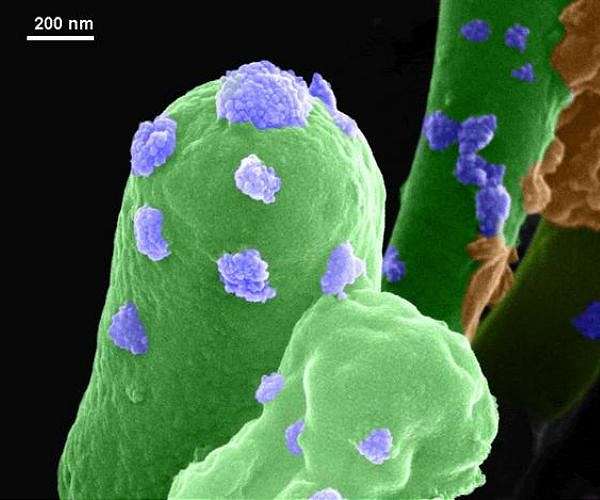
After confirming that the Bengaluru strain could efficiently generate mineral precipitates in the simulant, the team introduced perchlorate at concentrations similar to those detected in Martian regolith. In collaboration with scientists at the Indian Institute of Science Education and Research in Kolkata, they observed that the chemical stressed the bacteria: cells divided more slowly, shifted from rod like to more circular shapes, and began to clump into multicellular like aggregates. Stressed cells also secreted greater amounts of extracellular matrix, a mixture of proteins and other molecules that formed a coating around the microbe clusters.

Electron microscopy revealed that in the presence of perchlorate there were more calcium chloride like and calcium carbonate precipitates throughout the soil matrix. The extracellular matrix extended between cells and mineral particles, forming tiny "microbridges" that appeared to connect bacterial clusters and precipitates. These microbridges stitched the forming bricks together at the microscale and may have helped route nutrients to pockets of stressed bacteria embedded within the material.

Commercial Martian soil simulants typically omit perchlorate because it is flammable, so the researchers added the compound in controlled amounts to test its effect on biocementation. Mechanical tests on cured samples showed that bricks formed with perchlorate were stronger and better glued together than control specimens, but only when guar gum and the catalyst nickel chloride were also present to support bacterial metabolism. When these additional components were omitted, perchlorate remained a net stress factor and impaired the bacterium's performance.

The team suggests that the paradoxical strengthening effect arises because stress induced extracellular matrix production reinforces the mineral framework, improving cohesion of the composite. First author Swati Dubey notes that when the toxin is studied in isolation, it clearly stresses the microbe, but in the full brick mixture "with the right ingredients in the mixture, perchlorate is helping." The researchers now plan to probe the microbridge mechanism in more detail, including whether the structures act as nutrient highways that help bacteria tolerate perchlorate rich environments over longer periods.

Future experiments will place the system in high carbon dioxide atmospheres to better mimic Martian surface conditions and assess how gas composition influences biocementation. The group also wants to evaluate how long the engineered communities can remain active and maintain structural integrity under repeated stress cycles similar to diurnal temperature swings on Mars. Understanding these responses is key to designing reliable, biology based construction systems for long term extraterrestrial habitats.

Beyond Mars, the scientists see microbially induced calcium carbonate precipitation as a more sustainable construction strategy on Earth, where conventional cement production carries a large carbon footprint. On planetary surfaces such as the Moon and Mars, in situ resource utilisation using local regolith, limited added chemicals, and hardy microbes could supply landing pads, roads, launch platforms, and other infrastructure without shipping heavy building materials from Earth. Co author and ISRO astronaut trainee Shubhanshu Shukla points out that uneven terrain has already contributed to lander mishaps on the Moon, and engineered biobricks prepared directly on site could help smooth future landing zones and traffic corridors for rovers and crewed vehicles.

The study highlights that gauging how Earth microbes respond to alien soil chemistry is critical for safe and effective use of biological tools in space exploration. As missions push toward sustained operations on Mars, approaches that combine robust microbial strains, carefully tuned chemistry, and local materials may become central to building the first long lived outposts on another world.

Research Report:Effect of perchlorate on biocementation capable bacteria and Martian bricks

Related Links
Indian Institute of Science
Mars News and Information at MarsDaily.com
Lunar Dreams and more

Subscribe Free To Our Daily Newsletters
Tweet

RELATED CONTENT
MARSDAILY
New clues to Mars habitability in discovery of ancient beach
London, UK (SPX) Jan 30, 2026
New findings from NASAs Perseverance rover have revealed evidence of wave-formed beaches and rocks altered by subsurface water in a Martian crater that once held a vast lake - considerably expanding the timeline for potential habitability at this ancient site. In an international study led by Imperial College London, researchers uncovered that the so-called Margin unit in Marss Jezero crater preserves evidence of extensive underground interactions between rock and water, as well as the first defin ... read more

MARSDAILY
The coming end of ISS, symbol of an era of global cooperation

Launch to ISS pushed to Thursday over weather: NASA

NASA confirms first flight to ISS since medical evacuation

Crew 12 set for Dragon launch to Station in February

MARSDAILY
NASA Moon mission launch srubbed to March after test

NASA books fifth Axiom private astronaut flight to space station

Musk merges xAI into SpaceX in bid to build space data centers

SpaceX grounds Falcon 9 missions, could impact ISS launch

MARSDAILY
Martian toxin found to toughen microbe built bricks

Curiosity Blog, Sols 4788-4797: Welcome Back from Conjunction

NASA Study: Non-biologic Processes Don't Fully Explain Mars Organics

Perseverance rover completes landmark AI guided trek across Jezero rim

MARSDAILY
Dragon spacecraft gears up for crew 12 arrival and station science work

China prepares offshore test base for reusable liquid rocket launches

Retired EVA workhorse to guide China's next-gen spacesuit and lunar gear

Tiangong science program delivers data surge

MARSDAILY
BlackSky expands Gen 3 Assured deals with new defense customer

ESA member states back SWISSto12 HummingSat with fresh funding round

Muon Space ramps up multi-mission satellite constellations

Aerospacelab expands Pulsar navigation constellation work with new Xona satellite order

MARSDAILY
Launching the idea of data centers in space

Abundant element alloy enables rare earth free cryogenic cooling

Gilat books multimillion order for Sidewinder inflight ESA terminals

NTU Singapore boosts agile space access with trio of new projects

MARSDAILY
JWST study links sulfur rich gas giants to core growth in distant HR 8799 system

Survey of 80 near Earth asteroids sharpens view of their origins and risks

Lab made cosmic dust experiment reveals paths to life chemistry

Einstein effect clears planets from tight double star systems

MARSDAILY
Jupiter size refined by new radio mapping

Polar weather on Jupiter and Saturn hints at the planets' interior details

Europa ice delamination may deliver nutrients to hidden ocean

Birth conditions fixed water contrast on Jupiters moons


The content herein, unless otherwise known to be public domain, are Copyright 1995-2026 - SpaceDaily.com. All websites are published in Australia and are solely subject to Australian law and governed by Fair Use principals for news reporting and research purposes. AFP, UPI and IANS news wire stories are copyright Agence France-Presse, United Press International and Indo-Asia News Service. ESA news reports are copyright European Space Agency. All NASA sourced material is public domain. Additional copyrights may apply in whole or part to other bona fide parties. All articles labeled "by Staff Writers" include reports supplied to Space Media Network by industry news wires, PR agencies, corporate press officers and the like. Such articles are individually curated and edited by Space Media Network staff on the basis of the report's information value to our industry and professional readership. Advertising does not imply endorsement, agreement or approval of any opinions, statements or information provided by Space Media Network on any Web page published or hosted by Space Media Network. General Data Protection Regulation (GDPR) Statement Our advertisers use various cookies and the like to deliver the best ad banner available at one time. All network advertising suppliers have GDPR policies (Legitimate Interest) that conform with EU regulations for data collection. By using our websites you consent to cookie based advertising. If you do not agree with this then you must stop using the websites from May 25, 2018. Privacy Statement. Additional information can be found here at About Us.
Subscribe Free To Our Daily Newsletters