24/7 Space News
SPACE TRAVEL
The coming end of ISS, symbol of an era of global cooperation

The coming end of ISS, symbol of an era of global cooperation

By Frederic Bourigault
Paris, France (AFP) Feb 5, 2026
When the International Space Station comes back to Earth in 2030, it will mark the end of three decades of peaceful international cooperation -- and an era when space became central to our daily lives.

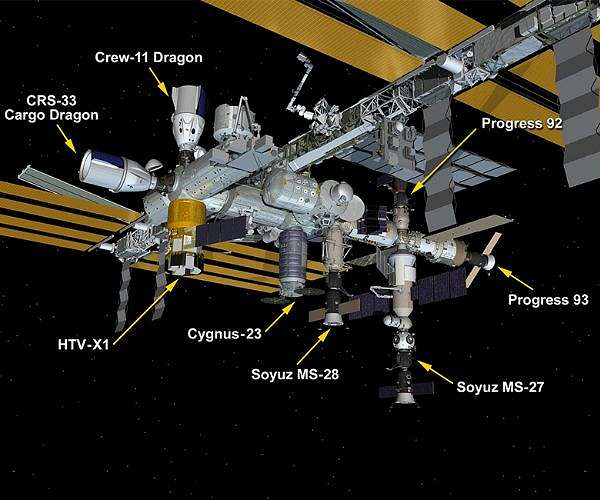
Since November 2000, there have always been several humans on board the football field-sized scientific laboratory, whipping around the planet at eight kilometres per second.

With a new crew of astronauts set to blast off for the station as soon as next week, some of those who have helped the station from the ground are nostalgic about its looming demise.

"The ISS is a cathedral to human cooperation and collaboration across borders, languages and cultures," John Horack, the former manager of NASA's Science and Mission Systems Office, told AFP.

"For more than 25 years, we have had people in space, 24/7/365," added Horack, who now holds the Neil Armstrong Chair in aerospace policy at Ohio State University.

"It is a testament to how we can 'figure it out' rather than 'fight it out' when we wish to interact with each other."

The ISS was first proposed in the aftermath of the Cold War, illustrating a newfound spirit of cooperation between space race rivals Russia and the United States.

While many ties between Russia and the West have been severed over Moscow's war in Ukraine, cooperation has continued on board the space station.

"The history of human spaceflight is first and foremost the space race," Lionel Suchet of France's space agency CNES told AFP.

"This is a very interesting moment in the evolution of space exploration," said Suchet, who coordinated several early ISS projects after witnessing its predecessor, the Mir space station, de-orbiting in 2001.

- Back to Earth -

However, the ISS is getting old and its equipment is outdated.

NASA announced last year it had selected Elon Musk's SpaceX to build a vehicle that can push the station back into Earth's atmosphere in 2030, where it will break up.

"This large rocket engine will slow down the ISS, and enable it to have a precise re-entry over the Pacific Ocean, far from land, people or any other potential hazards," Horack explained.

Several spacecraft and telescopes -- including Mir -- have met a similar fate, splashing down at an isolated spot in the ocean called Point Nemo.

After 2030, the only space station orbiting Earth will be China's Tiangong.

For the future, the US is focusing more on space stations built and operated by private companies.

"We are moving into an era where space stations have a much more commercial dimension," similar to what has already happened with rockets and satellites, Horack said.

National space agencies would then need to pay these companies to stay on board.

Several companies, including Jeff Bezos's Blue Origin and Axiom Space, are already working on plans to build the first commercial space station.

Suchet emphasised that "the business model will still be largely institutional because countries are always interested in sending astronauts into low-Earth orbit".

Scientific research and exploration also remain an "objective of all humanity", he added, pointing to treaties that govern how nations are supposed to act in space.

Whether these treaties will hold once humans make it to the Moon -- the US and China both have plans to build lunar bases -- remains to be seen.

- 'Quite sad' -

For Horack, the end of the ISS could be seen as "quite sad".

His children "had a lifetime of going out into the backyard to watch the ISS fly over".

But the end of this era will mark the opening of another, he added.

"We must grow as humans in our space-faring capacity, in our exploration of space, and in the use of space to generate social, economic, educational and quality of life outcomes for all people everywhere."

He finished by quoting the former head of the European Space Agency, Jean-Jacques Dordain: "If you want to go fast, go alone. If you want to go far, go together."

fbr-dl/rlp/ane

ISS A/S

Related Links
Space Tourism, Space Transport and Space Exploration News

Subscribe Free To Our Daily Newsletters
Tweet

RELATED CONTENT
SPACE TRAVEL
Crew 12 set for Dragon launch to Station in February
Paris, France (SPX) Feb 02, 2026
A four person international crew is preparing to launch to the International Space Station no earlier than Wednesday 11 February, riding a SpaceX Dragon spacecraft on a Falcon 9 rocket from Space Launch Complex 40 at Cape Canaveral Space Force Station in Florida. The planned liftoff time is 11:00 GMT, which corresponds to 12:00 CET and 06:00 EST, with two additional launch opportunities on 12 and 13 February if required. The launch schedule provides backup options on Thursday 12 February at 10:38 ... read more

SPACE TRAVEL
The coming end of ISS, symbol of an era of global cooperation

Launch to ISS pushed to Thursday over weather: NASA

NASA confirms first flight to ISS since medical evacuation

Crew 12 set for Dragon launch to Station in February

SPACE TRAVEL
NASA Moon mission launch srubbed to March after test

NASA books fifth Axiom private astronaut flight to space station

Musk merges xAI into SpaceX in bid to build space data centers

SpaceX grounds Falcon 9 missions, could impact ISS launch

SPACE TRAVEL
Martian toxin found to toughen microbe built bricks

Curiosity Blog, Sols 4788-4797: Welcome Back from Conjunction

NASA Study: Non-biologic Processes Don't Fully Explain Mars Organics

Perseverance rover completes landmark AI guided trek across Jezero rim

SPACE TRAVEL
Dragon spacecraft gears up for crew 12 arrival and station science work

China prepares offshore test base for reusable liquid rocket launches

Retired EVA workhorse to guide China's next-gen spacesuit and lunar gear

Tiangong science program delivers data surge

SPACE TRAVEL
BlackSky expands Gen 3 Assured deals with new defense customer

ESA member states back SWISSto12 HummingSat with fresh funding round

Muon Space ramps up multi-mission satellite constellations

Aerospacelab expands Pulsar navigation constellation work with new Xona satellite order

SPACE TRAVEL
Launching the idea of data centers in space

Abundant element alloy enables rare earth free cryogenic cooling

Gilat books multimillion order for Sidewinder inflight ESA terminals

NTU Singapore boosts agile space access with trio of new projects

SPACE TRAVEL
JWST study links sulfur rich gas giants to core growth in distant HR 8799 system

Survey of 80 near Earth asteroids sharpens view of their origins and risks

Lab made cosmic dust experiment reveals paths to life chemistry

Einstein effect clears planets from tight double star systems

SPACE TRAVEL
Jupiter size refined by new radio mapping

Polar weather on Jupiter and Saturn hints at the planets' interior details

Europa ice delamination may deliver nutrients to hidden ocean

Birth conditions fixed water contrast on Jupiters moons


The content herein, unless otherwise known to be public domain, are Copyright 1995-2026 - SpaceDaily.com. All websites are published in Australia and are solely subject to Australian law and governed by Fair Use principals for news reporting and research purposes. AFP, UPI and IANS news wire stories are copyright Agence France-Presse, United Press International and Indo-Asia News Service. ESA news reports are copyright European Space Agency. All NASA sourced material is public domain. Additional copyrights may apply in whole or part to other bona fide parties. All articles labeled "by Staff Writers" include reports supplied to Space Media Network by industry news wires, PR agencies, corporate press officers and the like. Such articles are individually curated and edited by Space Media Network staff on the basis of the report's information value to our industry and professional readership. Advertising does not imply endorsement, agreement or approval of any opinions, statements or information provided by Space Media Network on any Web page published or hosted by Space Media Network. General Data Protection Regulation (GDPR) Statement Our advertisers use various cookies and the like to deliver the best ad banner available at one time. All network advertising suppliers have GDPR policies (Legitimate Interest) that conform with EU regulations for data collection. By using our websites you consent to cookie based advertising. If you do not agree with this then you must stop using the websites from May 25, 2018. Privacy Statement. Additional information can be found here at About Us.
Subscribe Free To Our Daily Newsletters