





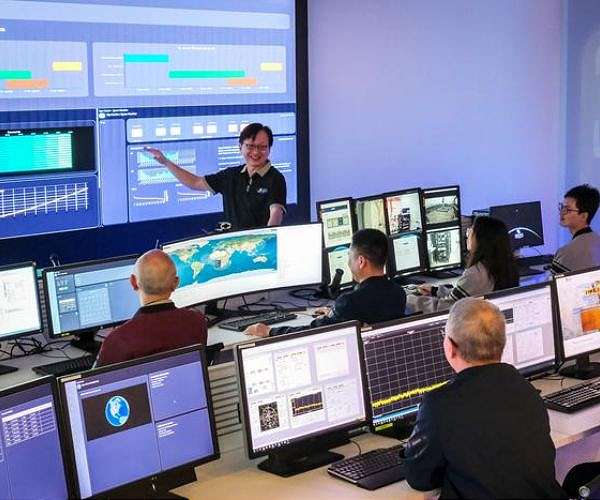
One of the new projects will see scientists from NTU's Satellite Research Centre integrate an edge computing artificial intelligence payload into a nanosatellite built by space technology firm Satoro Space. The 3U nanosatellite, measuring 30 centimetres by 10 centimetres by 10 centimetres, will process images directly on board using small AI models and an edge engine. This approach reduces the need to send large volumes of raw data back to Earth and enables quicker, more intelligent decision making in orbit.
The same satellite will also test next generation perovskite solar cells in space. These lightweight solar panels are being developed by researchers from NTU's School of Electrical and Electronic Engineering, School of Materials Science and Engineering, and local technology start up Singfilm. In orbit demonstration of the devices will provide critical data on their performance and durability in the harsh space environment.
Dean of the NTU College of Engineering, Professor Warren Chan, said that the Space Access Programme marks a significant step for Singapore's growing space ecosystem and represents a new phase for NTU, which pioneered the country's satellite and space education programme. He noted that space technologies are moving towards faster development cycles and smarter operations, and highlighted NTU's two decades of experience in co developing and deploying satellite technologies rapidly and cost effectively.
Chairman of Satoro Space, Mr Maverick Shih, said the joint project allows the company to build proven and reliable CubeSat solutions while working locally with the Satellite Research Centre in Singapore. He added that the collaboration will help Singapore research institutes to develop cutting edge space technology rapidly by combining academic expertise with commercial satellite platforms.
Under the second Space Access Programme project, NTU and its partners will deploy a larger nanosatellite designed for in orbit manoeuvres. The 16U satellite, measuring 40 centimetres by 30 centimetres by 30 centimetres and weighing up to 30 kilograms, will carry a MUlti Stage Ignition Compact engine developed by NTU spin off Aliena. This propulsion system electrically ionises a gas propellant and accelerates the ions using controlled electric and magnetic fields to generate steady and efficient thrust for orbit raising or lowering.
Aliena co founder and CEO Dr Lim Jian Wei, Mark, said that participation in the programme demonstrates the company's commitment to providing versatile propulsion systems across a wide range of satellite platforms. He pointed out that as the number of satellites in low Earth orbit continues to grow, advanced in orbit mobility is becoming essential rather than optional, enabling new mission concepts and supporting the effective, sustainable operation of satellite constellations.
The manoeuvring satellite will also carry an Atomic Oxygen Detector developed by NTU Temasek Laboratories. The instrument will study how advanced materials stand up to atomic oxygen, a highly reactive form of oxygen that can erode satellite components in very low Earth orbit. Understanding material durability in this regime is critical for designing long lived spacecraft operating at lower altitudes.
The third project in the programme will validate a Singapore developed electro optical imaging payload, known as LEOCAM, on the International Space Station. The payload uses a unique triple mirror optical design to deliver high resolution Earth observation images, with each pixel capturing finer ground details such as objects about a metre across. Operating from the space station will give engineers valuable performance data in an operational environment.
Dr Phua Poh Boon, Chief Technology Officer of LightHaus Photonics, said that testing the optical imaging payload on the International Space Station will be a key milestone for the company. LightHaus expects to become the first Singaporean firm to build a space based optical system, and in orbit verification of LEOCAM's capabilities will support future commercial Earth observation services.
Together, the three Space Access Programme projects underscore a wider shift in the global space sector towards smaller, more agile satellites that can be built, launched and tested faster than traditional large spacecraft. Professor Warren Chan said that NTU's strengths in artificial intelligence and space technologies place the university in a strong position to lead the development of edge computing AI in orbit, where data can be processed on board rather than relying solely on ground systems.
Developing AI capabilities in space reduces dependence on ground based processing and allows satellites to make faster, more informed decisions about what data to collect, process and downlink. According to Professor Chan, this provides Singapore with a strategic advantage as it builds a more agile and competitive space ecosystem, and will help partners bring innovations to market sooner by shortening development and validation cycles.
The three Space Access Programme projects are scheduled to start this year and will run for the next three years. Over that period, they are expected to strengthen NTU's role in advancing Singapore's space capabilities, expand opportunities for local companies in the commercial space sector, and provide new platforms for testing advanced technologies ranging from AI and propulsion to novel solar cells and imaging systems.
Related Links
Nanyang Technological University Singapore
Space Technology News - Applications and Research
| Subscribe Free To Our Daily Newsletters |

| Subscribe Free To Our Daily Newsletters |







