24/7 Space News
ROCKET SCIENCE
China sea launch boosts private rocket activity in 2026
illustration only

China sea launch boosts private rocket activity in 2026

by Riko Seibo
Tokyo, Japan (SPX) Jan 30, 2026

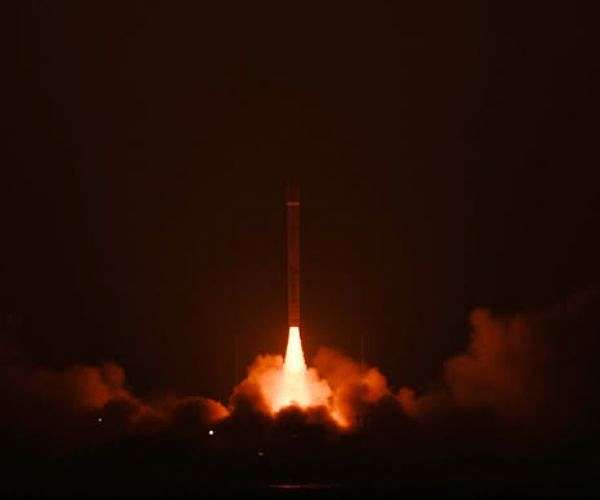
Galactic Energy has opened Chinas 2026 commercial launch campaign with a pre dawn sea based mission of its Ceres 1 carrier rocket on January 17, extending the companys record of frequent small satellite launches from both land and ocean platforms.

The latest flight lifted off at 4:10 am local time from a mobile barge in the Yellow Sea off the coast of Shandong province, sending four commercial satellites into low Earth orbit.

The payloads, built by Beijing based Guodian Gaoke, will expand the companys Tianqi internet of things constellation to 41 satellites, enabling global coverage for data collection services.

According to Galactic Energy, the Tianqi network is already supporting applications in forestry, agriculture, tourism, power generation and environmental protection, providing machine to machine connectivity in remote areas.

Ceres 1 first reached orbit in November 2020 from the Jiuquan Satellite Launch Center in the Inner Mongolia autonomous region, becoming the second privately developed Chinese orbital launcher after i Spaces SQX 1.

The solid fuel rocket is about 20 meters tall with a diameter of 1.4 meters and a liftoff mass of 33 metric tons, targeting the growing market for small payload launches.

Ceres 1 can carry a single 300 kilogram spacecraft or a cluster of satellites totaling 300 kilograms to a 500 kilometer sun synchronous orbit, or a 350 kilogram payload to a 200 kilometer low Earth orbit.

With this mission, the rocket has flown 23 times, placing 89 commercial satellites into orbit, with 21 of those launches reported as successful.

Galactic Energy is also preparing the debut launch of its larger Ceres 2 solid propellant vehicle from Jiuquan, aiming to offer higher capacity services to domestic and international customers.

Other Chinese commercial launch firms plan to introduce new vehicles in the near term, including Orienspaces Gravity 2, Deep Blue Aerospaces Nebula 1 and Space Pioneers TL 3.

In a separate mission, China conducted a Long March 2C launch on Thursday afternoon, orbiting the AlSat 3A remote sensing satellite for Algeria from the Jiuquan spaceport.

China Great Wall Industry, the contractor for the mission and the international commercial arm of China Aerospace Science and Technology Corp, said the rocket lifted off at 12:01 pm and successfully placed the spacecraft into its planned orbit.

AlSat 3A, developed by the China Academy of Space Technology, will provide data and imagery for land use planning, disaster prevention and mitigation in Algeria.

The satellite is the first delivered under a July 2023 agreement between China Great Wall Industry and the Algerian Space Agency, which covers two optical remote sensing satellites, ground infrastructure, training and support services.

The mission marks another step in space cooperation between China and Algeria, following the launch of the Alcomsat 1 communications satellite in December 2017.

Related Links
Galactic Energy
Rocket Science News at Space-Travel.Com

Subscribe Free To Our Daily Newsletters
Tweet

RELATED CONTENT
The following news reports may link to other Space Media Network websites.
ROCKET SCIENCE
NASA and GE run hybrid jet engine test toward commercial flight
Los Angeles CA (SPX) Jan 28, 2026
To an untrained eye, the aircraft engine sitting outside a Cincinnati area facility in December looked like standard hardware. For NASA and GE Aerospace researchers watching the unit fire up for a demonstration, it represented a hybrid engine performing at a level that could potentially power an airliner. The engine, tested at GE Aerospace's Peebles Test Operation site in Ohio, is a modified version of the company's Passport engine configured with hybrid-electric capability. The system can extract ... read more

ROCKET SCIENCE
Earliest launch window to ISS set for February 11: NASA

NASA astronaut stuck in space for nine months retires

What happens when fire ignites in space? 'A ball of flame'

ISS astronauts splash down on Earth after first-ever medical evacuation

ROCKET SCIENCE
SpaceX eyes IPO timed to planet alignment and Musk birthday: report

NASA Testing Advances Space Nuclear Propulsion Capabilities

Autophage rocket concept wins EU prize for debris free launch technology

NASA and GE run hybrid jet engine test toward commercial flight

ROCKET SCIENCE
Ancient deltas reveal vast Martian ocean across northern hemisphere

Tiny Mars' big impact on Earth's climate

The electrifying science behind Martian dust

Sandblasting winds sculpt Mars landscape

ROCKET SCIENCE
Retired EVA workhorse to guide China's next-gen spacesuit and lunar gear

China prepares offshore test base for reusable liquid rocket launches

Tiangong science program delivers data surge

China tallies record launch year as lunar and asteroid plans advance

ROCKET SCIENCE
Why PR Boxes Are Powerful Tools for Product Launches

ESA member states back SWISSto12 HummingSat with fresh funding round

Aerospacelab expands Pulsar navigation constellation work with new Xona satellite order

ThinkOrbital raises seed funding to advance orbital defense and construction systems

ROCKET SCIENCE
Understanding USDT How Stablecoins Maintain Value in Volatile Markets

Seismic networks offer new way to track space junk reentering atmosphere

Comtech wins multi-million dollar follow-on contract for civil space components

How Businesses Scale TikTok Accounts Organically

ROCKET SCIENCE
Metal rich winds detected in giant dusty cloud around distant star

ALMA survey maps turbulent youth of distant planetary systems

Icy cycles may have driven early protocell evolution

Cosmic dust chemistry forges peptide building blocks in deep space

ROCKET SCIENCE
Polar weather on Jupiter and Saturn hints at the planets' interior details

Birth conditions fixed water contrast on Jupiters moons

Study links Europa's quiet seafloor to hidden potential for life

Europa ice delamination may deliver nutrients to hidden ocean

Subscribe Free To Our Daily Newsletters


The content herein, unless otherwise known to be public domain, are Copyright 1995-2024 - Space Media Network. All websites are published in Australia and are solely subject to Australian law and governed by Fair Use principals for news reporting and research purposes. AFP, UPI and IANS news wire stories are copyright Agence France-Presse, United Press International and Indo-Asia News Service. ESA news reports are copyright European Space Agency. All NASA sourced material is public domain. Additional copyrights may apply in whole or part to other bona fide parties. All articles labeled "by Staff Writers" include reports supplied to Space Media Network by industry news wires, PR agencies, corporate press officers and the like. Such articles are individually curated and edited by Space Media Network staff on the basis of the report's information value to our industry and professional readership. Advertising does not imply endorsement, agreement or approval of any opinions, statements or information provided by Space Media Network on any Web page published or hosted by Space Media Network. General Data Protection Regulation (GDPR) Statement Our advertisers use various cookies and the like to deliver the best ad banner available at one time. All network advertising suppliers have GDPR policies (Legitimate Interest) that conform with EU regulations for data collection. By using our websites you consent to cookie based advertising. If you do not agree with this then you must stop using the websites from May 25, 2018. Privacy Statement. Additional information can be found here at About Us.