24/7 Space News
STELLAR CHEMISTRY
Radio view of rare supernova tracks dying star's final decade
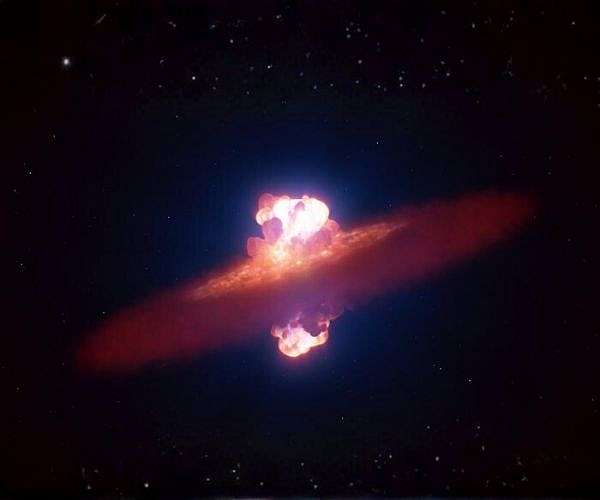
illustration only

Radio view of rare supernova tracks dying star's final decade

by Russ Bahorsky
Charlottesville VA (SPX) Jan 30, 2026

As from a rare kind of stellar explosion known as a Type Ibn supernova, giving them an unusually detailed look at the final decade in the life of a massive star before it died. The observations capture how the star shed large amounts of helium-rich gas shortly before it exploded, providing a record of its late-stage evolution.

The research team used the National Science Foundation's Very Large Array radio telescope in New Mexico to monitor faint radio emission from the supernova for about 18 months after the explosion. By tracking how the radio signal changed over time, they were able to reconstruct when and how much material the star expelled into space in the years leading up to its death.

Type Ibn supernovae occur when a massive star explodes into a dense envelope of helium-rich gas that it had already thrown off. When the supernova's shockwave plows into this gas, the interaction produces strong radio waves that carry information about the star's mass-loss history. In this case, the radio data revealed patterns that could not be seen with optical telescopes alone.

Lead author Raphael Baer-Way, a third-year Ph.D. student in astronomy at the University of Virginia, said the radio measurements effectively let astronomers look back in time over the last decade of the star's life. He described the surrounding gas as a kind of mirror that records the star's final activity and becomes visible when the explosion's shockwave slams into it.

The study indicates that the progenitor star likely belonged to a binary system, with two stars orbiting each other. The researchers conclude that gravitational interaction with a companion star probably drove the intense mass loss during the last few years before the explosion.

Baer-Way said the amount of mass inferred from the radio data is difficult to explain with a single isolated star. He argued that the scale and rapid timing of the mass loss are best accounted for when a companion star alters the structure and evolution of its partner late in life.

The new work shows that radio observations provide a powerful tool for probing the deaths of massive stars across the universe. Until now, most studies of such events have relied heavily on optical light, which does not always reveal the detailed history of mass loss in the years just before a supernova.

According to the team, systematically observing more supernovae in radio could show how common these intense mass-loss episodes are and how they shape the diversity of stellar explosions. A larger sample would also help clarify what kinds of stars produce Type Ibn events and how binary interaction influences their final fates.

Study co-author Maryam Modjaz, a professor of astronomy at the University of Virginia and an expert on massive star death and supernovae, said the work demonstrates the need to point radio telescopes at these rare explosions earlier than previously assumed. She noted that the signals can be brief, so rapid follow-up is essential to catch the crucial phases when the shockwave first encounters the nearby gas.

The findings are reported in The Astrophysical Journal Letters in a paper titled "The First Radio View of a Type Ibn Supernova in SN 2023fyq: Understanding the Mass-loss History in the Last Decade before the Explosion." The authors say their results set the stage for future campaigns that will link radio, optical, and other wavelengths to build a more complete picture of how massive stars live and die.

Research Report:The First Radio View of a Type Ibn Supernova in SN 2023fyq: Understanding the Mass-loss History in the Last Decade before the Explosion

Related Links
University of Virginia
Stellar Chemistry, The Universe And All Within It

Subscribe Free To Our Daily Newsletters
Tweet

RELATED CONTENT
The following news reports may link to other Space Media Network websites.
STELLAR CHEMISTRY
Possible "superkilonova" exploded not once but twice
Pasadena CA (SPX) Dec 17, 2025
When the most massive stars reach the ends of their lives, they blow up in spectacular supernova explosions, which seed the universe with heavy elements such as carbon and iron. Another type of explosion - the kilonova - occurs when a pair of dense dead stars, called neutron stars, smash together, forging even heavier elements such as gold and uranium. Such heavy elements are among the basic building blocks of stars and planets. So far, only one kilonova has been unambiguously confirmed to date, a ... read more

STELLAR CHEMISTRY
Earliest launch window to ISS set for February 11: NASA

NASA astronaut stuck in space for nine months retires

What happens when fire ignites in space? 'A ball of flame'

ISS astronauts splash down on Earth after first-ever medical evacuation

STELLAR CHEMISTRY
SpaceX eyes IPO timed to planet alignment and Musk birthday: report

NASA Testing Advances Space Nuclear Propulsion Capabilities

Autophage rocket concept wins EU prize for debris free launch technology

NASA and GE run hybrid jet engine test toward commercial flight

STELLAR CHEMISTRY
Ancient deltas reveal vast Martian ocean across northern hemisphere

Tiny Mars' big impact on Earth's climate

The electrifying science behind Martian dust

Sandblasting winds sculpt Mars landscape

STELLAR CHEMISTRY
Retired EVA workhorse to guide China's next-gen spacesuit and lunar gear

China prepares offshore test base for reusable liquid rocket launches

Tiangong science program delivers data surge

China tallies record launch year as lunar and asteroid plans advance

STELLAR CHEMISTRY
Why PR Boxes Are Powerful Tools for Product Launches

ESA member states back SWISSto12 HummingSat with fresh funding round

Aerospacelab expands Pulsar navigation constellation work with new Xona satellite order

ThinkOrbital raises seed funding to advance orbital defense and construction systems

STELLAR CHEMISTRY
Understanding USDT How Stablecoins Maintain Value in Volatile Markets

Seismic networks offer new way to track space junk reentering atmosphere

Comtech wins multi-million dollar follow-on contract for civil space components

How Businesses Scale TikTok Accounts Organically

STELLAR CHEMISTRY
Metal rich winds detected in giant dusty cloud around distant star

ALMA survey maps turbulent youth of distant planetary systems

Icy cycles may have driven early protocell evolution

Cosmic dust chemistry forges peptide building blocks in deep space

STELLAR CHEMISTRY
Polar weather on Jupiter and Saturn hints at the planets' interior details

Birth conditions fixed water contrast on Jupiters moons

Study links Europa's quiet seafloor to hidden potential for life

Europa ice delamination may deliver nutrients to hidden ocean

Subscribe Free To Our Daily Newsletters


The content herein, unless otherwise known to be public domain, are Copyright 1995-2024 - Space Media Network. All websites are published in Australia and are solely subject to Australian law and governed by Fair Use principals for news reporting and research purposes. AFP, UPI and IANS news wire stories are copyright Agence France-Presse, United Press International and Indo-Asia News Service. ESA news reports are copyright European Space Agency. All NASA sourced material is public domain. Additional copyrights may apply in whole or part to other bona fide parties. All articles labeled "by Staff Writers" include reports supplied to Space Media Network by industry news wires, PR agencies, corporate press officers and the like. Such articles are individually curated and edited by Space Media Network staff on the basis of the report's information value to our industry and professional readership. Advertising does not imply endorsement, agreement or approval of any opinions, statements or information provided by Space Media Network on any Web page published or hosted by Space Media Network. General Data Protection Regulation (GDPR) Statement Our advertisers use various cookies and the like to deliver the best ad banner available at one time. All network advertising suppliers have GDPR policies (Legitimate Interest) that conform with EU regulations for data collection. By using our websites you consent to cookie based advertising. If you do not agree with this then you must stop using the websites from May 25, 2018. Privacy Statement. Additional information can be found here at About Us.