24/7 Space News
TIME AND SPACE
'The beacons were lit!' A system to detect and map merging black holes
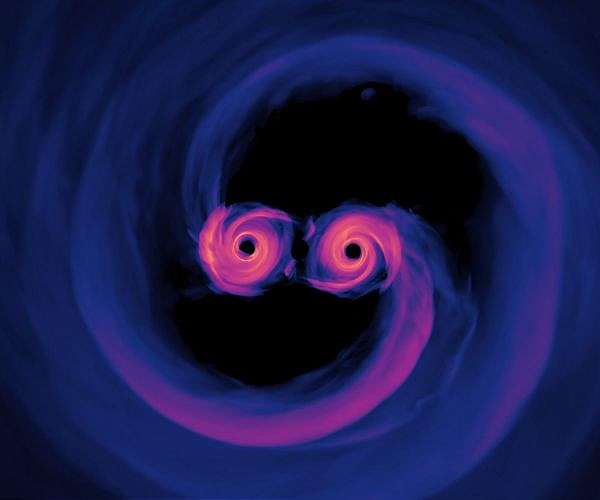
illustration only

'The beacons were lit!' A system to detect and map merging black holes

by Jim Shelton
New Haven CT (SPX) Feb 08, 2026
An international collaboration of astrophysicists that includes researchers from Yale has created and tested a detection system that uses gravitational waves to map out the locations of merging black holes - known as supermassive black hole binaries - around the universe.

Such a map would provide a vital new way to explore and understand astronomy and physics, just as X-rays and radio waves did in earlier eras, the researchers say. The new protocol demonstrated by the North American Nanohertz Observatory for Gravitational Waves (NANOGrav) offers a detection protocol to populate the map.

"Our finding provides the scientific community with the first concrete benchmarks for developing and testing detection protocols for individual, continuous gravitational wave sources," said Chiara Mingarelli, assistant professor of physics in Yale's Faculty of Arts and Sciences (FAS), member of NANOGrav, and corresponding author of a new study in the Astrophysical Journal Letters.

According to the researchers, even a small number of confirmed black hole binaries will enable them to anchor a map of the gravitational wave background. In the months ahead, NANOGrav will continue identifying and locating binaries.

Previous theoretical work led by Mingarelli and collaborators suggested that black hole mergers are five times more likely to be found in galaxies with a quasar, a brightly lit "beacon" in space fueled by gases falling into a black hole. Informed by this research, the new study details an end-to-end, targeted search framework from continuous gravitational waves from individual black hole merger candidates.

In 2023, NANOGrav reported on the discovery of the first direct evidence of a background of gravitational waves. The discovery suggested that gravitational waves, caused by slowly merging pairs of supermassive black holes, could be detected from Earth within a background field of low-frequency energy.

NANOGrav centered its detection methods around pulsars, which are the collapsed cores of massive stars that have exploded. Pulsars, which rotate rapidly, emit precisely timed radio signals.

The international collaborators then pivoted to the search for individual waves.

For the new study, a research team led by Mingarelli tested a novel methodology that combines measurements of the gravitational wave background with variable measurements of quasars. She and her colleagues conducted targeted searches for supermassive black hole binaries in 114 active galactic nuclei - areas in the center of galaxies where a black hole is drawing in matter.

That's how they found SDSS J1536+0411 (aka "Rohan") and SDSS J0729+4008 (aka "Gondor") - named, in part, after locales from J.R.R. Tolkien's "The Lord of the Rings" novels.

"The names come from both people and pop culture," Mingarelli said. "Rohan was first, for Rohan Shivakumar, the Yale student who first analyzed it, and Gondor was next, because, well - the beacons were lit!"

In "The Lord of the Rings," heroes joined forces after beacons were lit in Gondor and Rohan.

Mingarelli said the discovery offers intriguing possibilities across a range of astrophysics research - from gravitational wave theory and data analysis to galaxy mergers, and black hole astrophysics.

"Our work has laid out a roadmap for a systemic supermassive black hole binary detection framework," she said. "We carried out a systematic, targeted search, developed a rigorous protocol - and two targets rose to the top as examples motivating follow-up."

A number of Yale researchers are co-authors of the study. They include Priyamvada Natarajan, the Joseph S. and Sophia S. Fruton Professor and Chair of Astronomy and professor of physics; Paolo Coppi, professor of astronomy; Forrest Hutchison, Bjorn Larsen, and Qinyuan Zheng, who are students in the Yale Graduate School of Arts and Sciences; and Yale College students Rohan Shivakumar, Ellis Eisenberg, and Yu-Ting Chang.

NANOGrav receives support from the National Science Foundation, the Gordon and Betty Moore Foundation, a National Sciences and Engineering Research Council of Canada (NSERC) Discovery Grant, and the Canadian Institute for Advanced Research.

Research Report:The NANOGrav 15 yr Dataset: Targeted Searches for Supermassive Black Hole Binaries

Related Links
NANOGrav
Understanding Time and Space

Subscribe Free To Our Daily Newsletters
Tweet

RELATED CONTENT
TIME AND SPACE
Exploding primordial black hole model may link extreme neutrino and dark matter
Amherst MD (SPX) Feb 05, 2026
In 2023, a subatomic particle called a neutrino crashed into Earth with such a high amount of energy that it should have been impossible. In fact, there are no known sources anywhere in the universe capable of producing such energy - 100,000 times more than the highest-energy particle ever produced by the Large Hadron Collider, the world's most powerful particle accelerator. However, a team of physicists at the University of Massachusetts Amherst recently hypothesized that something like this could happ ... read more

TIME AND SPACE
The coming end of ISS, symbol of an era of global cooperation

Launch to ISS pushed to Thursday over weather: NASA

NASA confirms first flight to ISS since medical evacuation

Crew 12 set for Dragon launch to Station in February

TIME AND SPACE
NASA Moon mission launch srubbed to March after test

NASA books fifth Axiom private astronaut flight to space station

Musk merges xAI into SpaceX in bid to build space data centers

SpaceX grounds Falcon 9 missions, could impact ISS launch

TIME AND SPACE
Martian toxin found to toughen microbe built bricks

Curiosity Blog, Sols 4788-4797: Welcome Back from Conjunction

NASA Study: Non-biologic Processes Don't Fully Explain Mars Organics

Perseverance rover completes landmark AI guided trek across Jezero rim

TIME AND SPACE
Dragon spacecraft gears up for crew 12 arrival and station science work

China prepares offshore test base for reusable liquid rocket launches

Retired EVA workhorse to guide China's next-gen spacesuit and lunar gear

Tiangong science program delivers data surge

TIME AND SPACE
BlackSky expands Gen 3 Assured deals with new defense customer

ESA member states back SWISSto12 HummingSat with fresh funding round

Muon Space ramps up multi-mission satellite constellations

Aerospacelab expands Pulsar navigation constellation work with new Xona satellite order

TIME AND SPACE
Launching the idea of data centers in space

Abundant element alloy enables rare earth free cryogenic cooling

Gilat books multimillion order for Sidewinder inflight ESA terminals

NTU Singapore boosts agile space access with trio of new projects

TIME AND SPACE
JWST study links sulfur rich gas giants to core growth in distant HR 8799 system

Survey of 80 near Earth asteroids sharpens view of their origins and risks

Lab made cosmic dust experiment reveals paths to life chemistry

Einstein effect clears planets from tight double star systems

TIME AND SPACE
Jupiter size refined by new radio mapping

Polar weather on Jupiter and Saturn hints at the planets' interior details

Europa ice delamination may deliver nutrients to hidden ocean

Birth conditions fixed water contrast on Jupiters moons


The content herein, unless otherwise known to be public domain, are Copyright 1995-2026 - SpaceDaily.com. All websites are published in Australia and are solely subject to Australian law and governed by Fair Use principals for news reporting and research purposes. AFP, UPI and IANS news wire stories are copyright Agence France-Presse, United Press International and Indo-Asia News Service. ESA news reports are copyright European Space Agency. All NASA sourced material is public domain. Additional copyrights may apply in whole or part to other bona fide parties. All articles labeled "by Staff Writers" include reports supplied to Space Media Network by industry news wires, PR agencies, corporate press officers and the like. Such articles are individually curated and edited by Space Media Network staff on the basis of the report's information value to our industry and professional readership. Advertising does not imply endorsement, agreement or approval of any opinions, statements or information provided by Space Media Network on any Web page published or hosted by Space Media Network. General Data Protection Regulation (GDPR) Statement Our advertisers use various cookies and the like to deliver the best ad banner available at one time. All network advertising suppliers have GDPR policies (Legitimate Interest) that conform with EU regulations for data collection. By using our websites you consent to cookie based advertising. If you do not agree with this then you must stop using the websites from May 25, 2018. Privacy Statement. Additional information can be found here at About Us.
Subscribe Free To Our Daily Newsletters