24/7 Space News
TECH SPACE
Abundant element alloy enables rare earth free cryogenic cooling
illustration only

Abundant element alloy enables rare earth free cryogenic cooling

by Riko Seibo
Tokyo, Japan (SPX) Feb 04, 2026

In collaboration with the National Institute of Technology (KOSEN), Oshima College, the National Institute for Materials Science (NIMS) has developed a new regenerator material composed solely of abundant elements such as copper, iron and aluminum that can achieve cryogenic temperatures around 4 K (minus 269 degrees Celsius) without using any rare earth metals or liquid helium. The work targets the growing demand for reliable cryogenic cooling in applications such as medical magnetic resonance imaging (MRI) and quantum computers, where dependence on scarce resources poses technical and economic risks.

Conventional cryogenic cooling used in medical MRI and related systems relies heavily on liquid helium and rare earth elements, which face supply instability and concerns over long term resource depletion. Holmium, a key element in many existing regenerator materials, has an annual production of only about 100 tons and reserves that are unevenly distributed globally. With demand for cryogenic cooling expected to rise, researchers have been seeking alternative materials and mechanisms that remove this dependence on rare resources while maintaining practical performance.

The joint NIMS and KOSEN Oshima College team focused on regenerator materials for mechanical coolers of the Gifford McMahon (GM) type, which can operate without liquid helium. They designed and tested a regenerator material that uses only abundant elements, demonstrating that it can cool to cryogenic temperatures while delivering performance comparable to conventional rare earth based materials. The composition, described as CuFe0.98Al0.02O2 (CFAO), avoids rare earth metals entirely and instead exploits a magnetic phenomenon to achieve high specific heat at low temperatures.

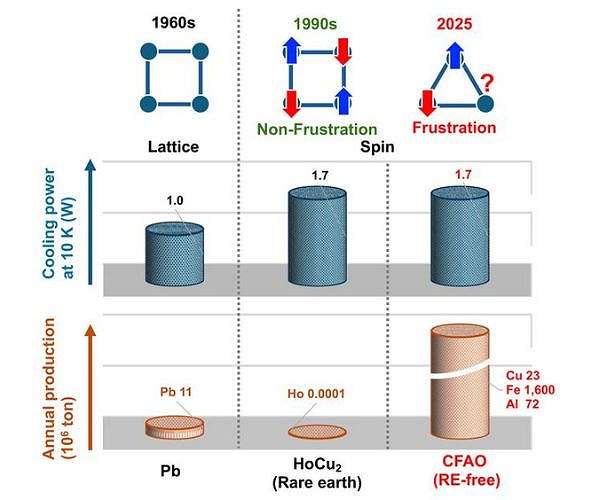
The key physical mechanism at work in the new material is magnetic frustration, a property found in some magnetic systems with a triangular lattice crystal structure where spins cannot simultaneously satisfy all mutual interactions. In such lattices, the spin orientations remain difficult to fully align until the system reaches cryogenic temperatures, which creates enhanced magnetic entropy and high specific heat in the low temperature regime. By harnessing this frustrated spin state in a transition metal oxide made from copper, iron and aluminum, the researchers achieved cryogenic specific heat behavior previously associated mainly with rare earth based compounds.

Experimental measurements revealed that the rare earth free regenerator material exhibits high specific heat at cryogenic temperatures despite being based on transition metals rather than rare earth elements. Its cooling capacity was shown to be comparable to that of lead, which was used in GM coolers in the 1960s, and to holmium based compounds such as HoCu2 that have dominated the field since the 1990s. This marks the first time a magnetic regenerator material without rare earth elements has reached performance levels considered practical for real world cooler applications.

Beyond matching performance, the new material offers advantages in sustainability and environmental impact because it is composed only of widely available elements. The use of copper, iron and aluminum reduces exposure to supply disruptions and price volatility associated with rare earth mining and processing. As a result, the technology could underpin a new generation of cryogenic cooling systems that are more robust against resource constraints and better aligned with long term environmental and economic goals.

The team highlights that this development directly addresses concerns over the limited availability of liquid helium as well as rare earth elements used in current regenerator designs. By decoupling cryogenic cooling performance from these constrained resources, the material could help stabilize the supply chain for critical medical and quantum technologies. In particular, MRI scanners and quantum computing hardware, both of which are expected to see continued growth in deployment, stand to benefit from more sustainable cooling solutions.

The project brought together expertise from NIMS and the National Institute of Technology (KOSEN), Oshima College under the Japan Science and Technology Agency (JST) Adaptable and Seamless Technology Transfer Program through Target driven R and D (A STEP). The research, titled "Innovative Cryogenic Cooling Material Using Spin Frustration from Abundant Elements," was led by principal investigator Noriki Terada and involved researchers Hiroaki Mamiya and Akiko Saito of the Green Magnetic Materials Group and Research Center for Magnetic and Spintronic Materials at NIMS, along with Professor Shinji Masuyama at KOSEN Oshima College. The results were published online in the journal Scientific Reports on December 22, 2025.

Looking ahead, the researchers see strong potential for applying the abundant element regenerator material in commercial GM coolers used for MRI systems and emerging quantum computing platforms. They note that the combination of high cryogenic specific heat, absence of rare earth elements and use of abundant resources positions the material as a promising candidate for large scale deployment. Further development is expected to focus on integrating the material into practical cryocooler designs, optimizing manufacturing processes and validating long term operational stability under real world conditions.

Research Report:Innovative Cryogenic Cooling Material Using Spin Frustration from Abundant Elements

Related Links
National Institute for Materials Science, Japan
Space Technology News - Applications and Research

Subscribe Free To Our Daily Newsletters
Tweet

RELATED CONTENT
The following news reports may link to other Space Media Network websites.
TECH SPACE
Desert sand mix points to new path for greener concrete
Berlin, Germany (SPX) Feb 02, 2026
Concrete is the most widely used building material in the world and relies on vast quantities of suitable sand, but common sources such as crushed rock and river sand are becoming scarce and cause major environmental disturbance when they are extracted. Researchers at the Norwegian University of Science and Technology (NTNU) and the University of Tokyo are now investigating whether the huge reserves of fine desert sand, which cannot be used in traditional concrete, can be turned into a useful constructi ... read more

TECH SPACE
NASA astronaut stuck in space for nine months retires

Tourists hit record in Japan, despite plunge from China

What happens when fire ignites in space? 'A ball of flame'

ISS astronauts splash down on Earth after first-ever medical evacuation

TECH SPACE
NASA and GE run hybrid jet engine test toward commercial flight

Starfighters completes key wind tunnel campaign for STARLAUNCH 1 air launch vehicle

Major equity deal backs Gilmour Space expansion of sovereign launch capability

Stratolaunch secures major funding to scale hypersonic flight services

TECH SPACE
Ancient deltas reveal vast Martian ocean across northern hemisphere

Tiny Mars' big impact on Earth's climate

The electrifying science behind Martian dust

Sandblasting winds sculpt Mars landscape

TECH SPACE
China prepares offshore test base for reusable liquid rocket launches

Retired EVA workhorse to guide China's next-gen spacesuit and lunar gear

Tiangong science program delivers data surge

China tallies record launch year as lunar and asteroid plans advance

TECH SPACE
Aerospacelab expands Pulsar navigation constellation work with new Xona satellite order

ThinkOrbital raises seed funding to advance orbital defense and construction systems

China outlines mega constellations in ITU satellite filings

Multiple satellite filings demonstrate transparency, responsibility and ambition: China Daily editorial

TECH SPACE
German software giant SAP's shares plunge on AI worries

Autonomous AI network boosts materials discovery efficiency

EU will struggle to secure key raw materials supply, warns report

Desert sand mix points to new path for greener concrete

TECH SPACE
Icy cycles may have driven early protocell evolution

Metal rich winds detected in giant dusty cloud around distant star

Cosmic dust chemistry forges peptide building blocks in deep space

Hidden magma oceans could shield rocky exoplanets from harmful radiation

TECH SPACE
Polar weather on Jupiter and Saturn hints at the planets' interior details

Europa ice delamination may deliver nutrients to hidden ocean

Birth conditions fixed water contrast on Jupiters moons

Study links Europa's quiet seafloor to hidden potential for life

Subscribe Free To Our Daily Newsletters


The content herein, unless otherwise known to be public domain, are Copyright 1995-2024 - Space Media Network. All websites are published in Australia and are solely subject to Australian law and governed by Fair Use principals for news reporting and research purposes. AFP, UPI and IANS news wire stories are copyright Agence France-Presse, United Press International and Indo-Asia News Service. ESA news reports are copyright European Space Agency. All NASA sourced material is public domain. Additional copyrights may apply in whole or part to other bona fide parties. All articles labeled "by Staff Writers" include reports supplied to Space Media Network by industry news wires, PR agencies, corporate press officers and the like. Such articles are individually curated and edited by Space Media Network staff on the basis of the report's information value to our industry and professional readership. Advertising does not imply endorsement, agreement or approval of any opinions, statements or information provided by Space Media Network on any Web page published or hosted by Space Media Network. General Data Protection Regulation (GDPR) Statement Our advertisers use various cookies and the like to deliver the best ad banner available at one time. All network advertising suppliers have GDPR policies (Legitimate Interest) that conform with EU regulations for data collection. By using our websites you consent to cookie based advertising. If you do not agree with this then you must stop using the websites from May 25, 2018. Privacy Statement. Additional information can be found here at About Us.