24/7 Space News
TIME AND SPACE
Exploding primordial black hole model may link extreme neutrino and dark matter
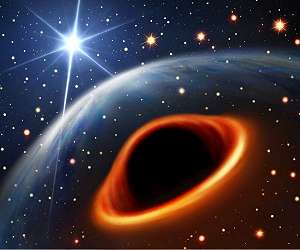
illustration only

Exploding primordial black hole model may link extreme neutrino and dark matter

by Daegan Miller for UMASS News
Amherst MD (SPX) Feb 05, 2026
In 2023, a subatomic particle called a neutrino crashed into Earth with such a high amount of energy that it should have been impossible. In fact, there are no known sources anywhere in the universe capable of producing such energy - 100,000 times more than the highest-energy particle ever produced by the Large Hadron Collider, the world's most powerful particle accelerator. However, a team of physicists at the University of Massachusetts Amherst recently hypothesized that something like this could happen when a special kind of black hole, called a "quasi-extremal primordial black hole," explodes.

In new research published by Physical Review Letters, the team not only accounts for the otherwise impossible neutrino but shows that the elementary particle could reveal the fundamental nature of the universe.

Black holes exist, and we have a good understanding of their life cycle: an old, large star runs out of fuel, implodes in a massively powerful supernova and leaves behind an area of spacetime with such intense gravity that nothing, not even light, can escape. These black holes are incredibly heavy and are essentially stable.

But, as physicist Stephen Hawking pointed out in 1970, another kind of black hole - a primordial black hole (PBH), could be created not by the collapse of a star, but from the universe's primordial conditions shortly after the Big Bang. PBHs exist only in theory so far, and, like standard black holes, are so massively dense that almost nothing can escape them - which is what makes them "black." However, despite their density, PBHs could be much lighter than the black holes we have so far observed. Furthermore, Hawking showed that PBHs could slowly emit particles via what is now known as "Hawking radiation" if they got hot enough.

"The lighter a black hole is, the hotter it should be and the more particles it will emit," says Andrea Thamm, co-author of the new research and assistant professor of physics at UMass Amherst. "As PBHs evaporate, they become ever lighter, and so hotter, emitting even more radiation in a runaway process until explosion. It's that Hawking radiation that our telescopes can detect."

If such an explosion were to be observed, it would give us a definitive catalog of all the subatomic particles in existence, including the ones we have observed, such as electrons, quarks and Higgs bosons, the ones that we have only hypothesized, like dark matter particles, as well as everything else that is, so far, entirely unknown to science. The UMass Amherst team has previously shown that such explosions could happen with surprising frequency - every decade or so - and if we were to pay attention, our current cosmos-observing instruments could register these explosions.

So far, so theoretical.

Then, in 2023, an experiment called the KM3NeT Collaboration captured that impossible neutrino - exactly the kind of evidence the UMass Amherst team hypothesized we might soon see.

But there was a hitch: A similar experiment, called IceCube, also set up to capture high-energy cosmic neutrinos, not only didn't register the event, it had never clocked anything with even one hundredth of its power. If the universe is relatively thick with PBHs, and they are exploding frequently, shouldn't we be showered in high-energy neutrinos? What can explain the discrepancy?

"We think that PBHs with a 'dark charge' - what we call quasi-extremal PBHs - are the missing link," says Joaquim Iguaz Juan, a postdoctoral researcher in physics at UMass Amherst and one of the paper's co-authors. The dark charge is essentially a copy of the usual electric force as we know it, but which includes a very heavy, hypothesized version of the electron, which the team calls a "dark electron."

"There are other, simpler models of PBHs out there," says Michael Baker, co-author and an assistant professor of physics at UMass Amherst; "our dark-charge model is more complex, which means it may provide a more accurate model of reality. What's so cool is to see that our model can explain this otherwise unexplainable phenomenon."

"A PBH with a dark charge," adds Thamm, "has unique properties and behaves in ways that are different from other, simpler PBH models. We have shown that this can provide an explanation of all of the seemingly inconsistent experimental data.

The team is confident that, not only can their dark-charge model PBHs explain the neutrino, it can also answer the mystery of dark matter. "Observations of galaxies and the cosmic microwave background suggest that some kind of dark matter exists," says Baker.

"If our hypothesized dark charge is true," adds Iguaz Juan, "then we believe there could be a significant population of PBHs, which would be consistent with other astrophysical observations, and account for all the missing dark matter in the universe."

"Observing the high-energy neutrino was an incredible event," Baker concludes. "It gave us a new window on the universe. But we could now be on the cusp of experimentally verifying Hawking radiation, obtaining evidence for both primordial black holes and new particles beyond the Standard Model, and explaining the mystery of dark matter."

Research Report:Explaining the PeV neutrino fluxes at KM3NeT and IceCube with quasiextremal primordial black holes

Related Links
University of Massachusetts Amherst
Understanding Time and Space

Subscribe Free To Our Daily Newsletters
Tweet

RELATED CONTENT
TIME AND SPACE
Laser timing tech sharpens black hole radio views
Tokyo, Japan (SPX) Jan 19, 2026
Radio telescopes capture faint radio signals from space and convert them into images of distant celestial objects, but resolving black holes sharply requires many instruments to observe in perfect synchrony as if they were a single giant dish. To meet this challenge, a KAIST led collaboration has implemented a reference signal system that sends an optical frequency comb laser directly into radio telescope receivers, using laser light to lock the timing and phase of observations with ultra high pre ... read more

TIME AND SPACE
The coming end of ISS, symbol of an era of global cooperation

Launch to ISS pushed to Thursday over weather: NASA

NASA confirms first flight to ISS since medical evacuation

Crew 12 set for Dragon launch to Station in February

TIME AND SPACE
NASA Moon mission launch srubbed to March after test

NASA books fifth Axiom private astronaut flight to space station

Musk merges xAI into SpaceX in bid to build space data centers

SpaceX grounds Falcon 9 missions, could impact ISS launch

TIME AND SPACE
Martian toxin found to toughen microbe built bricks

Curiosity Blog, Sols 4788-4797: Welcome Back from Conjunction

NASA Study: Non-biologic Processes Don't Fully Explain Mars Organics

Perseverance rover completes landmark AI guided trek across Jezero rim

TIME AND SPACE
Dragon spacecraft gears up for crew 12 arrival and station science work

China prepares offshore test base for reusable liquid rocket launches

Retired EVA workhorse to guide China's next-gen spacesuit and lunar gear

Tiangong science program delivers data surge

TIME AND SPACE
BlackSky expands Gen 3 Assured deals with new defense customer

ESA member states back SWISSto12 HummingSat with fresh funding round

Muon Space ramps up multi-mission satellite constellations

Aerospacelab expands Pulsar navigation constellation work with new Xona satellite order

TIME AND SPACE
Launching the idea of data centers in space

Abundant element alloy enables rare earth free cryogenic cooling

Gilat books multimillion order for Sidewinder inflight ESA terminals

NTU Singapore boosts agile space access with trio of new projects

TIME AND SPACE
JWST study links sulfur rich gas giants to core growth in distant HR 8799 system

Survey of 80 near Earth asteroids sharpens view of their origins and risks

Lab made cosmic dust experiment reveals paths to life chemistry

Einstein effect clears planets from tight double star systems

TIME AND SPACE
Jupiter size refined by new radio mapping

Polar weather on Jupiter and Saturn hints at the planets' interior details

Europa ice delamination may deliver nutrients to hidden ocean

Birth conditions fixed water contrast on Jupiters moons


The content herein, unless otherwise known to be public domain, are Copyright 1995-2026 - SpaceDaily.com. All websites are published in Australia and are solely subject to Australian law and governed by Fair Use principals for news reporting and research purposes. AFP, UPI and IANS news wire stories are copyright Agence France-Presse, United Press International and Indo-Asia News Service. ESA news reports are copyright European Space Agency. All NASA sourced material is public domain. Additional copyrights may apply in whole or part to other bona fide parties. All articles labeled "by Staff Writers" include reports supplied to Space Media Network by industry news wires, PR agencies, corporate press officers and the like. Such articles are individually curated and edited by Space Media Network staff on the basis of the report's information value to our industry and professional readership. Advertising does not imply endorsement, agreement or approval of any opinions, statements or information provided by Space Media Network on any Web page published or hosted by Space Media Network. General Data Protection Regulation (GDPR) Statement Our advertisers use various cookies and the like to deliver the best ad banner available at one time. All network advertising suppliers have GDPR policies (Legitimate Interest) that conform with EU regulations for data collection. By using our websites you consent to cookie based advertising. If you do not agree with this then you must stop using the websites from May 25, 2018. Privacy Statement. Additional information can be found here at About Us.
Subscribe Free To Our Daily Newsletters