





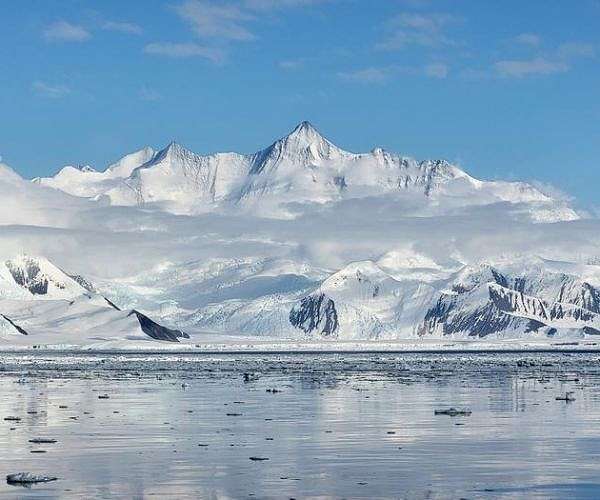
Ice in polar waters can move freely as drift ice, compact into pack ice or lock in place as fast ice when it attaches firmly to the coast or shallow seafloor. In Antarctica, this fast ice controls local biogeochemical cycles, shapes the habitat of species such as penguins and in some regions even acts as a natural runway for aircraft operations along the coast. Because it responds sensitively to changing winds, ocean temperatures and sea-ice cover, fast ice is a critical, but previously missing, element in the broader picture of Antarctic climate dynamics.
Direct satellite observations of Antarctic fast ice extend back only a few decades, far too short for understanding its long-term natural rhythms. To push the record back millennia, the team recovered sediment cores from Edisto Inlet on the northern coast of Victoria Land in the Ross Sea, where the seafloor preserves finely layered deposits. These laminated sediments consist of alternating dark and light layers that reflect distinct phases in the seasonal cycle of fast ice and open water.
The dark laminae mark the initial breakup of fast ice in early summer, when high concentrations of diatoms that live within the sea ice are released into the water column and sink to the seafloor. The light laminae are associated with extended ice-free conditions and open water dominated by the diatom Corethron pennatum, indicating longer periods without coastal ice cover. By counting and analyzing these contrasting layers with automated imaging techniques and microfossil data, the researchers produced a continuous, high-resolution record of fast-ice variability spanning roughly 3,700 years.
Analysis of this record shows that fast-ice breakup does not simply repeat in an annual pattern but instead follows more complex, longer-term cycles. The team identified persistent periodicities of about 90 years and 240 years in the timing of breakup, matching the well-known Gleissberg and Suess-de Vries cycles in solar activity. These multidecadal to centennial solar cycles arise from variations in the Sun's magnetic output and irradiance, suggesting a link between distant solar processes and the stability of Antarctic coastal ice.
The study proposes a cascade of processes that connect solar variability to fast-ice dynamics along the Victoria Land coast. Changes in solar activity alter the large-scale zonal winds over the Southern Ocean, which in turn drive the advance and retreat of regional pack ice, the belt of free-floating sea ice seaward of the coast. When this protective pack ice retreats early, satellite observations show that the landfast ice fringing the mainland becomes more exposed to local winds, waves and surface warming, increasing the likelihood of break-up events.
Climate model simulations, in which solar forcing was amplified to test the sensitivity of the system, support this mechanism. The models indicate that increased solar radiation warms the sea surface and diminishes the insulating effect of sea ice, enhancing heat exchange between ocean and atmosphere. This combination of warmer surface waters and reduced offshore pack ice cover leaves fast ice more vulnerable, helping to explain the solar-paced patterns in the sediment-derived breakup record.
According to the researchers, the new approach offers a practical route to extend knowledge of Antarctic coastal ice well beyond the era of direct measurements and satellite records. Laminated sediments occur in many parts of the Antarctic margin, meaning similar techniques could be applied widely to map natural variability in fast ice across the continent. This would allow scientists to better separate long-term natural fluctuations from human-driven climate change when assessing recent and future trends in Antarctic sea ice and coastal environments.
The work drew on support from the CNR Institute of Polar Sciences, the University of Bonn, the University of Cambridge, the University of Plymouth, the University of Trieste and the University of Pisa. Funding came from the Italian Programma Nazionale di Ricerche in Antartide, which supports multidisciplinary research aimed at understanding Antarctic climate processes and their global connections.
Research Report:Late Holocene fast-ice dynamics around the Northern Victoria Land Coast (Antarctica)
Related Links
University of Bonn
Beyond the Ice Age
| Subscribe Free To Our Daily Newsletters |
| Subscribe Free To Our Daily Newsletters |








