24/7 Space News
ROCKET SCIENCE
Fueling research in nuclear thermal propulsion
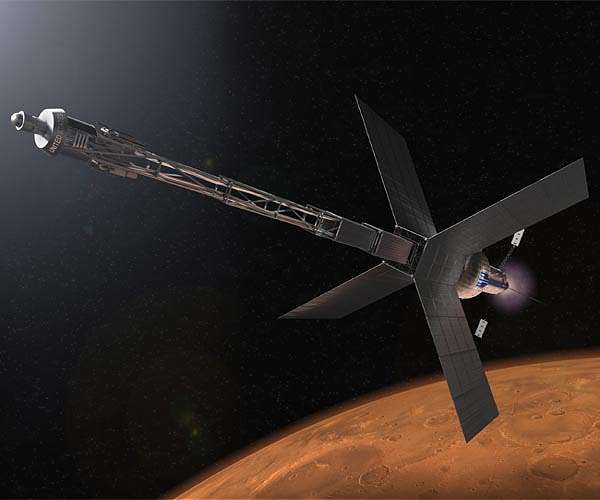
illustration only

Fueling research in nuclear thermal propulsion

by Staff Writers
by Poornima Apte for MIT News

Boston MA (SPX) Jan 14, 2026 Going to the moon was one thing; going to Mars will be quite another. The distance alone is intimidating. While the moon is 238,855 miles away, the distance to Mars is between 33 million and 249 million miles. The propulsion systems that got us to the moon just will not work.

Taylor Hampson, a master's student in the Department of Nuclear Science and Engineering (NSE), is well aware of the problem. It is one of the many reasons he is excited about his NASA-sponsored research into nuclear thermal propulsion (NTP).

The technique uses nuclear energy to heat a propellant, like hydrogen, to an extremely high temperature and expel it through a nozzle. The resultant thrust can significantly reduce travel times to Mars, compared to chemical rockets. "You can get double the efficiency, or more, from a nuclear propulsion engine with the same thrust. Besides, being in microgravity is not ideal for astronauts, so you want to get them there faster, which is a strong motivation for using nuclear propulsion over the chemical equivalents," Hampson says.

Understanding nuclear thermal propulsion

It is worth taking a quick survey of rocket propulsion techniques to understand where Hampson's work fits. There are three broad types of rocket propulsion: chemical, where thrust is achieved by the combustion of rocket propellants; electrical, where electric fields accelerate charged particles to high velocities to achieve thrust; and nuclear, where nuclear energy delivers needed propulsion.

Nuclear propulsion, which is only used in space, not to get to space, further falls into one of two categories: nuclear electric propulsion uses nuclear energy to generate electricity and accelerate the propellant. Nuclear thermal propulsion, which is what Hampson is researching, heats a propellant using nuclear power. A significant advantage of NTP is that it can deliver double the efficiency (or more) of the chemical equivalent for the same thrust. A disadvantage: cost and regulatory hurdles. "Sure, you can get double the efficiency or more from a nuclear propulsion engine, but there has not been a mission case that has needed it enough to justify the higher cost," Hampson says.

Until now.

With a human mission to Mars becoming a very real possibility - NASA plans on sending astronauts to Mars as early as the 2030s - NTP might soon come under the spotlight.

"It's almost futuristic"

Growing up on Florida's Space Coast and watching space shuttle launches stoked Hampson's early interest in science. Loving many other subjects, including history and math, it was not until his senior year that Hampson cast his lot into the engineering category. While space exploration got him hooked on aerospace engineering, Hampson was also intrigued by the possibility of nuclear engineering as a way to a greener future.

Wracked by indecision, he applied to schools in both fields and completed his undergraduate degree in aerospace engineering from Georgia Tech. It was here that a series of internships in space technology companies like Blue Origin and Stoke Space, and participation in Georgia Tech's rocket team, cemented Hampson's love for rocket propulsion.

Looking to pursue graduate studies, MIT seemed like the next logical step. "I think MIT has the best combination of nuclear and aerospace education, and is really strong in the field of testing nuclear fuels," Hampson says. Facilities in the MIT Reactor enable testing of nuclear fuel under conditions they would see in a nuclear propulsion engine. It helped that Koroush Shirvan, associate professor of NSE and Atlantic Richfield Career Development Professor in Energy Studies, was working on nuclear thermal propulsion efforts with NASA while focusing most of his efforts on the testing of nuclear fuels.

At MIT, Hampson works under the advisement of Shirvan. Hampson has had the chance to pursue further research in a project he started with an internship at NASA: studies of a nuclear thermal propulsion engine. "Nuclear propulsion is itself advanced, and I am working on what comes after that. It is almost futuristic," he says.

Modeling the effects of nuclear thermal propulsion

While the premise of NTP sounds promising, its execution will likely not be straightforward. For one thing, with NTP, the rocket engine will not start up and shut down like simple combustion engines. The startup is complex because rapid increase in temperatures can cause material failures. And the engines can take longer to shut down because of heat from nuclear decay. As a result, the components have to continue to be cooled until enough fission products decay away so there is not a lot of heat left, Hampson says.

Hampson is modeling the entirety of the rocket engine system - the tank, the pump, and more - to understand how these and many other parameters work together. Evaluating the entire engine is important because different configurations of parts (and even the fuel) can affect performance. To simplify calculations and to have simulations run faster, he is working with a relatively simple one-dimensional model. Using it, Hampson can follow the effects of variables on parameters like temperature and pressure on each of the components throughout the engine operation.

"The challenge is in coupling the thermodynamic effects with the neutronic effects," he says.

Ready for more challenges ahead

After years of indecision, delaying practically every academics-related decision to the last minute, Hampson seems to have zeroed in on what he expects to be his life's work - inspired by the space shuttle launches many years ago - and hopes to pursue doctoral studies after graduation.

Hampson always welcomes a challenge, and it is what motivates him to run. Training for the Boston Marathon, he fractured his leg, an injury that surfaced when he was running for yet another race, the Beantown Marathon. He is not bowed by the incident. "I learned that you are a lot more capable than you think," Hampson says, "although you have to ask yourself about the cost," he laughs. (He was in crutches for weeks after).

A thirst for a challenge is also one of the many reasons he chose to research thermal nuclear propulsion. It helps that the research indulges his love for the field. "Relatively speaking, it is a field in need of much more advancement; there are many more unsolved problems," he says.

Related Links
Department of Nuclear Science and Engineering
Rocket Science News at Space-Travel.Com

Subscribe Free To Our Daily Newsletters
Tweet

RELATED CONTENT
The following news reports may link to other Space Media Network websites.
ROCKET SCIENCE
Framatome to manufacture sealed fuel sources for ESA lunar and deep space power systems
Berlin, Germany (SPX) Nov 06, 2025
Framatome entered into a contract to collaborate with the European Space Agency, Perpetual Atomics, and Amentum to industrialize sealed fuel sources for radioisotope power systems (RPS) supporting the ENDURE program. The initiative aims to establish European capability to produce radioisotope-based sealed fuel sources with a focus on lunar and deep space exploration. Radioisotope power systems provide continuous heating and power for operations in extreme deep space and lunar environments. ENDURE ... read more

ROCKET SCIENCE
NASA Back for Seconds with New Food System Design Challenge

New orbital mapping system targets Earth Moon libration traffic

International Space Station crew to return early after astronaut medical issue

Startups go public in litmus test for Chinese AI

ROCKET SCIENCE
PH-1 test flight advances Chinese reusable suborbital spacecraft plans

Starfighters completes supersonic tests for GE Aerospace ramjet program

Fueling research in nuclear thermal propulsion

Indian rocket hits snag during launch

ROCKET SCIENCE
Ancient deltas reveal vast Martian ocean across northern hemisphere

Tiny Mars' big impact on Earth's climate

The electrifying science behind Martian dust

Sandblasting winds sculpt Mars landscape

ROCKET SCIENCE
Tiangong science program delivers data surge

China tallies record launch year as lunar and asteroid plans advance

China harnesses nationwide system to drive spaceflight and satellite navigation advances

Shenzhou 21 crew complete eight hour spacewalk outside Tiangong station

ROCKET SCIENCE
Aerospacelab expands Pulsar navigation constellation work with new Xona satellite order

China outlines mega constellations in ITU satellite filings

Multiple satellite filings demonstrate transparency, responsibility and ambition: China Daily editorial

ThinkOrbital raises seed funding to advance orbital defense and construction systems

ROCKET SCIENCE
Momentus to flight test 3D printed fuel tank on Vigoride 7

How IVRT Testing Ensures Consistent Product Quality

Quantum camera startup plans satellite and telescope constellations

This exotic form of ice just got weirder

ROCKET SCIENCE
Creating hallucination-free, psychedelic-like molecules by shining light on life's basic building blocks

Pandora exoplanet mission checks in after launch

Mixed crystal phase of superionic water mapped inside giant planets

Berkeley Scientists set to home in on 100 signals from Seti at Home

ROCKET SCIENCE
Jupiter's moon Europa has a seafloor that may be quiet and lifeless

Uranus and Neptune may be rock rich worlds

SwRI links Uranus radiation belt mystery to solar storm driven waves

Looking inside icy moons

Subscribe Free To Our Daily Newsletters


The content herein, unless otherwise known to be public domain, are Copyright 1995-2024 - Space Media Network. All websites are published in Australia and are solely subject to Australian law and governed by Fair Use principals for news reporting and research purposes. AFP, UPI and IANS news wire stories are copyright Agence France-Presse, United Press International and Indo-Asia News Service. ESA news reports are copyright European Space Agency. All NASA sourced material is public domain. Additional copyrights may apply in whole or part to other bona fide parties. All articles labeled "by Staff Writers" include reports supplied to Space Media Network by industry news wires, PR agencies, corporate press officers and the like. Such articles are individually curated and edited by Space Media Network staff on the basis of the report's information value to our industry and professional readership. Advertising does not imply endorsement, agreement or approval of any opinions, statements or information provided by Space Media Network on any Web page published or hosted by Space Media Network. General Data Protection Regulation (GDPR) Statement Our advertisers use various cookies and the like to deliver the best ad banner available at one time. All network advertising suppliers have GDPR policies (Legitimate Interest) that conform with EU regulations for data collection. By using our websites you consent to cookie based advertising. If you do not agree with this then you must stop using the websites from May 25, 2018. Privacy Statement. Additional information can be found here at About Us.