





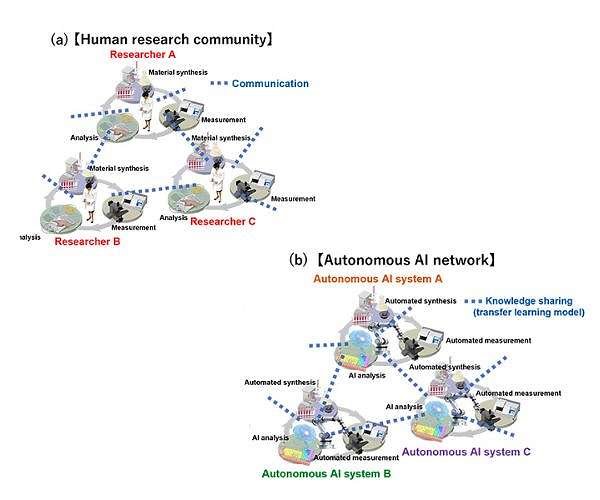
Autonomous AI systems that integrate artificial intelligence, robotics, and computer simulations have emerged worldwide as powerful tools for materials exploration. Until now, most of these systems have operated independently, each focusing on a specific material system or property space without practical mechanisms for collaboration. While data sharing among such systems is technically straightforward, directly reusing raw data from another system in an ongoing autonomous exploration is challenging because each system typically targets different composition spaces, experimental conditions, or optimization objectives.
Human research communities provide a model for more effective collaboration. Researchers in different fields form networks through ongoing communication, exchanging not just raw data but distilled knowledge and insights. By sharing principles, trends, and conceptual links rather than entire datasets, human researchers can build on each other's work and accelerate discovery across diverse domains. The NIMS and University of Tsukuba team set out to replicate this style of knowledge-centric collaboration among autonomous AI systems engaged in materials exploration.
To achieve this, the researchers designed an algorithm that enables each autonomous AI system to incorporate knowledge extracted by other systems as a reference for its own decision making. Instead of exchanging original measurement data or simulation outputs, the systems share compact representations of what they have learned, such as trends linking structural or compositional features to target properties. Each system can then adjust its exploration strategy by consulting this shared knowledge while still operating autonomously in its own search space.
The team tested the concept using three autonomous AI systems, each tasked with optimizing a different physical property. In the simulations, the systems initially explored their respective search spaces independently, establishing a baseline optimization speed. The researchers then allowed the three systems to form an autonomous AI network by spontaneously exchanging the knowledge each had learned about its materials-property relationships. Once this knowledge transfer began, the optimization speed in each system increased compared with the isolated case.
These results show that networking autonomous AI systems through knowledge sharing can improve the exploration efficiency of every participating system. The improvement arises not from larger data volumes, but from cross-referencing higher-level insights learned in different but related exploration tasks. The work suggests that when multiple autonomous materials platforms share properly structured knowledge, they can collectively accelerate the discovery and optimization of materials beyond what any single system can achieve on its own.
The study highlights a path toward scalable, collaborative infrastructures for materials discovery. Autonomous AI systems that combine AI, robotics, and simulations are already being developed and deployed worldwide, continuously conducting experiments and calculations to identify and synthesize new compounds. The number and diversity of these platforms are expected to grow rapidly, spanning many classes of materials and functions. According to the team, this emerging global ecosystem of autonomous AI systems has the potential to create far greater value if the systems are interconnected in knowledge-sharing networks.
Looking ahead, the researchers plan to extend their autonomous AI network concept to larger and more heterogeneous collections of systems. They aim to construct more extensive networks in which different platforms, each specializing in distinct material classes or measurement modalities, cooperate by exchanging knowledge in real time. Further development will focus on refining the algorithms for knowledge extraction, representation, and transfer so that systems can benefit from each other's experience even when their tasks and experimental setups differ significantly.
The project was carried out under the Japan Science and Technology Agency (JST) Strategic Basic Research Program CREST initiative titled "Scientists augmentation and materials discovery by hierarchical autonomous materials search" (project code JPMJCR21O1). The research was led by Principal Researcher Yuma Iwasaki of the Data-driven Materials Design Group at NIMS and Associate Professor Yasuhiko Igarashi of the Institute of Systems and Information Engineering at the University of Tsukuba. The article, titled "Networking autonomous material exploration systems through transfer learning," appears in npj Computational Materials and details the methods used to implement and assess the autonomous AI network.
Research Report:Networking autonomous material exploration systems through transfer learning
Related Links
National Institute for Materials Science, Japan
Space Technology News - Applications and Research
| Subscribe Free To Our Daily Newsletters |
| Subscribe Free To Our Daily Newsletters |







