





With Sentinel 2B and Sentinel 2C now leading the core task of delivering high resolution, camera like images of Earths surface, Sentinel 2A is being used as a test platform to explore new observing modes, including experimental night time imaging.
Sentinel 2A, launched in 2015, marked a major milestone by combining a high resolution multispectral optical imager with a 290 kilometer wide swath to provide detailed views of changing land and coastal areas, supporting services such as the Copernicus Land Monitoring Service for agriculture, and forest and water management.
Although optimised for land applications, the mission has also delivered valuable information on marine biology, methane emissions and changing polar ice, extending its impact far beyond its initial land monitoring focus.
The Sentinel 2 constellation is based on two identical satellites in the same orbit, separated by 180 degrees for optimal coverage and data delivery, with Sentinel 2B launched in 2017 and Sentinel 2C following in 2024 to take over duties from the ageing Sentinel 2A.
All Sentinel 2 satellites carry a 13 band multispectral imager that, like a camera, depends on light to capture images by using sunlight reflected by Earths surface and atmosphere to observe the planet.
During the night part of their orbit, the satellites pass through darkness, and in normal operations the imagers switch off when flying over night shrouded regions because the current generation was not designed for night time imaging.
Despite this, the concept for the follow on Sentinel 2 Next Generation mission includes a requirement to acquire imagery at night over selected regions, motivating tests with Sentinel 2A as it approaches the end of its operational life.
While Sentinel 2A continues to support routine mission operations, engineers and scientists are dedicating part of its remaining time in orbit to experiments that prepare for Sentinel 2 Next Generation, including trials to assess performance when imaging in darkness.
In these trials Sentinel 2A has been activated during night passes, and the resulting data show that the mission can capture bright anthropogenic and natural features such as gas flares from oil production sites in the Middle East.
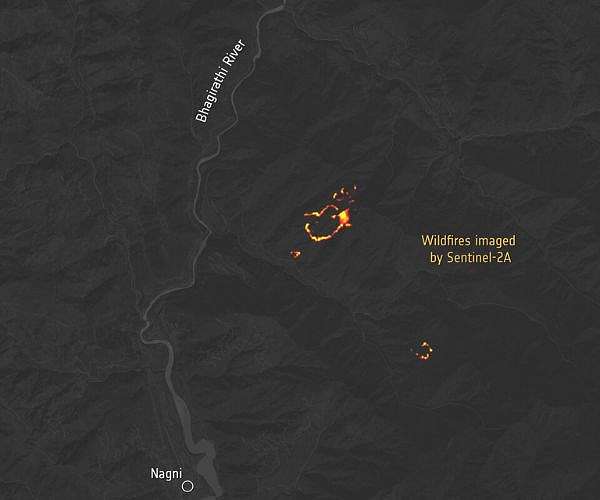
The same campaign has demonstrated sensitivity to more subtle targets, including a wildfire in India and clusters of fishing boats off the coast of South Korea, revealing that even modest light sources can be detected under suitable conditions.
ESA Sentinel 2 Next Generation Mission Scientist Simon Proud said, "We are extremely pleased with these results, which help pave the way for the Sentinel 2 Next Generation mission."
"Not only has Sentinel 2A been able to capture images of gas flares from oil production in the Middle East, which are of course pretty bright, but also more subtle characteristics such as a wildfire in India and fishing boats off the coast of South Korea all during the night time."
Proud noted that the current Sentinel 2 mission remains outstanding in delivering a wealth of data for Copernicus operational services, the commercial sector and the science community, while these new tests further extend the boundaries of what an optical mission can do.
He added that the night time experiments provide invaluable insight for the design of Sentinel 2 Next Generation, a system being developed with the ambitious goal of achieving even higher spatial resolution and adding the ability to image parts of the planet when the Sun is down.
Mission teams are now defining which key features the next generation mission should observe at night and are assessing the technical feasibility of systematic night imaging in terms of instrument design, calibration and energy demand.
According to Proud, the Sentinel 2A results indicate that for night time targets such as city lights, gas flares and fleets of fishing vessels, Sentinel 2 Next Generation will be able to deliver a significant volume of useful information to users.
Night imagery has important applications in security and in monitoring city lights, which act as an indicator of urban growth, infrastructure development and changes in human activity patterns.
ESA Sentinel 2 Mission Manager Ferran Gascon explained that the night imaging campaign required careful preparation by mission teams and inevitably placed additional strain on the ageing Sentinel 2A satellite.
Switching on the imager during the night portion of the orbit demanded a substantial amount of energy, but Gascon reported that Sentinel 2A coped well with the additional load throughout the campaign.
Even after a decade in orbit and the demands of this experimental activity, Sentinel 2A remains in remarkably good health and continues to deliver a wealth of data to a broad user community that relies on the mission for a wide range of everyday applications.
The night time trial results now feed directly into planning for Sentinel 2 Next Generation, confirming that operational night imaging of features such as gas flares, city lights, wildfires and fishing fleets is a realistic objective for the future Copernicus constellation.
Related Links
Sentinel-2 at ESA
Earth Observation News - Suppiliers, Technology and Application
| Subscribe Free To Our Daily Newsletters |
| Subscribe Free To Our Daily Newsletters |








