24/7 Space News
TIME AND SPACE
Runaway black hole jet outshines legendary death star
illustration only

Runaway black hole jet outshines legendary death star

by Clarence Oxford
Los Angeles CA (SPX) Feb 08, 2026

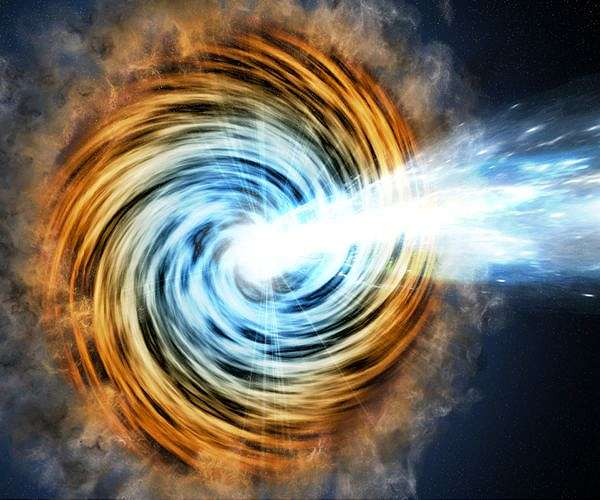
A supermassive black hole that shredded a nearby star is blasting out a jet of energy that has kept brightening for four years, in one of the most powerful events ever recorded in the universe.

The outburst comes from a tidal disruption event designated AT2018hyz, in which a star strayed too close to a black hole and was torn apart by intense gravitational forces in a process astronomers describe as spaghettification.

Researchers first spotted the event in 2018 with an optical telescope and initially classified it as an ordinary example of its kind, but years later they noticed that the previously quiet black hole had begun emitting an unusually strong signal in radio waves.

Led by University of Oregon astrophysicist Yvette Cendes, the team has now tracked the radio emission long enough to show that it is still rising sharply and is about 50 times brighter than when it was first detected in 2019.

Their latest analysis, reported in the Astrophysical Journal, indicates that the radiation is likely being funneled into a single jet, which would help explain why the event appeared unremarkable at early times if the jet was not yet pointed towards Earth.

Cendes and colleagues use highly sensitive radio observations from large facilities in New Mexico and South Africa to monitor the eruption, while faint visible light continues to glow from the region around the black hole.

From these measurements they calculated the current energy outflow and found that it rivals that of a gamma ray burst, putting it in the running as one of the most energetic single events ever observed in the cosmos.

To provide a sense of scale, the team compares the outpouring to estimates of the output of the fictional Death Star from Star Wars and concludes that the real black hole is emitting at least a trillion times more energy, and possibly up to 100 trillion times more.

The radio emission is expected to keep rising exponentially and could peak around 2027, giving astronomers a rare chance to watch a powerful jet evolve in real time and to test models of how black holes feed on disrupted stars.

The object, which Cendes informally calls Jetty McJetface in a nod to Boaty McBoatface, has already defied expectations about how long a tidal disruption event can stay active, and the team plans to keep following it to see how extreme it becomes.

Cendes is also searching archival data and new observations for other black holes that may show similarly delayed and long-lasting radio flares, arguing that such behavior might have been missed in the past because most follow-up campaigns end soon after an apparent explosion fades.

Winning observing time on major international radio telescopes is competitive, and proposals have traditionally focused on short-lived outbursts, but this event is prompting astronomers to rethink how long they keep watching after a star is torn apart.

Research Report:Continued Rapid Radio Brightening of the Tidal Disruption Event AT2018hyz

Related Links
University of Oregon
Understanding Time and Space

Subscribe Free To Our Daily Newsletters
Tweet

RELATED CONTENT
The following news reports may link to other Space Media Network websites.
TIME AND SPACE
Exploding primordial black hole model may link extreme neutrino and dark matter
Amherst MD (SPX) Feb 05, 2026
In 2023, a subatomic particle called a neutrino crashed into Earth with such a high amount of energy that it should have been impossible. In fact, there are no known sources anywhere in the universe capable of producing such energy - 100,000 times more than the highest-energy particle ever produced by the Large Hadron Collider, the world's most powerful particle accelerator. However, a team of physicists at the University of Massachusetts Amherst recently hypothesized that something like this could happ ... read more

TIME AND SPACE
New crew set to launch for ISS after medical evacuation

The coming end of ISS, symbol of an era of global cooperation

Bezos's Blue Origin to 'pause' space tourism to focus on Moon efforts

Crew 12 set for Dragon launch to Station in February

TIME AND SPACE
NASA Moon mission launch srubbed to March after test

NASA delays Moon mission over frigid weather

China sea launch boosts private rocket activity in 2026

Rocket Lab conducts second Electron mission in eight days to orbit Korean imaging satellite

TIME AND SPACE
Martian toxin found to toughen microbe built bricks

Perseverance rover completes landmark AI guided trek across Jezero rim

New clues to Mars habitability in discovery of ancient beach

Ancient deltas reveal vast Martian ocean across northern hemisphere

TIME AND SPACE
Dragon spacecraft gears up for crew 12 arrival and station science work

China prepares offshore test base for reusable liquid rocket launches

Retired EVA workhorse to guide China's next-gen spacesuit and lunar gear

Tiangong science program delivers data surge

TIME AND SPACE
BlackSky expands Gen 3 Assured deals with new defense customer

ESA member states back SWISSto12 HummingSat with fresh funding round

Muon Space ramps up multi-mission satellite constellations

Aerospacelab expands Pulsar navigation constellation work with new Xona satellite order

TIME AND SPACE
Launching the idea of data centers in space

Anthropic unveils new AI model as OpenAI rivalry heats up

NTU Singapore boosts agile space access with trio of new projects

Musk merges xAI into SpaceX in bid to build space data centers

TIME AND SPACE
Survey of 80 near Earth asteroids sharpens view of their origins and risks

Lab made cosmic dust experiment reveals paths to life chemistry

Einstein effect clears planets from tight double star systems

Engineered microbes use light to build new molecules

TIME AND SPACE
Jupiter size refined by new radio mapping

Polar weather on Jupiter and Saturn hints at the planets' interior details

Europa ice delamination may deliver nutrients to hidden ocean

Birth conditions fixed water contrast on Jupiters moons

Subscribe Free To Our Daily Newsletters


The content herein, unless otherwise known to be public domain, are Copyright 1995-2024 - Space Media Network. All websites are published in Australia and are solely subject to Australian law and governed by Fair Use principals for news reporting and research purposes. AFP, UPI and IANS news wire stories are copyright Agence France-Presse, United Press International and Indo-Asia News Service. ESA news reports are copyright European Space Agency. All NASA sourced material is public domain. Additional copyrights may apply in whole or part to other bona fide parties. All articles labeled "by Staff Writers" include reports supplied to Space Media Network by industry news wires, PR agencies, corporate press officers and the like. Such articles are individually curated and edited by Space Media Network staff on the basis of the report's information value to our industry and professional readership. Advertising does not imply endorsement, agreement or approval of any opinions, statements or information provided by Space Media Network on any Web page published or hosted by Space Media Network. General Data Protection Regulation (GDPR) Statement Our advertisers use various cookies and the like to deliver the best ad banner available at one time. All network advertising suppliers have GDPR policies (Legitimate Interest) that conform with EU regulations for data collection. By using our websites you consent to cookie based advertising. If you do not agree with this then you must stop using the websites from May 25, 2018. Privacy Statement. Additional information can be found here at About Us.