24/7 Space News
ICE WORLD
Polar bears bulk up despite melting Norwegian Arctic: study

Polar bears bulk up despite melting Norwegian Arctic: study

By Julien MIVIELLE
Paris, France (AFP) Jan 29, 2026
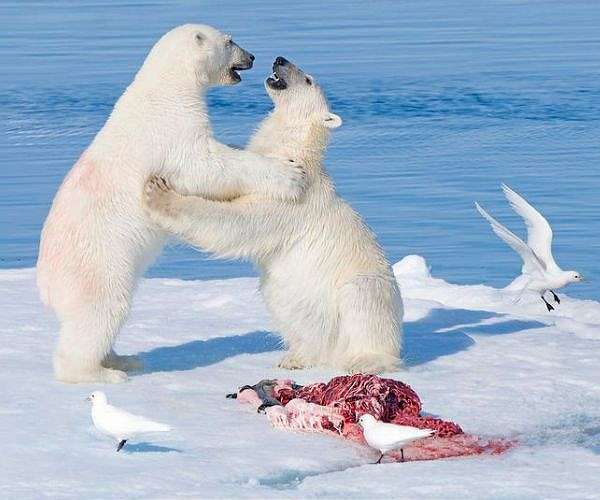
Their icy hunting grounds are rapidly shrinking, but polar bears in Norway's remote Svalbard archipelago have defied the odds by bulking up instead of wasting away, a study said Thursday.

The Barents Sea has lost sea ice faster than other areas with polar bears as temperatures have risen there more than in other Arctic regions, according to the research published in the journal Scientific Reports.

But instead of growing leaner like polar bears in other parts of the Arctic where the sea ice where they hunt is retreating, those in Svalbard have gained body fat.

"The increase in body condition during a period of significant loss of sea ice was a surprise," Jon Aars, the study's lead author and a scientist at the Norwegian Polar Institute (NPI), told AFP.

Polar bears in Svalbard have become plumper by feasting on land-based prey such as reindeer and walruses -- species that have recovered after being over-exploited by humans, the study said.

Warmer temperatures have also made it easier for them to hunt ringed seals that now crowd in smaller sea ice areas.

- Rapid warming -

The scientists analysed the body condition index (BCI) of 770 adult bears between 1995 and 2019 to determine how much -- or how little -- fat they carry.

They found that their BCI fell until 2000 but increased in subsequent years despite a period of rapid loss of sea ice.

The total polar bear population of the Barents Sea was estimated at between 1,900 and 3,600 in 2004 and may have increased since then, the study said.

The increase in air temperature has been two to four times higher in the Arctic than the global average over recent decades.

The Barents Sea has experienced even greater increases in temperature than other regions in the Arctic over the past four decades, rising by up to 2C per decade in some areas.

The area has also lost sea ice habitat at a rate of four days per year between 1979 and 2014, more than twice as fast as other regions hosting polar bears, it said.

The Svalbard findings "may seem surprising because they contradict the results of studies conducted in other polar bear populations", said Sarah Cubaynes, a researcher at French environmental research centre CEFE who was not involved in the study.

The physical condition of polar bears in Hudson Bay, for example, "has greatly declined due to warming", Cubaynes told AFP.

- Bleaker future -

Had he been asked to predict when he started working at NPI in 2003 what would happen to the bears, Aars said he would have declared at the time that they "would likely be skinnier".

"And we see the opposite, bears are now in better condition, even though they are forced to be on land much more of the time, without the ability to hunt ringed seals," he said.

A deterioration in body condition is usually a sign of future demographic problems for these Arctic animals.

"When conditions get worse, with less access to food, we anticipate to first see that bears get skinnier, that they do not accumulate so much fat reserves," Aars said.

"This we expect to see before things get even worse, and survival and reproduction decreases significantly," he said.

The unexpected results in Svalbard underscore the importance of not extrapolating findings from one region to another, the study said.

The situation in Svalbard "indicates a complex relationship between habitat, ecosystem structure, energy intake, and energy expenditure", the authors wrote.

While Aars said the good body condition of Svalbard's polar bears is "good news", the study warned that they are "likely to be negatively affected in the near future" by a warming planet and shrinking sea ice.

The bears may still be able to prey on walruses and reindeer, but "we think they still depend on hunting seals on the ice", Aars said.

jmi/lt/np/fg

BCI NAVIGATION

Related Links
Beyond the Ice Age

Subscribe Free To Our Daily Newsletters
Tweet

RELATED CONTENT
ICE WORLD
NATO chief, Danish PM agree on boosting Arctic security; Danish troops were combat ready in Greenland
Brussels, Belgium (AFP) Jan 23, 2026
NATO chief Mark Rutte and Danish Prime Minister Mette Frederiksen agreed Friday the alliance should boost work on Arctic security, after US President Donald Trump backed off his threats to seize Greenland. "We're working together to ensure that the whole of NATO is safe and secure and will build on our cooperation to enhance deterrence and defence in the Arctic," Rutte wrote on X after meeting Frederiksen in Brussels. Frederiksen - who was to travel to Greenland to meet its premier on Friday - ... read more

ICE WORLD
Earliest launch window to ISS set for February 11: NASA

NASA astronaut stuck in space for nine months retires

Tourists hit record in Japan, despite plunge from China

What happens when fire ignites in space? 'A ball of flame'

ICE WORLD
Autophage rocket concept wins EU prize for debris free launch technology

SpaceX eyes IPO timed to planet alignment and Musk birthday: report

NASA and GE run hybrid jet engine test toward commercial flight

NASA Testing Advances Space Nuclear Propulsion Capabilities

ICE WORLD
Ancient deltas reveal vast Martian ocean across northern hemisphere

Tiny Mars' big impact on Earth's climate

The electrifying science behind Martian dust

Sandblasting winds sculpt Mars landscape

ICE WORLD
China prepares offshore test base for reusable liquid rocket launches

Retired EVA workhorse to guide China's next-gen spacesuit and lunar gear

Tiangong science program delivers data surge

China tallies record launch year as lunar and asteroid plans advance

ICE WORLD
Aerospacelab expands Pulsar navigation constellation work with new Xona satellite order

ThinkOrbital raises seed funding to advance orbital defense and construction systems

China outlines mega constellations in ITU satellite filings

Multiple satellite filings demonstrate transparency, responsibility and ambition: China Daily editorial

ICE WORLD
Smartphone kit offers low cost on site radiation dose checks

Scaling rules for metamaterials promise better implants and safer devices

EU nations back chemical recycling for plastic bottles

Autonomous AI network boosts materials discovery efficiency

ICE WORLD
Engineered microbes use light to build new molecules

Icy cycles may have driven early protocell evolution

Metal rich winds detected in giant dusty cloud around distant star

Cosmic dust chemistry forges peptide building blocks in deep space

ICE WORLD
Polar weather on Jupiter and Saturn hints at the planets' interior details

Europa ice delamination may deliver nutrients to hidden ocean

Birth conditions fixed water contrast on Jupiters moons

Study links Europa's quiet seafloor to hidden potential for life


The content herein, unless otherwise known to be public domain, are Copyright 1995-2026 - SpaceDaily.com. All websites are published in Australia and are solely subject to Australian law and governed by Fair Use principals for news reporting and research purposes. AFP, UPI and IANS news wire stories are copyright Agence France-Presse, United Press International and Indo-Asia News Service. ESA news reports are copyright European Space Agency. All NASA sourced material is public domain. Additional copyrights may apply in whole or part to other bona fide parties. All articles labeled "by Staff Writers" include reports supplied to Space Media Network by industry news wires, PR agencies, corporate press officers and the like. Such articles are individually curated and edited by Space Media Network staff on the basis of the report's information value to our industry and professional readership. Advertising does not imply endorsement, agreement or approval of any opinions, statements or information provided by Space Media Network on any Web page published or hosted by Space Media Network. General Data Protection Regulation (GDPR) Statement Our advertisers use various cookies and the like to deliver the best ad banner available at one time. All network advertising suppliers have GDPR policies (Legitimate Interest) that conform with EU regulations for data collection. By using our websites you consent to cookie based advertising. If you do not agree with this then you must stop using the websites from May 25, 2018. Privacy Statement. Additional information can be found here at About Us.
Subscribe Free To Our Daily Newsletters