





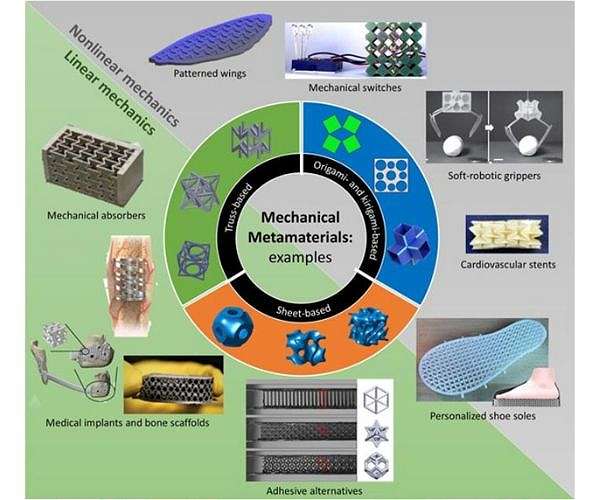
In work reported in the journal Small Structures, PhD student H.C.V.M. Shyam Veluvali and colleagues investigated how the scale of the metamaterial architecture affects basic responses such as elasticity under load. By systematically varying the size of the unit cells and the number of cells assembled into a block, the team identified clear trends in how stiffness and other effective mechanical properties change as the lattice grows. They found that as more unit cells are added and the structure becomes larger, its overall mechanical response becomes easier to predict using continuum-style models, whereas smaller assemblies can deviate from bulk behavior and require more detailed treatment.
These findings provide practical guidance for engineering metamaterials for applications where mechanical performance must be tuned very precisely. One area of particular interest is bone implants, which are commonly manufactured from titanium alloys that are far stiffer than the surrounding bone. Because these conventional implants carry most of the load from everyday activities such as chewing or talking, the natural bone experiences reduced stress, adapts to the lower load over time, and can become weaker.
Veluvali and co-authors propose using architected metamaterial implants as an alternative to solid titanium designs. By tailoring the lattice architecture, they can bring the effective stiffness of the implant closer to that of the host bone, allowing loads to be shared more evenly. When the implant and bone carry similar loads, the bone is more likely to maintain its strength over long periods, reducing the risk of degradation and failure around the implant site.
The study also demonstrates that the type of force acting on a metamaterial strongly influences its response, and that this dependence must be considered when designing structures for real-world conditions. The researchers examined how different loading modes, including shear, stretching, and torsion, affect the same lattice architectures. They showed that a configuration optimized for one type of load does not necessarily behave optimally under another, highlighting the need to evaluate multiple loading scenarios during design.
Earlier studies on mechanical metamaterials often focused on a single loading condition, which limited understanding of how these structures behave in more complex environments. By examining several kinds of mechanical forces, the Groningen-led team has provided a more complete picture of how architected lattices deform and carry load when used in practical devices. This broader view is important for optimizing metamaterials that must perform reliably under varied and sometimes unpredictable stresses.
Beyond implants, the new insights are relevant for technologies that rely on precise control over mechanical performance. For example, the grippers of robotic hands can use metamaterial lattice elements to combine delicacy with strength, enabling secure handling of objects without damage. Similarly, energy-absorbing components such as car bumpers can incorporate architected structures that deform in controlled ways during impact, dissipating energy while protecting occupants and other vehicle systems.
By clarifying how unit cell size, number, and arrangement affect global behavior, the work helps engineers to choose appropriate scales and patterns when they design metamaterial components. The authors emphasize that selecting the right block size and architecture can lead to safer, longer-lasting structures across a range of uses, from orthopaedic and spinal implants to robotic systems and automotive safety components. Their results provide a framework for linking microscopic design choices to macroscopic performance targets in next-generation mechanical metamaterials.
Research Report:When Scale Matters: Size-Dependent Mechanics of Architected Lattices for Implants and Beyond
Related Links
University of Groningen
Space Technology News - Applications and Research
| Subscribe Free To Our Daily Newsletters |
| Subscribe Free To Our Daily Newsletters |







