24/7 Space News
ROCKET SCIENCE
NASA Testing Advances Space Nuclear Propulsion Capabilities
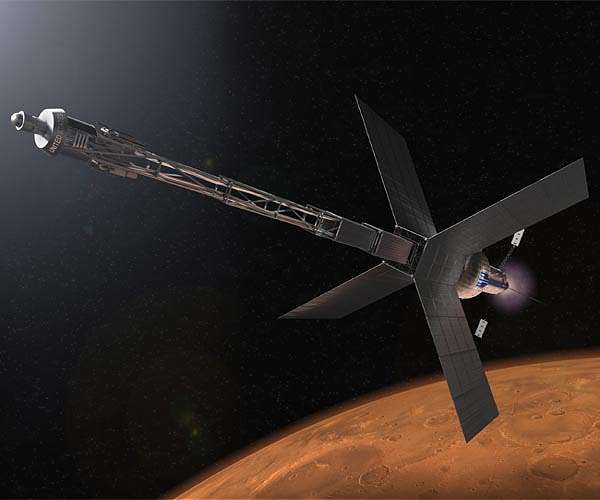
illustration only

NASA Testing Advances Space Nuclear Propulsion Capabilities

by Daniel Boyette
Washington DC (SPX) Jan 27, 2026

Nuclear propulsion and power technologies could unlock new frontiers in missions to the Moon, Mars, and beyond. NASA has reached an important milestone advancing nuclear propulsion that could benefit future deep space missions by completing a cold-flow test campaign of the first flight reactor engineering development unit since the 1960s.

Teams at the agency's Marshall Space Flight Center in Huntsville, Alabama, conducted more than 100 tests on the engineering development unit over several months in 2025. The 44-inch by 72-inch unit, built by BWX Technologies of Richmond, Virginia, is a full-scale, non-nuclear, flight-like development test article the size of a 100-gallon drum that simulates propellant flow throughout the reactor across a range of operational conditions.

The cold-flow tests at NASA Marshall are the culmination of a multi-year activity for the agency and its industry partners. Key test objectives included simulating operational fluid-dynamic responses, gathering critical information for design of the flight instrumentation and control system, providing crucial validation of analytical tools, and serving as a pathfinder for manufacturing, assembly, and integration of near-term flight-capable nuclear propulsion systems.

Other benefits to space travel include increasing the science payload capacity and higher power for instrumentation and communication.

Test engineers were able to demonstrate that the reactor design is not susceptible to destructive flow-induced oscillations, vibrations or pressure waves that occur when a moving fluid interacts with a structure in a way that makes the system shake.

"We're doing more than proving a new technology," said Jason Turpin, manager of the Space Nuclear Propulsion Office at NASA Marshall. "This test series generated some of the most detailed flow responses for a flight-like space reactor design in more than 50 years and is a key steppingstone toward developing a flight-capable system. Each milestone brings us closer to expanding what's possible for the future of human spaceflight, exploration, and science."

Related Links
NASA
Rocket Science News at Space-Travel.Com

Subscribe Free To Our Daily Newsletters
Tweet

RELATED CONTENT
The following news reports may link to other Space Media Network websites.
ROCKET SCIENCE
Fueling research in nuclear thermal propulsion
Boston MA (SPX) Jan 14, 2026
Going to the moon was one thing; going to Mars will be quite another. The distance alone is intimidating. While the moon is 238,855 miles away, the distance to Mars is between 33 million and 249 million miles. The propulsion systems that got us to the moon just will not work. ... read more

ROCKET SCIENCE
NASA astronaut stuck in space for nine months retires

Tourists hit record in Japan, despite plunge from China

What happens when fire ignites in space? 'A ball of flame'

ISS astronauts splash down on Earth after first-ever medical evacuation

ROCKET SCIENCE
NASA moves moon rocket to launch pad ahead of Artemis 2 mission

Interstellar raises major Series F funding to expand launch and satellite business

Starfighters completes key wind tunnel campaign for STARLAUNCH 1 air launch vehicle

Major equity deal backs Gilmour Space expansion of sovereign launch capability

ROCKET SCIENCE
Ancient deltas reveal vast Martian ocean across northern hemisphere

Tiny Mars' big impact on Earth's climate

The electrifying science behind Martian dust

Sandblasting winds sculpt Mars landscape

ROCKET SCIENCE
Retired EVA workhorse to guide China's next-gen spacesuit and lunar gear

China prepares offshore test base for reusable liquid rocket launches

Tiangong science program delivers data surge

China tallies record launch year as lunar and asteroid plans advance

ROCKET SCIENCE
Aerospacelab expands Pulsar navigation constellation work with new Xona satellite order

ThinkOrbital raises seed funding to advance orbital defense and construction systems

China outlines mega constellations in ITU satellite filings

Multiple satellite filings demonstrate transparency, responsibility and ambition: China Daily editorial

ROCKET SCIENCE
Understanding USDT How Stablecoins Maintain Value in Volatile Markets

Top 7 Free Coin Value Apps for Android and iPhone

Seismic networks offer new way to track space junk reentering atmosphere

Comtech wins multi-million dollar follow-on contract for civil space components

ROCKET SCIENCE
Hidden magma oceans could shield rocky exoplanets from harmful radiation

Cosmic dust chemistry forges peptide building blocks in deep space

Hidden magma oceans could shield rocky exoplanets from harmful radiation

Metal rich winds detected in giant dusty cloud around distant star

ROCKET SCIENCE
Computer models let scientists peer into the mystery beneath Jupiter's clouds

Polar weather on Jupiter and Saturn hints at the planets' interior details

Europa ice delamination may deliver nutrients to hidden ocean

Birth conditions fixed water contrast on Jupiters moons

Subscribe Free To Our Daily Newsletters


The content herein, unless otherwise known to be public domain, are Copyright 1995-2024 - Space Media Network. All websites are published in Australia and are solely subject to Australian law and governed by Fair Use principals for news reporting and research purposes. AFP, UPI and IANS news wire stories are copyright Agence France-Presse, United Press International and Indo-Asia News Service. ESA news reports are copyright European Space Agency. All NASA sourced material is public domain. Additional copyrights may apply in whole or part to other bona fide parties. All articles labeled "by Staff Writers" include reports supplied to Space Media Network by industry news wires, PR agencies, corporate press officers and the like. Such articles are individually curated and edited by Space Media Network staff on the basis of the report's information value to our industry and professional readership. Advertising does not imply endorsement, agreement or approval of any opinions, statements or information provided by Space Media Network on any Web page published or hosted by Space Media Network. General Data Protection Regulation (GDPR) Statement Our advertisers use various cookies and the like to deliver the best ad banner available at one time. All network advertising suppliers have GDPR policies (Legitimate Interest) that conform with EU regulations for data collection. By using our websites you consent to cookie based advertising. If you do not agree with this then you must stop using the websites from May 25, 2018. Privacy Statement. Additional information can be found here at About Us.