





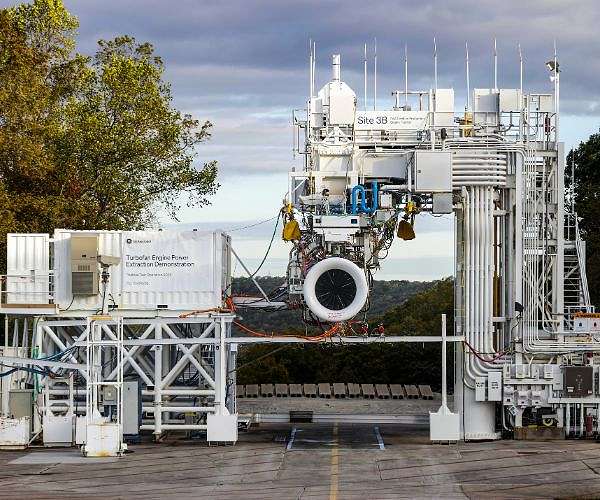
The engine, tested at GE Aerospace's Peebles Test Operation site in Ohio, is a modified version of the company's Passport engine configured with hybrid-electric capability. The system can extract energy from some parts of the engine's operation and insert that supplementary power into other sections, allowing electric motors to assist while the core runs on jet fuel.
NASA, GE Aerospace, and other partners spent years maturing the technologies needed for this demonstration. Earlier efforts focused on components such as power system controls and electric motors, but the Peebles run marked the first test of an integrated hybrid-electric propulsion system of this scale in a realistic environment.
"Turbines already exist. Compressors already exist. But there is no hybrid-electric engine flying today. And that's what we were able to see," said Anthony Nerone, who served as manager of the agency's Hybrid Thermally Efficient Core (HyTEC) project at NASA's Glenn Research Center in Cleveland during the test engine's development.
The test campaign required GE Aerospace to design and integrate equipment not used in previous engine trials at the site. New systems routed electrical power into and out of the engine, interfaced with control electronics, and supported data acquisition, making the power extraction demonstration one of the most complex GE Aerospace has staged at Peebles.
"They had to integrate equipment they've never needed for previous tests like this," said Laura Evans, acting HyTEC project manager at Glenn. Despite that complexity, the team witnessed a successful demonstration, with the engine on a mount performing many of the tasks it would need to carry out in an aircraft.
Hybrid-electric propulsion is drawing attention as U.S. aviation searches for power systems that can do more while cutting fuel costs. Hybrid aircraft engine concepts began to emerge from Glenn roughly 20 years ago, when turning those ideas into practical systems seemed nearly impossible, Nerone said.
"Now," he said. "When you go to a conference, hybrid technology is everywhere." With the Peebles test, NASA and GE now have real data on how hybrid systems behave at conditions relevant to flight.
From that early research start, NASA's work transitioned into HyTEC and its cost-sharing contract with GE Aerospace. HyTEC's goal is to mature technologies that will enable a hybrid engine burning up to 10 percent less fuel than today's best-in-class designs, while NASA aims to leverage its resources to help bring such systems to market faster.
Both NASA and GE Aerospace are analyzing data from the demonstration along with results from previous work and are making progress toward a compact engine test targeted for later
Related Links
NASA
Rocket Science News at Space-Travel.Com
| Subscribe Free To Our Daily Newsletters |

| Subscribe Free To Our Daily Newsletters |







