





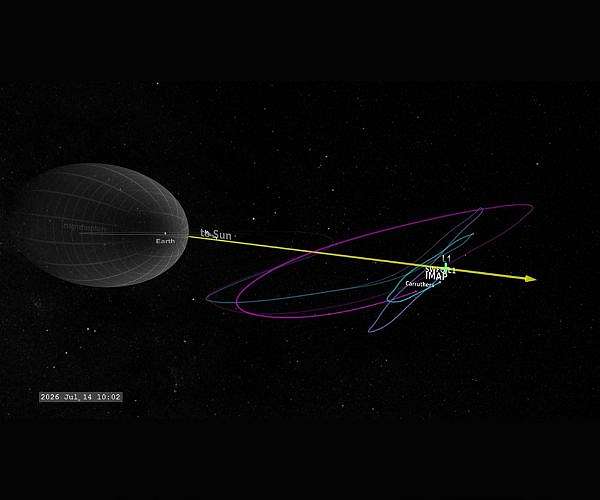
The mission, which launched on Sept. 24, 2025, relies on 10 scientific instruments to chart a comprehensive picture of what is roiling in space, from high-energy particles originating at the Sun, to magnetic fields in interplanetary space, to dust left from exploded stars in interstellar space.
NASAs IMAP (Interstellar Mapping and Acceleration Probe) is mapping the boundaries of our heliosphere - a giant protective bubble created by the Sun that encapsulates our solar system. The spacecraft studies the Suns activity and how the heliospheres boundary interacts with the local galactic neighborhood beyond.
Through studying this vast range of particles and the magnetic fields that guide them, IMAP will investigate two of the most important overarching issues in heliophysics, namely the energization of charged particles from the Sun and the interaction of the solar wind at its boundary with interstellar space.
With the start of its primary science mission, some of IMAPs data is now being fed into the IMAP Active Link for Real-Time (I-ALiRT) system, which broadcasts near-real-time observations of the space weather conditions, such as the solar wind and energetic particles, headed toward Earth. This data can be used to inform forecasters, who issue advanced warnings and alerts of potential adverse space weather effects on the health and safety of spacecraft and astronauts.
Principal investigator and Princeton University professor David McComas leads the IMAP mission, which has an international team of 27 partner institutions. The Johns Hopkins Applied Physics Laboratory (APL) in Laurel, Maryland, managed the development phase, built the spacecraft, and operates the mission, which is the fifth in NASAs Solar Terrestrial Probes Program portfolio. The Explorers and Heliophysics Projects Division at NASAs Goddard Space Flight Center in Greenbelt, Maryland, manages the Solar Terrestrial Probes Program for the agencys Heliophysics Division of NASAs Science Mission Directorate.
-ED -SPACE STORY--
industry
SDSW https://www.businesswire.com/news/home/20260202358221/en/CesiumAstro-Closes-%24470M-in-Series-C-Capital-for-Rapid-U.S.-Growth-in-2026
CONTACT: https://www.businesswire.com/news/home/20260202358221/en/CesiumAstro-Closes-%24470M-in-Series-C-Capital-for-Rapid-U.S.-Growth-in-2026
295
25-DEC-49
CesiumAstro raises 470 million to scale US space communications business
CesiumAstro raises 470 million to scale US space communications business
cesiumastro-series-c-capital-splash-hg.jpg
cesiumastro-series-c-capital-splash-lg.jpg
cesiumastro-series-c-capital-splash-bg.jpg
cesiumastro-series-c-capital-splash-sm.jpg
illustration only
CesiumAstro Inc.
by Clarence Oxford
Los Angeles CA (SPX) Feb 03, 2026
CesiumAstro Inc. has secured 470 million dollars in new growth capital, reinforcing its position as a mission critical provider of next generation space and defense communications systems across commercial, government, and national security markets.
The raise combines 270 million dollars in equity funding led by Trousdale Ventures and 200 million dollars in financing from the Export Import Bank of the United States and J P Morgan, structured under EXIMs Make More In America initiative as a public private partnership to support domestic manufacturing and technology deployment.
Equity participants in the Series C round include Woven Capital, Janus Henderson Investors, Airbus Ventures, the Development Bank of Japan Inc., MESH, NewSpace Capital, and other global investors, reflecting broad institutional and strategic interest in CesiumAstros software defined, AI enabled communications platforms.
"This is a scale moment," said Shey Sabripour, Founder and CEO of CesiumAstro. "Our technology is moving from breakthrough to American Industrial backbone. This funding lets us deliver resilient, AI enabled communications to connect, detect and defend at global scale faster."
The company plans to use the capital to accelerate its US expansion, including construction of a new 270,000 square foot headquarters facility near Austin, Texas, that will significantly expand manufacturing capacity and integration space for satellites, payloads, and advanced computing systems.
CesiumAstro will also scale production of Element, its fully integrated low Earth orbit satellite platform, while advancing multiple government and commercial programs that rely on high throughput, software defined communications architectures for resilient space networks.
"CesiumAstro embodies the kind of enduring innovation we look for engineering excellence with the discipline to deliver hardware over hype," said Phillip Sarofim, Founder of Trousdale Ventures. "Weve backed the company across multiple rounds because this team isnt chasing headlines they are building a forever company. Over the past year alone, CesiumAstro moved from announcing its first fully integrated satellite to securing eight SpaceX rideshare launches, accelerating on orbit validation. Their momentum and maturity set them apart."
The companys vertically integrated approach spans satellites, high performance communications payloads, and advanced onboard processing, all designed, manufactured, and tested in house to AS9100D and ISO 9001:2015 standards, which management argues reduces schedule risk and enables faster iteration for both government and commercial customers.
"CesiumAstro is fundamentally redefining how we connect the world from space. By moving away from rigid, legacy hardware and toward a modular, software defined approach, they have unlocked a level of flexibility the industry has not seen before," said Will Fung, principal at Woven Capital. "CesiumAstro brings together deep technical and industry expertise, enabling the team to reliably deliver mission ready systems at scale for both government and commercial customers today, with a clear path to new applications like vehicles in the near future."
According to the company, demand is rising for resilient, high capacity space architectures capable of supporting proliferated constellations and defense networks that can operate in contested environments, and CesiumAstro expects its AI enabled systems to play a central role in these deployments.
"This raise reflects broad confidence in our execution across commercial and defense markets," said Ken Smith, CFO of CesiumAstro. "With the addition of significant non dilutive EXIM financing, this funding both validates our progress and accelerates our next phase of growth."
Related Links
IMAP at NASA
Solar Science News at SpaceDaily
| Subscribe Free To Our Daily Newsletters |
| Subscribe Free To Our Daily Newsletters |








