





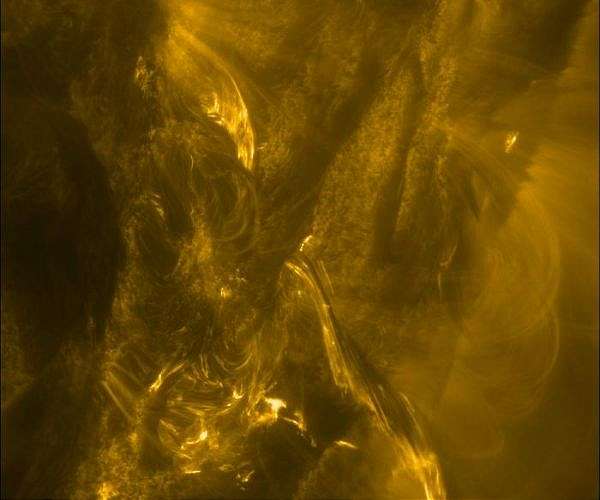
During a close approach to the Sun on 30 September 2024, the ESA-led Solar Orbiter spacecraft captured one of its most detailed views yet of a large solar flare using four instruments that together provided a near-complete picture of the event from the corona down to the visible surface.
Solar flares are intense explosions that occur when energy stored in tangled magnetic fields is suddenly released through magnetic reconnection, where criss-crossing field lines of opposite polarity break and reconnect, heating plasma to millions of degrees and accelerating particles to high energies in just minutes.
The most powerful flares can trigger chains of events that lead to geomagnetic storms at Earth and radio blackouts, making it essential to understand how the stored magnetic energy is released so quickly and how it accelerates particles that can endanger satellites, astronauts and technological systems.
In the new observations, Solar Orbiter's Extreme Ultraviolet Imager (EUI) resolved structures just a few hundred kilometres across in the outer atmosphere, or corona, recording images every two seconds, while the SPICE, STIX and PHI instruments probed different layers and temperature regimes down to the photosphere over a period of about 40 minutes before and during the flare.
"When EUI first looked at the region at 23:06 UT, around 40 minutes before the flare peaked, we already saw a dark arch-like filament of twisted magnetic field and plasma connected to a cross-shaped pattern of brightening magnetic loops," says Pradeep Chitta of the Max Planck Institute for Solar System Research and lead author of the study.
In the high-cadence EUI data, new magnetic strands appeared in every image frame, each confined and becoming twisted like small ropes, until the structure grew unstable and the strands began to break and reconnect, triggering a cascade of further reconnection events that rapidly intensified the region.
A particularly strong brightening started at 23:29 UT, when the dark filament disconnected from one side, hurled material into space and violently unrolled, with bright reconnection signatures flaring along its length as the main flare erupted at about 23:47 UT.
"These minutes before the flare are extremely important and Solar Orbiter gave us a window right into the foot of the flare where this avalanche process began," says Chitta, who notes that the observations show how a sequence of smaller reconnection events in space and time can drive a large flare rather than a single coherent blast.
The results provide direct support for a long-suspected avalanche model in which many small, interacting reconnection events collectively power a major flare, demonstrating that the flare's "central engine" is a cascade of magnetic energy releases rather than one isolated episode.
For the first time, simultaneous SPICE and STIX measurements let the team examine in fine detail how the rapid succession of reconnection events deposited energy in the corona, with high-energy X-ray emission marking where accelerated particles struck denser layers and released their energy.
During the 30 September flare, emission from ultraviolet to X-rays was already rising when SPICE and STIX started observing, then surged as reconnection intensified, accelerating particles to about 40 to 50 percent of the speed of light, corresponding to roughly 431 to 540 million kilometres per hour.
The observations show that energy was efficiently transferred from the stressed magnetic field to the surrounding plasma during these reconnection events, driving intense heating and particle acceleration that are central to hazardous space weather conditions.
"We saw ribbon-like features moving extremely quickly down through the Sun's atmosphere, even before the main flare episode," says Chitta. "These streams of raining plasma blobs are signatures of energy deposition that grow stronger as the flare progresses, and they continue even after the flare appears to subside."
After the main phase, EUI images show the cross-shaped magnetic structure relaxing, while STIX and SPICE recorded cooling plasma and declining particle emission, and PHI detected the flare's imprint on the visible surface, together building a three-dimensional view of how the eruption unfolded from the corona to the photosphere.
"We didn't expect that the avalanche process could lead to such high energy particles," says Chitta, adding that fully disentangling the details of particle acceleration in these environments will require even higher resolution X-ray imaging from future missions.
"This is one of the most exciting results from Solar Orbiter so far," says Miho Janvier, ESA's Solar Orbiter co-project scientist, who notes that the observations highlight the key role of avalanche-like magnetic energy release in powering flares and raise the question of whether similar processes operate in all solar and stellar flares.
Co-author David Pontin of the University of Newcastle, Australia, says that by combining the EUI data with magnetic field measurements, researchers could reconstruct the chain of events that led to the flare, challenging existing theoretical models and providing crucial constraints for refining them to improve future flare and space weather predictions.
Research Report:A magnetic avalanche as the central engine powering a solar flare
Related Links
European Space Agency
Solar Science News at SpaceDaily
| Subscribe Free To Our Daily Newsletters |
| Subscribe Free To Our Daily Newsletters |








