24/7 Space News
TIME AND SPACE
Muon study clarifies superconducting behavior in strontium ruthenate
illustration only

Muon study clarifies superconducting behavior in strontium ruthenate

by Riko Seibo
Tokyo, Japan (SPX) Feb 10, 2026

Quantum materials and superconductors are inherently complex, and unconventional superconductors pose an even greater challenge because they fall outside standard theoretical descriptions. One prominent example is the layered perovskite strontium ruthenate, Sr2RuO4 (SRO214), whose superconducting properties were first identified by a team including Yoshiteru Maeno, now at the Toyota Riken - Kyoto University Research Center.

For many years SRO214 was widely regarded as a candidate spin-triplet superconductor, in which paired electrons retain magnet-like characteristics and can potentially carry quantum information without electrical resistance. That picture was recently questioned when nuclear magnetic resonance (NMR) experiments reported behavior inconsistent with spin-triplet pairing, creating an urgent need for independent tests using different experimental techniques.

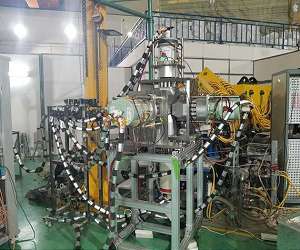
Motivated by this controversy, a collaborative team led by Maeno turned to muon spin rotation and relaxation, a magnetic resonance method based on muons, elementary particles closely related to electrons. The researchers implanted muons into high-quality single crystals of SRO214 and probed them with an upgraded muon spin rotation (muSR) spectrometer at the Paul Scherrer Institute (PSI), which offers the sensitivity required to detect extremely small changes in internal magnetic fields in the superconducting state under applied external fields.

These field-dependent changes, characterized as the Knight shift, reveal how electron spins behave when they form Cooper pairs. By tracking the Knight shift across the superconducting transition, the team could infer whether the pairs preserve or lose their spin polarization. The improved muSR setup at PSI made it possible to resolve subtle magnetic signatures that had previously been difficult to access.

During the study, the team identified a serious pitfall in a common experimental practice: mounting many small crystals side by side to boost signal intensity. They showed that stray magnetic fields generated by the Meissner effect in neighboring superconducting crystals can produce misleading signals in muSR measurements, masquerading as intrinsic features of the material rather than artifacts of the sample configuration.

To address this issue, the researchers established a new protocol that marries muSR with complementary measurements using a superconducting quantum interference device (SQUID). This combined approach allowed them to monitor the sample magnetization and separate genuine Knight-shift changes from spurious contributions caused by stray fields.

With the refined methodology, the team observed a clear reduction of the Knight shift when SRO214 entered the superconducting state. This behavior is consistent with spin-singlet superconductivity, in which electron spins pair in opposite directions and lose their net magnetization, contradicting the earlier spin-triplet interpretation for this material.

The findings demonstrate that the superconductivity of SRO214 can be reconciled with a spin-singlet order parameter, reshaping understanding of this long-studied unconventional superconductor. The work also highlights how methodological subtleties, such as crystal arrangement and magnetic screening, can strongly influence the interpretation of precision measurements in quantum materials.

According to co-author Rustem Khasanov, recent advances at PSI have pushed muSR to a level where it can directly and reliably probe exceptionally subtle magnetic phenomena in superconductors. The researchers expect that their approach will spur further muon-based investigations of superconducting states, providing a powerful complement to established techniques like NMR.

Research Report:Muon Knight Shift as a Precise Probe of the Superconducting Symmetry of Sr2RuO4

Related Links
Kyoto University
Understanding Time and Space

Subscribe Free To Our Daily Newsletters
Tweet

RELATED CONTENT
The following news reports may link to other Space Media Network websites.
TIME AND SPACE
One dimensional anyons offer tunable quantum statistics
Tokyo, Japan (SPX) Feb 05, 2026
Physicists have traditionally divided all elementary particles in three dimensional space into just two categories, bosons and fermions, depending on how systems of identical particles behave when the particles exchange places. In standard quantum theory, experimental observations in three dimensions point to a strict binary: when two identical particles swap positions, the combined quantum state either remains unchanged, corresponding to bosons, or it acquires a minus sign, corresponding to fermions, w ... read more

TIME AND SPACE
The coming end of ISS, symbol of an era of global cooperation

NASA confirms first flight to ISS since medical evacuation

Crew 12 set for Dragon launch to Station in February

Bezos's Blue Origin to 'pause' space tourism to focus on Moon efforts

TIME AND SPACE
Isar Aerospace expands engine and stage testing at Esrange

NASA Moon mission launch srubbed to March after test

NASA books fifth Axiom private astronaut flight to space station

Musk merges xAI into SpaceX in bid to build space data centers

TIME AND SPACE
Martian toxin found to toughen microbe built bricks

Curiosity Blog, Sols 4788-4797: Welcome Back from Conjunction

NASA Study: Non-biologic Processes Don't Fully Explain Mars Organics

Perseverance rover completes landmark AI guided trek across Jezero rim

TIME AND SPACE
Dragon spacecraft gears up for crew 12 arrival and station science work

China prepares offshore test base for reusable liquid rocket launches

Retired EVA workhorse to guide China's next-gen spacesuit and lunar gear

Tiangong science program delivers data surge

TIME AND SPACE
BlackSky expands Gen 3 Assured deals with new defense customer

ESA member states back SWISSto12 HummingSat with fresh funding round

Muon Space ramps up multi-mission satellite constellations

Aerospacelab expands Pulsar navigation constellation work with new Xona satellite order

TIME AND SPACE
Launching the idea of data centers in space

Gilat books multimillion order for Sidewinder inflight ESA terminals

NTU Singapore boosts agile space access with trio of new projects

Musk merges xAI into SpaceX in bid to build space data centers

TIME AND SPACE
Survey of 80 near Earth asteroids sharpens view of their origins and risks

Lab made cosmic dust experiment reveals paths to life chemistry

Einstein effect clears planets from tight double star systems

Engineered microbes use light to build new molecules

TIME AND SPACE
Jupiter size refined by new radio mapping

Polar weather on Jupiter and Saturn hints at the planets' interior details

Europa ice delamination may deliver nutrients to hidden ocean

Birth conditions fixed water contrast on Jupiters moons

Subscribe Free To Our Daily Newsletters


The content herein, unless otherwise known to be public domain, are Copyright 1995-2024 - Space Media Network. All websites are published in Australia and are solely subject to Australian law and governed by Fair Use principals for news reporting and research purposes. AFP, UPI and IANS news wire stories are copyright Agence France-Presse, United Press International and Indo-Asia News Service. ESA news reports are copyright European Space Agency. All NASA sourced material is public domain. Additional copyrights may apply in whole or part to other bona fide parties. All articles labeled "by Staff Writers" include reports supplied to Space Media Network by industry news wires, PR agencies, corporate press officers and the like. Such articles are individually curated and edited by Space Media Network staff on the basis of the report's information value to our industry and professional readership. Advertising does not imply endorsement, agreement or approval of any opinions, statements or information provided by Space Media Network on any Web page published or hosted by Space Media Network. General Data Protection Regulation (GDPR) Statement Our advertisers use various cookies and the like to deliver the best ad banner available at one time. All network advertising suppliers have GDPR policies (Legitimate Interest) that conform with EU regulations for data collection. By using our websites you consent to cookie based advertising. If you do not agree with this then you must stop using the websites from May 25, 2018. Privacy Statement. Additional information can be found here at About Us.