





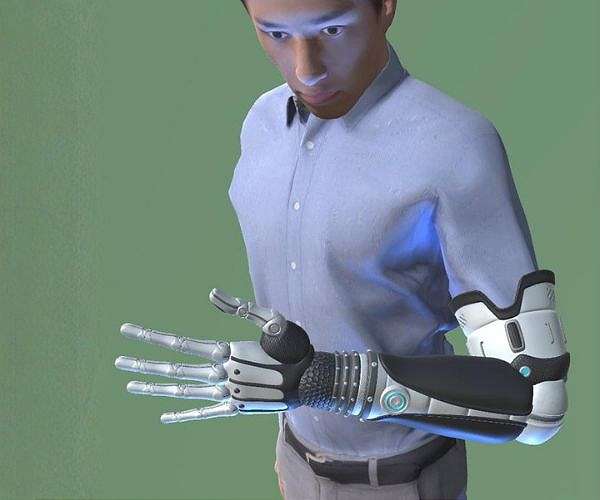
The team used a virtual reality setup in which participants embodied an avatar whose left forearm was replaced by a robotic prosthetic arm. In this scenario, the prosthetic forearm flexed automatically toward a target rather than being driven directly by the user's commands. By presenting this reaching task repeatedly while systematically varying the arm's movement duration, the researchers could isolate how different speeds influence embodiment and impressions of the robot.
Movement duration was adjusted across six levels, ranging from a very rapid 125 milliseconds to a slow 4 seconds. After each condition, participants provided ratings of body ownership, which reflects how much the prosthetic felt like part of their own body, and sense of agency, which captures how much they felt in control of the movement. They also evaluated usability using the System Usability Scale and judged the robot's social characteristics with the Robotic Social Attributes Scale, including competence, warmth, and discomfort.
A clear pattern emerged from these tests. When the arm moved at a moderate speed corresponding to about 1 second of movement duration, participants reported the highest levels of body ownership, sense of agency, and usability. This speed is close to natural human reaching movements, suggesting that matching everyday motor patterns helps an autonomous prosthesis feel more like a genuine limb and less like an external machine.
At the extremes, embodiment and usability suffered. In the fastest condition at 125 milliseconds and in the slowest condition at 4 seconds, ratings of body ownership, agency, and usability all dropped significantly. These findings indicate that both overly hasty and sluggish autonomous motions can make a prosthetic limb feel less like part of the body and more like an awkward or unsettling tool, even when its goal is clear.
Social impressions of the prosthetic arm also depended on speed. Perceived competence was higher at moderate and slightly faster movement speeds, aligning with the idea that swift, efficient actions can make a robot appear capable. However, discomfort ratings peaked under the fastest movement condition, highlighting a tradeoff between efficiency and ease of acceptance. Warmth, another social attribute, showed no strong dependence on speed, implying that timing alone does not make the arm seem more or less friendly.
The study adds to earlier work showing that autonomous body movements are more acceptable when their goals and intentions are easy to understand. Here, by holding the task goal constant and varying only movement duration, the researchers demonstrated that timing itself is a powerful design parameter for future AI enabled prostheses. Simply pushing for maximum speed and precision may not be sufficient if the resulting behavior clashes with users' expectations for how their own bodies should move.
These insights extend beyond prosthetic arms to a wider class of technologies that augment or extend the human body. Supernumerary robotic limbs, exoskeletons, and wearable robots all rely on coordinated interactions with the user and often perform semi-autonomous actions. Designing their motion profiles to align with human movement patterns could support stronger embodiment, better usability, and more positive social impressions in daily life.
Looking to the future, the researchers plan to investigate how long-term experience changes embodiment of autonomous robotic body parts. People often come to experience familiar tools as if they were extensions of their own bodies, and similar adaptation might occur with fast and accurate robotic limbs through continuous use. Over time, behaviors that initially felt too quick or too independent could become normal and easier to accept.
The work also underscores the importance of virtual reality as a testbed for emerging prosthetic technologies. VR allows scientists to simulate advanced control strategies and hardware configurations that are not yet widely available, while carefully manipulating individual factors such as movement speed. This approach makes it possible to evaluate psychological responses, acceptance, and design requirements ahead of large-scale deployment in clinical and everyday settings.
Research Report: Movement speed of an autonomous prosthetic limb shapes embodiment, usability and robotic social attributes in virtual reality
Related Links
Toyohashi University of Technology
Space Technology News - Applications and Research
| Subscribe Free To Our Daily Newsletters |
| Subscribe Free To Our Daily Newsletters |







