24/7 Space News
TIME AND SPACE
Laser timing tech sharpens black hole radio views
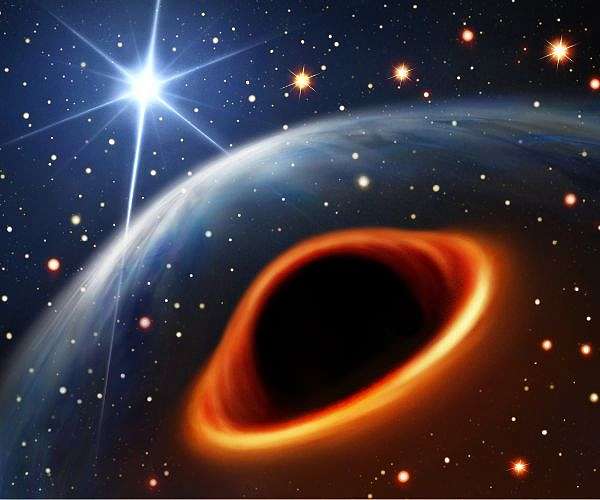
illustration only

Laser timing tech sharpens black hole radio views

by Riko Seibo
Tokyo, Japan (SPX) Jan 19, 2026

Radio telescopes capture faint radio signals from space and convert them into images of distant celestial objects, but resolving black holes sharply requires many instruments to observe in perfect synchrony as if they were a single giant dish.

To meet this challenge, a KAIST led collaboration has implemented a reference signal system that sends an optical frequency comb laser directly into radio telescope receivers, using laser light to lock the timing and phase of observations with ultra high precision.

An optical frequency comb differs from an ordinary laser because it emits tens of thousands of evenly spaced colors whose exact frequencies are known and can be tuned with the accuracy of an atomic clock, forming what researchers describe as an ultra precision ruler made of light.

Very Long Baseline Interferometry, or VLBI, depends on aligning the phases of radio signals collected by widely separated telescopes as if they were being measured against a single precise ruler, but conventional electronic reference signals become harder to calibrate as observation frequencies increase and phase stability demands grow.

The KAIST team addressed these limitations by delivering the frequency comb output directly to the radio telescope front end, aiming to improve the fundamental precision of phase alignment by using light based signals from the generation stage and unifying reference generation and phase calibration inside one optical system.

In this scheme, older techniques that struggle at higher frequencies resemble rulers that make phase matching difficult, whereas the new laser based approach acts like an ultra precision ruler that fixes the phase with extremely stable light and prepares the way for intercontinental arrays that operate as coherently as one elaborately controlled telescope.

The researchers validated the concept through test observations at the Korea VLBI Network Yonsei Radio Telescope, where they detected stable interference fringes between telescopes and demonstrated that accurate phase calibration is achievable in real observations rather than only in laboratory tests.

The system has since been installed at the KVN SNU Pyeongchang Radio Telescope, enabling expanded experiments that use multiple sites at once and providing a stronger platform for next generation VLBI campaigns targeting black holes and other compact radio sources.

According to the team, the improved reference scheme is expected to sharpen black hole images by reducing long standing phase delay errors between instruments, which have limited dynamic range and image fidelity in previous high frequency VLBI observations.

Beyond astronomy, the researchers anticipate that the technology can extend to applications that need extremely accurate space time measurements, including intercontinental comparisons of advanced atomic clocks, geodetic studies of Earth using space geodesy techniques, and precise tracking of deep space probes over vast distances.

Professor Jungwon Kim of KAIST explained that the work shows how the limits of electronic signal generation can be surpassed by directly applying optical frequency comb lasers in radio telescopes and that the approach should advance both precision black hole imaging and broader fields such as frequency metrology and time standards.

The project involved co first authors Dr Minji Hyun, now at the Korea Research Institute of Standards and Science, and Dr Changmin Ahn at KAIST, and drew on cooperation with the Korea Astronomy and Space Science Institute, the Korea Research Institute of Standards and Science, and the Max Planck Institute for Radio Astronomy in Germany.

The team reported the results in the journal Light Science and Applications on January 4, 2026 in a paper titled Optical frequency comb integration in radio telescopes: advancing signal generation and phase calibration.

Research Report: Optical frequency comb integration in radio telescopes: advancing signal generation and phase calibration

Related Links
The Korea Advanced Institute of Science and Technology (KAIST)
Understanding Time and Space

Subscribe Free To Our Daily Newsletters
Tweet

RELATED CONTENT
The following news reports may link to other Space Media Network websites.
TIME AND SPACE
Bright supernova offers new view of black hole birth
Tokyo, Japan (SPX) Jan 13, 2026
What astronomers know about the birth of a black hole has long mirrored the objects themselves, tending to be dark, difficult to observe, and seemingly quiet despite their immense gravitational influence. Stellar mass black holes form in the final gravitational collapse of massive stars with several tens of the mass of the Sun, and these heavyweights were thought not to produce bright supernova explosions in their death throes. That picture has now changed with real time observations of the supern ... read more

TIME AND SPACE
Explore the World with These Travel Tips

The Quiet Transformation of GPS - What's Coming by 2026

NASA Back for Seconds with New Food System Design Challenge

New orbital mapping system targets Earth Moon libration traffic

TIME AND SPACE
NASA moves moon rocket to launch pad ahead of Artemis 2 mission

PH-1 test flight advances Chinese reusable suborbital spacecraft plans

GE and Lockheed validate compact rotating detonation ramjet for hypersonic missiles

China tests Long March 12B reusable first stage at Jiuquan

TIME AND SPACE
Ancient deltas reveal vast Martian ocean across northern hemisphere

Tiny Mars' big impact on Earth's climate

The electrifying science behind Martian dust

Sandblasting winds sculpt Mars landscape

TIME AND SPACE
Tiangong science program delivers data surge

China tallies record launch year as lunar and asteroid plans advance

China harnesses nationwide system to drive spaceflight and satellite navigation advances

Shenzhou 21 crew complete eight hour spacewalk outside Tiangong station

TIME AND SPACE
China outlines mega constellations in ITU satellite filings

ThinkOrbital raises seed funding to advance orbital defense and construction systems

Aerospacelab expands Pulsar navigation constellation work with new Xona satellite order

Multiple satellite filings demonstrate transparency, responsibility and ambition: China Daily editorial

TIME AND SPACE
The decentralized future of space transactions

How IVRT Testing Ensures Consistent Product Quality

The Silent Partner - How Machine Learning Quietly Powers Modern Space Operations

Why Space Theme Slots Are Popular with Canadian Casino Players

TIME AND SPACE
Hidden magma oceans could shield rocky exoplanets from harmful radiation

Frozen hydrogen cyanide crystals may have helped spark early chemistry for life

Pandora exoplanet mission checks in after launch

Mixed crystal phase of superionic water mapped inside giant planets

TIME AND SPACE
Computer models let scientists peer into the mystery beneath Jupiter's clouds

Jupiter's moon Europa has a seafloor that may be quiet and lifeless

Uranus and Neptune may be rock rich worlds

SwRI links Uranus radiation belt mystery to solar storm driven waves

Subscribe Free To Our Daily Newsletters


The content herein, unless otherwise known to be public domain, are Copyright 1995-2024 - Space Media Network. All websites are published in Australia and are solely subject to Australian law and governed by Fair Use principals for news reporting and research purposes. AFP, UPI and IANS news wire stories are copyright Agence France-Presse, United Press International and Indo-Asia News Service. ESA news reports are copyright European Space Agency. All NASA sourced material is public domain. Additional copyrights may apply in whole or part to other bona fide parties. All articles labeled "by Staff Writers" include reports supplied to Space Media Network by industry news wires, PR agencies, corporate press officers and the like. Such articles are individually curated and edited by Space Media Network staff on the basis of the report's information value to our industry and professional readership. Advertising does not imply endorsement, agreement or approval of any opinions, statements or information provided by Space Media Network on any Web page published or hosted by Space Media Network. General Data Protection Regulation (GDPR) Statement Our advertisers use various cookies and the like to deliver the best ad banner available at one time. All network advertising suppliers have GDPR policies (Legitimate Interest) that conform with EU regulations for data collection. By using our websites you consent to cookie based advertising. If you do not agree with this then you must stop using the websites from May 25, 2018. Privacy Statement. Additional information can be found here at About Us.